
Three Scenarios for the LDP Leadership Election
自民党总裁选举的三个剧本,都无法回避选后一大难题
Sha Qingqing, “Three Scenarios for the LDP Leadership Election,” Guancha, 3 October 2025.
Sha Qingqing
Historian and columnist
Multiple Variations Under a Power Vacuum
Currently, Japanese politics has reached a crossroads filled with uncertainty. The upcoming Liberal Democratic Party (LDP) presidential election serves as a prism reflecting its future direction.
The background to the LDP presidential election on October 4 is quite delicate. On one hand, the LDP-Komeito ruling coalition lost the House of Councillors election in July of this year, losing its majority in the upper house, which means the coalition has simultaneously lost its majority in both the House of Representatives and the House of Councillors. On the other hand, political heavyweights within the LDP, such as Taro Aso, have been "pressuring" Prime Minister Shigeru Ishiba to resign, almost explicitly citing personal preferences as justification following the defeat in the upper house election.
However, the most fundamental issue remains the LDP's lack of a strong "common sovereign" in the "post-Abe era." The sudden death of former Prime Minister Shinzo Abe left the party's largest faction, the "Abe faction" (Seiwakai), in a leadership vacuum and ideological confusion. Meanwhile, the "slush fund scandal" (political donation scandal) has continued to ferment, severely damaging the political credibility and organizational capacity of the LDP's factions, particularly the Abe faction, profoundly rewriting the balance of power within the party.
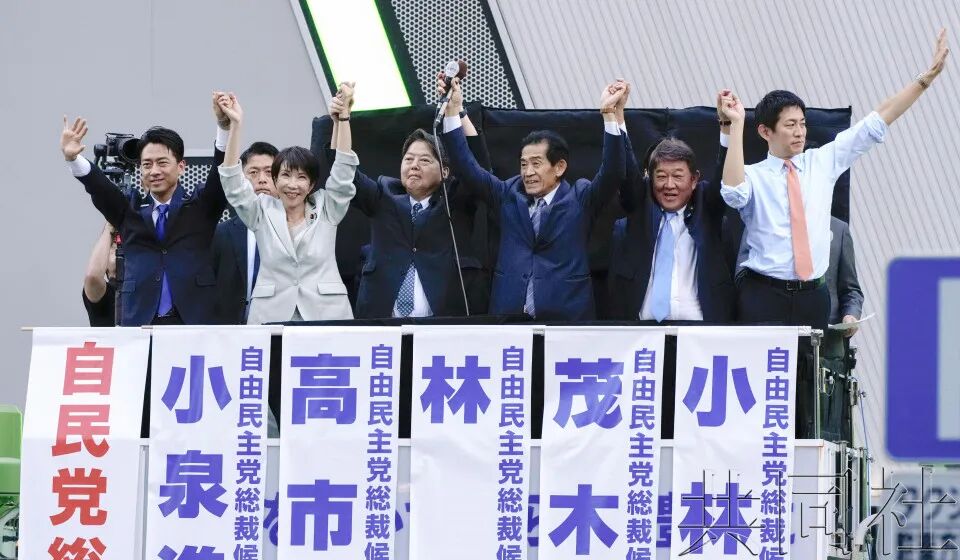
On the afternoon of September 24, candidates for the LDP presidential election concluded their street speeches. Among the five candidates, Shinjiro Koizumi, Sanae Takaichi, and Yoshimasa Hayashi are viewed favorably by the public. Kyodo News
In fact, as early as the LDP presidential election in October of last year and the House of Representatives election in November, the author pointed out that as the traditional power structure loosened, Japanese politics entered a "Chaotic Era." A year later, the situation remains unchanged.
On the surface, this LDP presidential election is a revival match for the "Losers' Alliance," but in essence, it is not a single-dimensional competition. Instead, it is an interwoven performance of three or even more "scripts": First, the "generational transition" script represented by 44-year-old Shinjiro Koizumi, questioning whether the LDP is ready to welcome the youngest prime minister in constitutional history; second, the "inheriting the Abe line" script represented by Sanae Takaichi, testing the vitality of the "Abe faction's" political legacy after suffering significant damage; and third, the "Kochikai elite" script represented by Yoshimasa Hayashi, showcasing the return of the steady politician favored by traditional factions and the bureaucratic system.
What are the internal logic, feasibility, and underlying power dynamics of these three scripts? To some extent, regardless of which script ultimately plays out, they all face the question of what to do after the election.
The "Koizumi Script": The Charm and Risks of Generational Transition
Shinjiro Koizumi is not challenging the LDP presidency (and thus the prime ministership) for the first time, but this election seems to be his closest attempt yet. Whenever he appears among the candidates for the LDP presidency, he is always the most talked-about figure, and this time is no exception. On one hand, this is due to the "halo" projected by his father, Junichiro Koizumi; on the other, it is due to his fresher image compared to traditional politicians, as well as the public discussion sparked by his immature political performance. Shinjiro Koizumi represents not only the leap in his own political career but also the challenge posed by the younger generation of the LDP to traditional political paradigms.
1. A Political Style Distinct from His Father's Generation
Shinjiro Koizumi's father, former Prime Minister Junichiro Koizumi, was known for his "lone wolf" image. His political maneuvering lay in breaking factional ties and appealing directly to public opinion, carrying strong populist overtones. However, Shinjiro Koizumi has taken a completely different path, returning to more traditional political operations.
Shinjiro Koizumi is more sociable, capable of gaining broad support, and actively building cross-factional alliance networks. Among these, his alliance with former rival Taro Kono, as well as the support from members within multiple factions, are viewed by outsiders as signs of his maturing political skills. This strategy of "vertical and horizontal alliances" forms a stark contrast to his father's path dependence on "theatrical politics," reflecting the adaptation and transformation of a new generation of politicians to the current political ecosystem.
Furthermore, the "Koizumi script" has the potential to construct an imaginative scenario: he has the potential to court the so-called "small right-wing" party, the Ishin no Kai (Japan Innovation Party), to form a coalition government. Currently, the LDP-Komeito ruling coalition holds a minority in both houses of the Diet. If the Ishin no Kai joins, how Koizumi balances the LDP-Komeito alliance will be a major test—after all, in past Diet elections, Komeito and the Ishin no Kai have been in competition, but this would inject new variables into Japanese politics.
In any case, the imagination of a new ruling coalition reveals that Shinjiro Koizumi's political vision has transcended the internal dynamics of the LDP and begun to touch upon the deeper issues of party system restructuring. This is precisely what Prime Minister Shigeru Ishiba, as a member of a marginal faction within the LDP, has found difficult to achieve. Once Shinjiro Koizumi is elected, he is expected to bring structural changes to the Japanese political scene that exceed expectations.
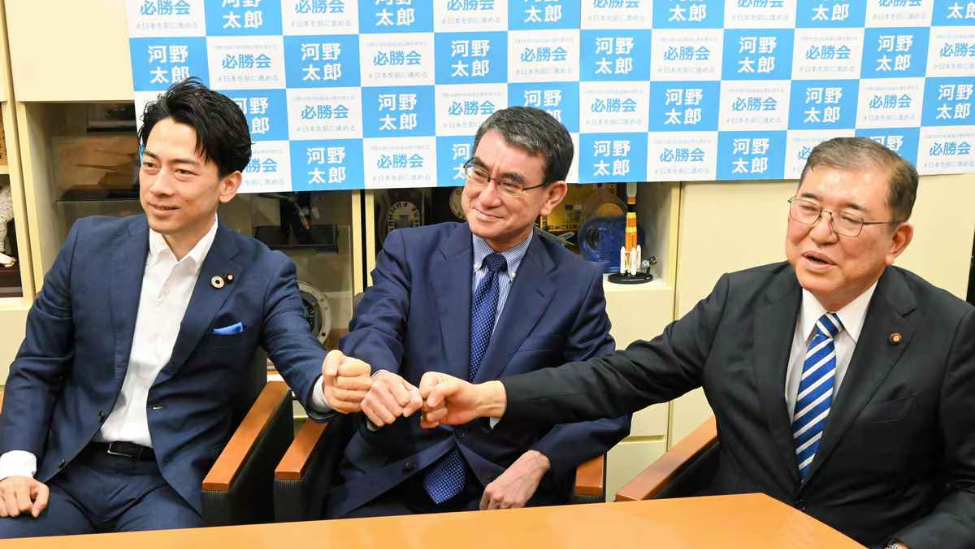
On September 19, 2021, on the eve of the LDP presidential election, Shinjiro Koizumi, Taro Kono, and Shigeru Ishiba held a roundtable discussion at the House of Representatives building. At that time, Shinjiro Koizumi and Shigeru Ishiba supported Taro Kono's candidacy for the presidency. Japanese media
2. Modernization and Controversy in Campaign Strategy
In terms of campaign strategy, the Koizumi camp exhibits distinct characteristics of the times. Recently, the Koizumi campaign team was reported to have hired "internet trolls" to conduct positive publicity and "smear other candidates" on social media. His team quickly acknowledged this allegation, and Koizumi himself swiftly distanced himself from it, stating directly that he was unaware of it.
This small detail indicates on one hand that the overall political operations of the LDP remain relatively traditional, with the use of the internet and social media not being widespread or proficient; but on the other hand, the Koizumi team is expanding the battlefield of election discourse from traditional street speeches and media interviews to social media, which is more powerful in dissemination but also more controversial. This operation can effectively shape, and even manipulate, public opinion trends, especially when courting younger party members and centrist voters who are more sensitive to the internet; however, in a traditional or relatively conservative society like Japan, it has also brought criticism of "political opportunism" and triggered vigilance and criticism from traditional media outlets such as Shukan Bunshun.
3. The Inherent Risks of Generational Transition
Despite the strong momentum, Shinjiro's "path to the presidency/prime ministership" is not smooth. It is reported that his father, Junichiro Koizumi, does not agree with him running for the presidency now, with the main concern being that he is still too young and needs more political experience and training. This concern is not unfounded; it points to two core risks of young politicians ascending to the pinnacle of power too early:
First, the risk of being manipulated. Japanese politics, especially the roles of LDP president and Prime Minister of Japan, severely test one's ability to manage the complex bureaucratic system and experience in maneuvering within the Diet. If Shinjiro Koizumi fails to win the LDP presidency after several attempts, he is likely to deplete his political energy; and even if elected, he may be manipulated by behind-the-scenes heavyweights and become a puppet due to his lack of seniority, the latter being clearly more dangerous. A young prime minister lacking a solid factional base and core decision-making advisors is easily constrained by party elders or the bureaucratic group on major policy issues, and his will for reform may be eroded as a result.
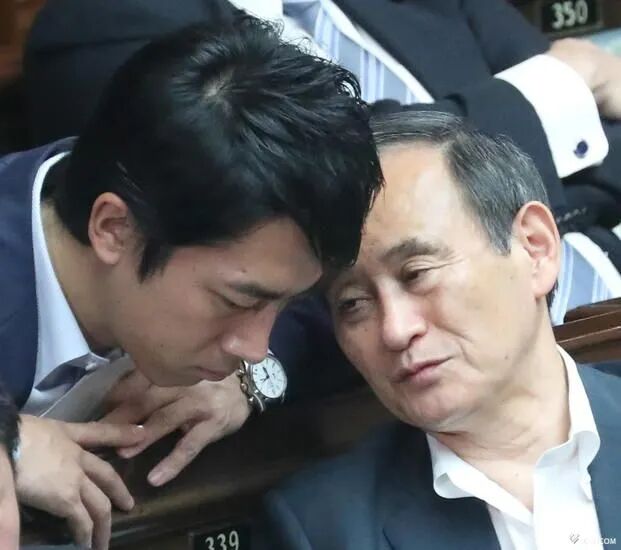
File photo: Shinjiro Koizumi and his supporter Yoshihide Suga behind him. Jiji Press
Second, the weighing of historical opportunity. Among the many motivations for Koizumi's candidacy, there may be a mindset of "if I do not run this time, I may miss the chance to become the youngest prime minister in Japan's constitutional history." This also implies a deep concern about the current situation of the Liberal Democratic Party (LDP). Although the opposition parties are unlikely to gain significant momentum, they are watching with bated breath; once there is a change of government and the LDP loses power, the path to the premiership would likely become even more difficult. The LDP has enjoyed one-party dominance and long-term rule in Japanese politics, but the other side of the coin is that it is deeply entrenched with accumulated ills and lacks vitality. Facing the rapid changes of the current era and geopolitics, the LDP's response has clearly been insufficient, and thus the anxiety among the party's elite regarding the stability of the regime is considerable.
The core of the "Koizumi Scenario" is a high-risk, high-reward political gamble. It champions generational transition, attempting to achieve a breakthrough during a window of loosening power through flexible alliance strategies and operations that keep pace with the times. However, its unstable foundation, lack of experience, and the doubts from conservative forces within the party collectively constitute the greatest obstacles to realizing this scenario.
The "Takaichi Scenario": The Fading and Predicament of the Abe Line
In contrast to Koizumi Shinjiro's rising momentum, the keyword for Sanae Takaichi's election prospects this time is likely "stalling." As the most direct inheritor of Shinzo Abe's political legacy, Sanae Takaichi's campaign performance is an important indicator for measuring the influence of the Abe line in the post-Abe era.
1. The Collapse of the Core Support Base
The fundamental reason for Sanae Takaichi's election "stalling" lies in the disintegration of the "Abe Faction," which is the source of her power. First, in the House of Representatives and House of Councillors elections over the past year, many Abe Faction lawmakers who supported Sanae Takaichi lost their seats, leading to a shrinkage of her base in the Diet member votes. Second, the Abe Faction was purged due to the "slush fund scandal," a major scandal that Japanese society has not yet forgotten, causing Sanae Takaichi's political image and mobilization capability to plummet.
Last year, the "Abe Faction" promoted a spokesperson in the presidential election to avoid being marginalized, but now that the once-mighty faction is struggling to save itself, it naturally lacks the strength to provide strong organizational support and financial guarantees for Takaichi's election. This loss of support base has also directly led to Sanae Takaichi's advantage in the grassroots party member votes being overtaken by Koizumi.
2. The "Double-Edged Sword" Effect of Political Rhetoric
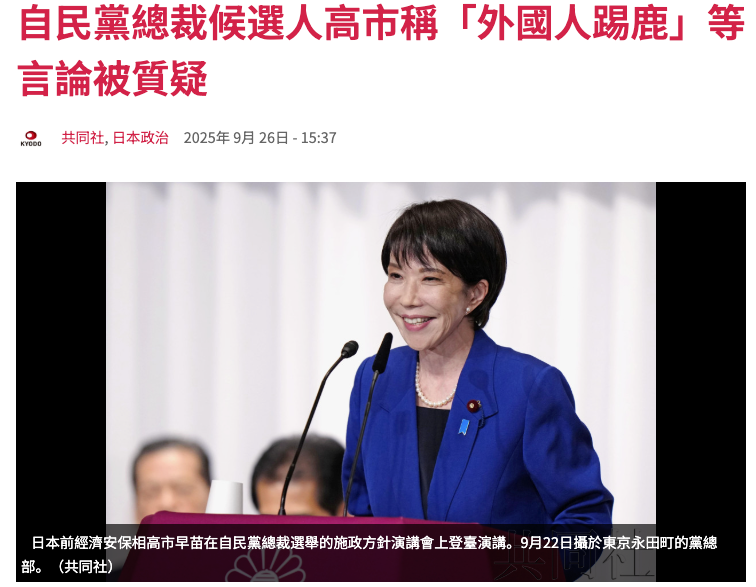
Sanae Takaichi's campaign strategy and platform carry a distinct far-right hue. For instance, she attempted to boost her momentum by making xenophobic remarks targeting foreigners, but such opportunistic rhetoric has backfired in the current political environment. On one hand, it has triggered wariness within the ruling coalition; the Komeito party, which is in a coalition government with the LDP, has explicitly stated its unwillingness to cooperate with far-right political figures and has not ruled out the possibility of withdrawing from the coalition. This is undoubtedly a major blow to Sanae Takaichi's ability to form a cabinet and maintain governing stability after her election, forcing the LDP to consider a more perilous question: What happens after the election?—This is likely even more difficult than for Koizumi and Hayashi Yoshimasa.
On the other hand, Sanae Takaichi's statements on certain traditional right-wing topics have not fully consolidated traditional right-wing voters either. For example, her attitude on core conservative issues such as visits to the Yasukuni Shrine has been ambiguous. This attempt to sway toward the center to broaden her voter base has instead provoked dissatisfaction among some core supporters, who accuse her of political opportunism and a lack of substantive content. This situation, where she pleases neither side, highlights the predicament in Sanae Takaichi's positioning on the political spectrum.
3. The Limitations of Personal Charisma
Of course, the root cause of Sanae Takaichi's inability to replicate and continue Shinzo Abe's success lies in the limitations of her personal traits. She has always been regarded as a "moon-type" political figure, relying more on Shinzo Abe's support and reflecting his political energy, while lacking unique political insights and deep roots. In other words, Takaichi's political appeal stems primarily from the label of "Abe's successor," rather than her own political philosophy, policy capabilities, or personal charisma.
Furthermore, she lacks a stable political base and has no loyal followers of her own. Once Abe's halo faded due to his death and the factional scandal, Sanae Takaichi's shortcomings were fully exposed.
The "Takaichi Scenario" can be said to profoundly enact the phrase "when the man leaves, the tea grows cold." Merely shouting the slogan of "inheriting the Abe line" is unsustainable. After losing the organizational shelter of a powerful faction and the personal halo of the leader, her mobilization capability for the far-right line and her political market share shrank rapidly.
The "Hayashi Scenario": The Return of the Technocrat and the Faction's Long-Term Strategy
Between Koizumi's aggressive advancement and Takaichi's strenuous struggle, Hayashi Yoshimasa represents a third path—a more traditional and steady path of elite politics. According to recent polls in Japan, Hayashi Yoshimasa still trails behind Koizumi and Takaichi overall.
1. An Impeccable Political Resume
Hayashi Yoshimasa's resume is arguably unmatched in current Japanese politics. He has held key cabinet positions such as Minister of Agriculture, Forestry and Fisheries, Minister of Foreign Affairs, Minister of Defense, and Chief Cabinet Secretary, and possesses an educational background from the University of Tokyo and Harvard University, along with 30 years of experience as a Councillor. This means that as a presidential candidate, Hayashi Yoshimasa is not only familiar with the operational logic of core bureaucratic ministries such as the Ministry of Finance and the Ministry of Foreign Affairs, but also possesses experience in handling comprehensive issues including domestic affairs, diplomacy, and security.
At the same time, Hayashi Yoshimasa's personal traits of being low-key and steady reveal a "profound side" in national administration, which holds considerable appeal for an LDP that craves stability after three prime ministerships under Shinzo Abe, Yoshihide Suga, and Fumio Kishida.
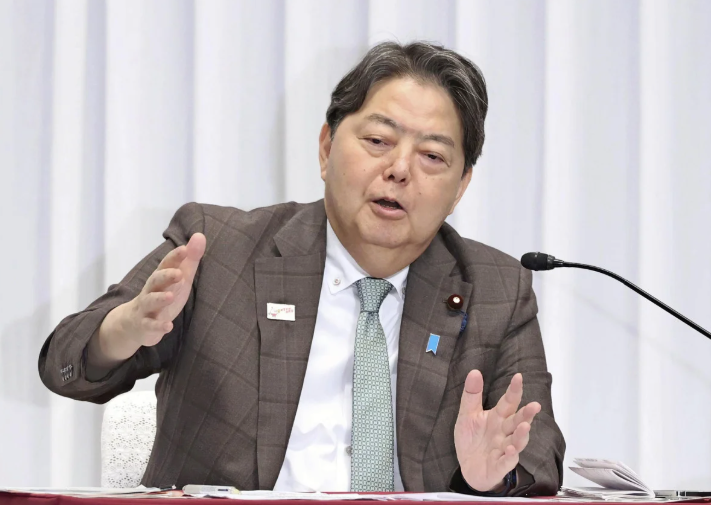
File photo: Hayashi Yoshimasa. On September 28, Hayashi Yoshimasa discussed the issue of separating Class-A war criminals at the Yasukuni Shrine on a Fuji Television program.
2. The Will of the "King Maker" and Factional Support
Hayashi Yoshimasa's rise is inseparable from the strong factional support behind him. Standing behind him is the strong backing of the "Kochikai" faction led by Fumio Kishida. Although the factions have nominally been dissolved, Fumio Kishida remains highly active in politics, hoping to become the decisive figure (king maker) within the LDP. Kishida has previously revealed his wish for Hayashi Yoshimasa to succeed him and has explicitly supported his candidacy. This is actually another core logic of power operations within the LDP: even the prime minister needs to plan for his "exit strategy," extending his and his faction's influence within the party by nurturing a successor.
Currently, Hayashi Yoshimasa's support base appears to be expanding, with various forces, including Shigeru Ishiba and those around him, also moving closer to him. Under the dominant mindset of seeking stability within the LDP, Hayashi Yoshimasa is gradually becoming the convergence point for "anti-Koizumi" or "anti-Takaichi" forces.
3. Potential Impact on Relations with China
Compared to the other two candidates, Hayashi Yoshimasa has another layer of role that leads outsiders to have more imagination about how he would handle Sino-Japanese relations. Hayashi Yoshimasa served as the chairman of the Japan-China Friendship Diet Members League from 2017 to 2021, leading outsiders to label him as "pro-China," although he clarified himself as "China-aware." In contrast to the negative impression left on the Chinese public by Koizumi Shinjiro's father regarding visits to the Yasukuni Shrine, and Sanae Takaichi's hardline right-wing stance, Hayashi Yoshimasa's relatively moderate posture and his past experiences in Sino-Japanese exchanges form a stark contrast.
However, in this LDP presidential election, this layer of Chinese experience for Hayashi Yoshimasa is likely not a plus point.
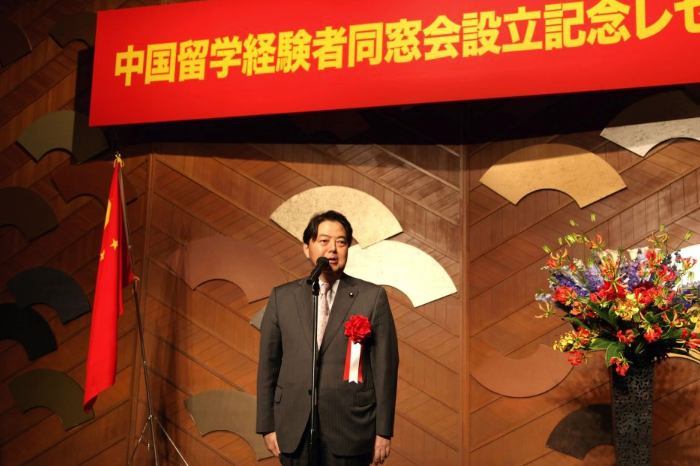
In March 2018, the "All-Japan Alumni Association of Graduates from China" held its founding reception at the Hotel New Otani in Tokyo. Hayashi Yoshimasa, then Japan's Minister of Education, Culture, Sports, Science and Technology, attended and delivered a speech. China News Service
The essence of the "Hayashi scenario" is the LDP's "return" to and longing for the traditional elite governance model after experiencing turmoil. It relies on the candidate's deep resume, stable factional support, and the endorsement of party veterans. The advantage of this scenario lies in its stability and predictability, but its challenge is that, in the face of high expectations for change in Japanese society, this steady course may be perceived as conservative and lacking in vitality.
Hesitating at the Crossroads
Given the voting system for the LDP presidential election, once a second round of voting is triggered, the situation may undergo a major turning point. The first round consists of votes from Diet members and local party members. If no candidate receives a majority, the top two candidates proceed to a second-round runoff. The second round is primarily voted on by Diet members, at which point the flow of votes from candidates eliminated in the first round becomes crucial.
This election involves a total of 590 votes, with each of the 295 LDP Diet members casting one vote, and ordinary party members and "party friends" (registered supporters) across the country proportionally converted into 295 local votes. According to Kyodo News on September 28, with six days remaining until the election vote, 20 percent of Diet members had still not declared their stance.
Currently, if a second round of voting is reached, the three most likely combinations are: Koizumi Shinjiro and Sanae Takaichi, Koizumi Shinjiro and Hayashi Yoshimasa, and Hayashi Yoshimasa and Sanae Takaichi; the first two are more likely.
The key to the final round is how the power struggle unfolds. Based on various signs, Aso Taro harbors "hostility" toward Hayashi Yoshimasa, but has not yet explicitly declared support for Sanae Takaichi. Therefore, if Sanae Takaichi is eliminated in the first round, the residual forces of the Abe faction behind her and the votes of the Aso faction may flow to Koizumi Shinjiro, giving Koizumi a significant advantage. On the other hand, if Koizumi Shinjiro and Hayashi Yoshimasa enter the second-round showdown, moderate Diet members within the LDP who are uneasy about Koizumi's inexperience may lean toward Hayashi Yoshimasa.
The final result of the election is not a simple contest of public opinion, but rather a behind-the-scenes deal and collusion among factional leaders, precise down to the single-digit vote count. The victory or defeat of the candidates depends not only on their own strength, but also on their position within the complex network of intra-party interpersonal relationships and factional interest calculations.
More importantly, behind the various calculations of this LDP presidential election lie multiple tensions facing Japanese politics.
First, the tension between generational transition and path dependence. The new generation, represented by Koizumi Shinjiro, attempts to challenge tradition with new political language and campaign models, but the fragility of their own foundation forces them to face the risk of being "manipulated" by old forces. Meanwhile, traditional elites represented by Hayashi Yoshimasa continue the classic promotion path of factional support and seniority-based advancement. Their steadiness is their appeal, but also their predicament.
Second, the tension between traditional politics and real-world needs. Sanae Takaichi's "loss of momentum" reflects the strong aversion in Japanese society to the old-style political model after the "Abe faction" suffered significant damage due to scandals. How to respond to society's calls for reform is the biggest challenge facing the LDP's governance.
Finally, the tension between intra-party democracy and factional backroom politics. Although the weight of party member votes is increasing and the election process appears open, the final outcome may still be determined by interest exchanges and power distribution among a minority of factional leaders during the voting.
Whether a "44-year-old prime minister" takes office, launching reforms full of variables, or a more experienced politician takes the helm, returning to a steady course, this election will be a key battle defining the direction of Japanese politics for the coming years. The LDP, this giant ship, is slowly and heavily choosing its course at the historical crossroads.
