
Intellectual Freedom and Scholarly Discipline
自由学风,规范学术
Sha Qingqing, “Intellectual Freedom and Scholarly Discipline,” in An Oral History of Fudan History Alumni, edited by the Department of History, Fudan University (Fudan University Press, September 2025), 456–465.
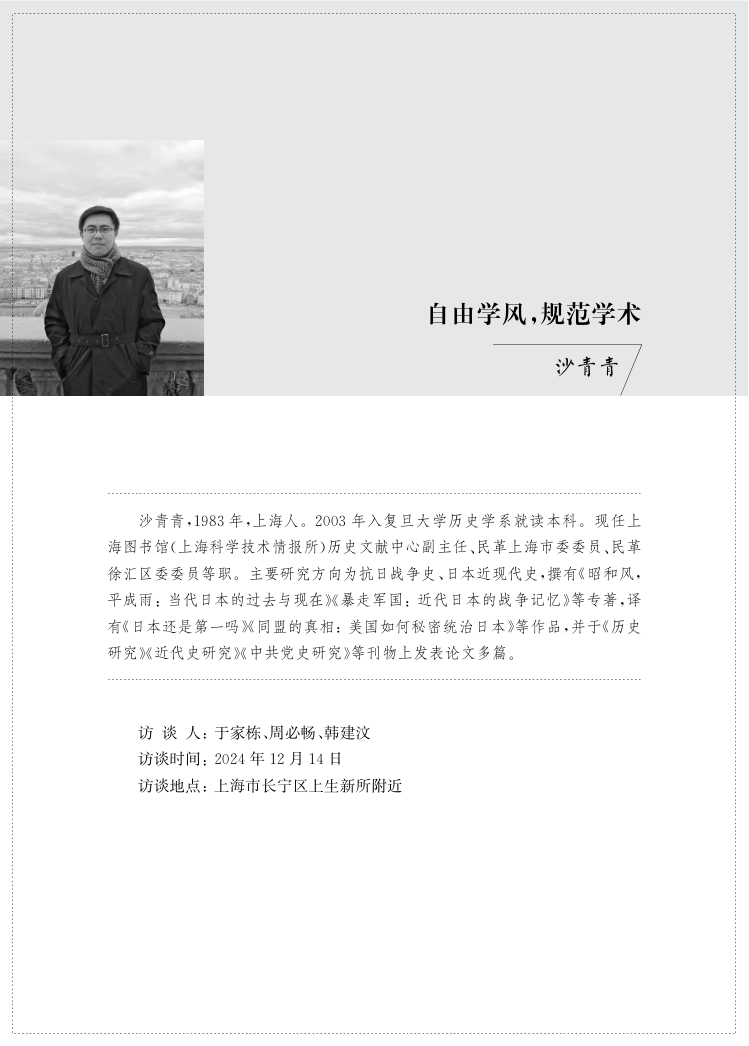
A Spirit of Academic Freedom, A Standard of Scholarly Rigor
Sha Qingqing, born in 1983, is from Shanghai. He entered the Department of History at Fudan University in 2003 to pursue his undergraduate studies. He currently serves as Deputy Director of the Historical Documents Center at the Shanghai Library (Shanghai Institute of Scientific and Technical Information), as well as a member of the Shanghai Municipal Committee of the Revolutionary Committee of the Chinese Kuomintang and a member of the Xuhui District Committee of the Revolutionary Committee of the Chinese Kuomintang. His primary research interests include the history of the War of Resistance Against Japanese Aggression and modern and contemporary Japanese history. He has authored monographs such as The Showa Wind, the Heisei Rain: Japan's Past and Present and Japan’s March to Militarism: War Memory in Modern Japan, and has translated works including Is Japan Still Number One? and The Truth About the Alliance: How the United States Secretly Rules Japan. He has also published numerous papers in journals such as Historical Research, Modern Chinese History Studies, and Studies in the History of the Communist Party of China.
Interviewers: Yu Jiadong, Zhou Bichang, Han Jianwen Interview Date: December 14, 2024 Interview Location: Near Shangsheng Xinsuo, Changning District, Shanghai
Roots and Enlightenment: The First Encounter with the Department of History at Fudan University
Zhou Bichang (hereinafter referred to as "Zhou"): How did you come to connect with Fudan University? What was your impression of it before you entered?
Sha Qingqing (hereinafter referred to as "Sha"): I have been interested in history since my secondary school days, so choosing history as my major was a natural progression. I didn't have many specific thoughts, nor did I consider future employment; it was purely driven by interest. In Shanghai, the Department of History at Fudan University is quite representative. Moreover, the older generation of teachers at Fudan were still active at that time, and I had already heard of them during high school. For instance, the senior teacher Fan Shuzhi was still teaching large lectures to undergraduates then. There was also Gu Xiaoming, who taught American history; he appeared on television programs and wrote columns in newspapers, being one of the earliest university teachers to be very active in the media, which I found quite novel. Additionally, there was Yao Dali from the Institute of History and Geography, who was highly regarded in the academic community, and I had heard of him as well.
At that time, we had certain expectations of Fudan. We felt that Fudan had a very free and relaxed atmosphere for academic discussion, and that the relationship between teachers and students was good, making it an excellent place for learning and further study.
Zhou: Did your experience at Fudan match your expectations? What were your feelings when you first enrolled? Sha: I think it largely matched. Although the hardware conditions at Fudan were not particularly good at that time—for example, the Guanghua Building had not yet been constructed, and the conditions in several dormitory buildings on the main campus were quite poor—overall, the atmosphere of academic discussion throughout the university and the harmonious relationship between teachers and students are still fondly remembered today.
Since we were local Shanghai students, we had limited opportunities to interact with students from other regions before university life. After arriving at Fudan, I got to know the living conditions and diverse hometown backgrounds of classmates from all over the country through interactions within the department and in the dormitories. This was also an opportunity to broaden my social experience. At that time, our class had three majors: History, Cultural Heritage and Museology, and Tourism Management. The students had different academic backgrounds, and we engaged in exchanges with one another.
The first week of enrollment was mostly filled with novelty and excitement. Relatively speaking, the educational state of university was completely different from that of high school. University teachers rarely taught strictly from the textbook; although they had a general framework, their lectures were sometimes described as "driving a trolleybus without tracks." Some courses, even those taught by teachers from our own department, were general education large lectures that everyone could choose. For example, in Fan Shuzhi's "Outline of National History," when he gave large lectures, students from other majors
would also come to listen, and during the class, one would hear very different perspectives and angles from students of other majors. Moreover, Fan Shuzhi's teaching style was quite free. Although the ideas of students from other majors and departments sometimes differed from the main thrust of his lectures, he would allow them to speak and engage in equal discussion with them. Some courses were extremely rare and valuable. For instance, Jin Guangyao offered a course on "The History of the Cultural Revolution." Teacher Jin had deep accumulation and narrated objectively, neither extreme nor conformist, providing a relatively good and complete account of that special period of history. I was deeply impressed by one occasion when Teacher Jin invited us to a seminar. There were no restrictions; even undergraduates who were interested could attend, so I went. The lecture was held in a small conference room in the Guanghua Building, with about a dozen participants. It was moderated by Teacher Jin, with Roderick MacFarquhar, who wrote The Cambridge History of the People's Republic of China, as the main speaker. MacFarquhar passed away many years ago. Thinking about this now, I feel such opportunities were too rare, and it is hard to imagine similar activities happening today. Teacher Jin believed this was a great opportunity for students.
Breaking Boundaries and Observing Changes: Expanding Horizons and the Flow of Academic Style
Zhou: During your studies at Fudan, besides Teachers Fan Shuzhi and Jin Guangyao, were there any other teachers or courses that left a deep impression on you?
Sha: I had more contact with Teacher Zhang Qing, and I even did a small project with him. Besides Teacher Zhang's course "Introduction to Historiography," I also took his "History of Modern Chinese Thought." At the time, Teacher Zhang gave us the impression of being very passionate during class. Initially, we were a bit afraid because we found him serious, and he was tall and imposing. But after getting to know him better, we felt that Teacher Zhang Qing was very good to his students. Whether it was "Introduction to Historiography" or "History of Modern Chinese Thought," I found his teaching and narration very engaging, with the sentiment of an idealist. Especially when he spoke about some of his research subjects, such as Fu Sinian and Hu Shi, you could feel that he had an intellectual concern for these figures beyond mere historical research. He also provided us with a very good template for studying intellectual and cultural history. In particular, the course "History of Modern Chinese Thought" helped students grasp the overall context of modern Chinese intellectual history and understand key figures. These two courses by Teacher Zhang had a profound impact on me, and I may still have some of the notes today.
Another course that left a deep impression was "The World Before the 15th Century," which was a general education course. I think that especially at the undergraduate stage, students' research fields are not yet clearly defined, and they have not yet reached the stage of differentiation or focus.
944 A Spirit of Academic Freedom, A Standard of Scholarly Rigor
At this stage, such general history courses are quite necessary for most students in the major, and even for those outside the major. At the very least, they help students establish some basic common sense, which helps construct a coordinate system. Moreover, the name of this course was deeply considered. Why was the 15th century chosen as the node to divide world history? I think this also reveals the course design's attention to world history, or to the relationship between the world and China. Relatively speaking, I think research on world history for this period in China is very weak, both in the public sphere and in the professional field. Personally, I feel that the strength needs to be strengthened. To give the most typical example, why have many "pseudo-history theories" resurfaced in recent years? I think this is largely due to the weakness of research on world history before the 15th century.
I also took a course on oral history back then, just as Professor Chen Yan had started teaching it. Professor Chen covered many basic concepts of oral history and methods for oral history interviews; at the time, this was a very new direction. Moreover, Professor Chen’s style was free-spirited, and the atmosphere in class was lively. The assignment at that time involved interviews with faculty members for the History Department’s 80th anniversary and interviews about one’s own family history. However, I did not participate in the interviews myself; I was assigned to write the transitional remarks for the 80th-anniversary celebration ceremony. Professor Chen Yan also offered a course on gender history, which I also took. At the time, I felt that both courses were quite “avant-garde.” In fact, Professor Chen Yan’s early research was not in this area; she was a student of Professor Wu Jingping and initially worked on diplomatic history. It was only later that she explored her new academic direction. Looking back now, both oral history interviews and gender history represent new trends in the development of historiography over the past decade or so.
At Fudan University during that era, gender issues, gender history, or gender studies were just beginning to flourish. Everyone felt this was a very “trendy” topic, and people would take the course out of concern, believing that this topic could be openly discussed. At that time, people were unfamiliar with the topic of gender history; rather, they held attitudes of concern and curiosity, hoping to deepen their understanding. Professor Chen Yan would pose questions and facilitate discussions around certain issues in society at the time. At the same time, she would discuss views and debates that were popular in Europe and America, even crossing disciplinary boundaries to talk about Foucault’s related research and theories. Thus, overall, it was a relatively open state.
Zhou: We understand that you have achieved fruitful results in the field of modern Japanese history, but we noticed that the courses you selected during your university years did not seem to be many related to modern Japanese history. What kind of opportunity subsequently led you toward research in modern Japanese history?
Sha: Actually, I have always been interested in Japanese history. The main reason I took few related courses at the time was that there were very few professors in the department who worked on Japanese history, apart from Professor Feng Wei. Therefore, the department did not have many course resources on Japanese history at that time. I even took courses at the Center for Japanese Studies because I felt there were no relevant courses to choose from within the department. Additionally, in fact, many of the topics I have worked on are related to modern Chinese history. If one researches modern Chinese history, Japan is an unavoidable topic. The article I published in Historical Research actually discusses
The Northeast Question refers to the Soviet Union's policy toward Japan and its policy on the Northeast Question before and after the Mukden Incident. While it is a topic concerning modern Chinese history or involving the Soviet Union, it implicitly involves Japan—specifically, its connection to the Mukden Incident and Japan's occupation of Manchuria at the time. Therefore, ever since leaving Fudan, I have continued to focus on Japanese history.
In recent years, the number of faculty members and courses on Japanese history in the department has gradually increased, such as Professor Shang Zhaoqi. Professor Shang also organizes reading groups for graduate or undergraduate students, and the conditions have improved as well.
I think I am actually someone with very diverse academic interests. I am interested in modern Chinese history, but I also have many interests in world history. Besides Japanese history, I am very interested in the history of Europe and America. If you search for my papers, you will find that the fields covered are quite varied. For instance, the article I published in Modern Chinese History Studies is a typical article on the political history of the Republic of China, discussing church-state relations and folk religion. The article in Historical Research involves discussions of national history and transnational history, and I have also written some articles related to Party history. When I was selecting courses, I chose entirely based on my own interests, especially in an environment like Fudan, where there are excellent majors, excellent topics, and excellent teachers. I think one should fully utilize existing resources; if there are courses that interest you, then choose them. There is no need to set a very clear direction for yourself too early, especially during the undergraduate stage, as this easily limits one's research. This situation is even more pronounced domestically. The reason Fudan established the college system and promotes general education is also based on this consideration. Sometimes, after getting to know them, you find that many teachers and researchers have very narrow horizons; they may know nothing at all beyond their own 'small patch of land' of research. I think this is essentially caused by our academic mechanism. Researchers still need the ability and basic awareness to broaden their perspectives. Therefore, I think that during the undergraduate stage, if you can consciously cultivate a broader vision and wider interests, it may be better for your future growth and research. At least you won't be ignorant of everything once you leave your specific field of research. This situation is particularly undesirable in humanities research.
I think undergraduates can undertake research projects, but the academic assessment system in our universities leads you to delve into a very narrow direction. This is helpful for writing papers, but it limits one's own academic cultivation and accumulation. If you go on to pursue a master's or doctoral degree, this situation will become very obvious. When attending academic conferences and communicating with students and teachers, you will find that they know nothing other than their own research topics. Those of us who do historical research relatively emphasize drawing inferences about other cases from one instance; this situation leads to significant problems. In the past, when I communicated with some students, I would discuss an issue: many students use databases to search for materials when writing papers. I think having such databases is good, but things were not like that in our time. At that time, Professor Feng Xiaocai had a very good viewpoint that I found very useful. He told me, 'Just take a historical source and flip through it, without having a strong purpose, such as 'I must understand this specific thing.' Just take a historical source...'
154 Liberal Academic Style, Standardized Scholarship
Flip through the entire collection of materials from beginning to end, or read a year’s worth of newspapers like the Shen Bao. This method is extremely useful for cultivating a sense of history. Conversely, if you only type keywords into a database to search, you may end up with significant oversights. Of course, from the perspective of writing a paper, this is a quick and convenient method, but it is not conducive to grasping a sense of history, a historical imagination that allows you to put yourself in others’ shoes. Let me give an example. Suppose I want to study Yu Qiaqing. If I search for Yu Qiaqing in the Shen Bao, I can indeed list the relevant events, but sometimes you lack a historical imagination regarding the news. What other things were happening in the same newspaper at the same time? Or what events before or after in the newspaper are related to this event? Historical events influence one another. For another example, you find a news item in the Shen Bao, located in a specific section on a specific page, but you only look at that section. You do not look at what other news happened on that same day. This information, to some extent, may help you better establish the importance of this event within the news and public opinion context of the time. How did people at the time view what you consider important? Why was what you consider unimportant on the front page? If you have a broader historical perspective, it is more conducive to grasping the historical context of the time, rather than being immersed in your own keyword searches. If you write papers entirely relying on keyword searches, there may be major problems, namely that the scenarios you envision differ from the context of people at the time. This applies to newspapers, and it also applies to other archival historical materials. For instance, regarding the paper I published in Historical Research, they asked me how I came to write it. I said I read it out of the Selected Documents on Soviet History. I read them volume by volume, and on a certain page, I saw a telegram from Stalin regarding the Mukden Incident, which seemed different from my intuitive judgment. Then I read further with this question in mind, and subsequently wrote related papers. This is my logic, equivalent to a research consciousness, rather than thinking of a topic first and then digging through various archives.
Yu Jiadong (hereinafter referred to as "Yu"): Current undergraduate students place great emphasis on academic monographs, and may have less grasp of primary historical sources. What is your view on this situation?
Sha: I can give an example. Many people feel that perhaps undergraduates do not need to read too many primary sources, and that reading secondary monographs is enough. But at least during my time, the concept conveyed to us by our teachers was precisely the opposite. I remember clearly that in Professor Wu Jingping’s course on "Diplomatic History of the Republic of China," he told us that when writing papers and citing materials, you must include primary sources. You cannot submit a paper consisting entirely of secondary materials—I am not asking you to write a literature review. He was actually forcing you to look at primary sources.
At that time, I borrowed a selection of German diplomatic archives from him, which was a translated English edition. There were no PDFs on computers back then. I asked Professor Wu to lend me this book. He said he couldn’t find it temporarily, but would find it for me later. Later, after a class, he gave me a photocopy. He was very careful at the time, saying I had to return it after reading, as he only had this photocopy.
At that time, many teachers, whether in world history or modern history, would tell us that
although you are undergraduates, you should try to read some primary historical sources, especially if you are specializing in modern history. For example, the Shen Bao; you can even read its advertisements. You can see what the advertisements looked like at the time, what the advertising culture of the people was like, and what goods were being sold. All of these can help you establish a historical perspective. I think that if you have time during your undergraduate years, you should read widely through primary historical sources. This is a way to help you establish a sense of the era of the history at that time. Databases are very convenient, and I use them too, but the problem is that relying solely on searches makes it difficult to establish a continuous thread and picture.
Looking Back and Looking Forward: The Road Traveled and the Road Ahead
Zhou: During your time studying at Fudan, was there any landmark that left the deepest impression on you? Sha: In my memory, Classroom 3108 in the Third Teaching Building had a halo around it, because the best lectures and the lectures by the most popular teachers were always arranged in Classroom 3108. At that time, many lectures were in the evening, perhaps starting at 6:30 or 7:00. Classroom 3108 was often full, and the corridor outside the windows was also packed with people. Moreover, this tradition started early, probably in the 1980s or 1990s. There were many lectures at the time. Each department had its own monthly themes, and many lectures by overseas scholars were also held in Classroom 3108. I remember clearly that Kenneth Pomeranz, who wrote The Great Divergence, visited Fudan once, and I was pulled in to act as the interpreter. The audience included undergraduate, master’s, and doctoral students, as well as some teachers from the department, such as Professor Fan Shuzhi and several other teachers specializing in Ming and Qing history. Professor Fan also had a very in-depth exchange with Pomeranz, because when Pomeranz’s The Great Divergence was published, it sparked great controversy. Professor Fan expressed sympathy for him, saying that he found many of his viewpoints very meaningful, and that some of the criticisms of him were unreasonable. There were many such exchanges at that time.
Zhou: After graduating from Fudan, what work experiences have you had? Sha: I went directly into the Shanghai Library. Because my interests are quite miscellaneous, if I were in the university research system, I would face more restrictions. Instead, in a place like the library, I have more space. Beyond daily affairs and political work, I can still do some research that interests me, and the degree of freedom is indeed greater. If you search for my papers, you will find that basically every two or three years is a cycle; after two or three years, I switch to a new topic. This is unlikely to happen in a university setting.
I believe Fudan’s influence on me lies mainly in some basic academic norms and concepts. The teachers at Fudan demonstrated what the most basic norms of academic research are, and this is very important. Setting aside whether the papers are written well or poorly,
354 A Spirit of Academic Freedom, Standardized Scholarship
researchers should at least know the basic path and norms for writing a paper or conducting a study. Whether it is the most basic "Introduction to Historiography" course or the specialized courses of the department at the time, the teaching and training in these courses cultivate these kinds of awareness in students. Whether you go down the academic path in the future or not, you will form some very basic cognitions and avoid many detours. Like in my interviews over the years, I have seen some young people who seem to have good educational backgrounds, but there are problems with the basic norms of their papers. This belongs to a lack of solid fundamental skills and a failure to establish a sense of norms.
In addition, I think the atmosphere of discussion and the academic horizon provided by the Department of History at Fudan can well cultivate academic taste. Thinking carefully, the period when I read most frequently was probably during my undergraduate years. Sometimes we took general elective courses, and since the final assessment was either a paper or an open-book exam, I would sit in the back and read my own books. Moreover, at that time, I would borrow books from teachers. There were no PDFs or electronic scans back then; we all went to print shops to make photocopies and then bound a book together. Although it was troublesome, it was actually during this stage that I read the most books. This foundational reading volume supports a person’s academic positioning and builds the foundational framework for the entire learning and research career, which is very important.
Zhou: There are voices suggesting that the open-ended undergraduate training in the Department of History is "free but useless," which may be detrimental to the overall quality of students. What is your view on the undergraduate training in the Department of History at Fudan?
Sha: I think there are both good and bad aspects; every department and every school is like this. Relatively speaking, it is precisely the humanities disciplines that are difficult to require or categorize according to a unified standard. I believe that humanities disciplines should, on the contrary, give students more room to grow, especially at the undergraduate stage, when students may not have a particularly clear idea of what they want to do in the future. How many students truly know very clearly that they want to work on a specific topic or research project during their undergraduate years? I don't think that is necessarily the case. Moreover, interests are always changing. Under these circumstances, setting too many limits on oneself actually compresses many possibilities. Having a broader, more complex—putting it nicely, a liberal arts—awareness, I think, would actually be better. One should not compress one's possibilities during the undergraduate stage. Let me give an example of a senior colleague, Teacher Jiang Ming, who works on late Qing history and wrote The Fleet with the Dragon Flag Flying, which discusses the Jiawu War. In the 1980s, he was in the History Department; after graduation, he worked in the University Youth League Committee, and later left the academic system to work in a state-owned enterprise in Shanghai. But throughout his life, he has been able to maintain his academic interest in history, continuing to conduct research on late Qing history in his spare time, and many of his academic achievements have earned a high reputation in the academic field. He did not become a university professor, nor did he obtain a PhD, but this did not prevent him from continuing to conduct research in this area.
I can also give an example of Teacher Qiu Luming. In fact, he has his own research field, but he is interested in many things. We know each other privately, and we have many topics to chat about in our usual conversations. My impression is that the first time I met Teacher Qiu was at a lecture, where the topic was Sino-Soviet relations in modern history. I was the main speaker, and he was the guest speaker. The
topic had nothing to do with his research field, and this was more than a decade ago. Of course, when he writes papers, he focuses on his own professional field, but this does not prevent him from paying attention to other things. I think broad interests are very important for doing humanities research. I think some papers in certain departments are actually of very limited significance. Finding a certain bank or a certain company and conducting a cross-sectional study may have some significance. But if one just discusses the matter on its own terms, talking only about how this company or bank developed in modern times, I think that is actually not very interesting.
In the 1990s, Fudan University established a "Liberal Arts Base Class." The idea at the time was for humanities teachers to give unified lectures to undergraduates. These students were not divided by major; they were trained in the Liberal Arts Base Class. This was the earliest attempt at general education, equipped with relatively good faculty. Among them was Teacher Xu Yingjin, who is now in the Department of Philosophy at Fudan. He himself originally wanted to study in the History Department and even wrote papers on modern history and the late Qing period. I later asked him why he gave up history to study in the Philosophy Department. He said the main reason was that when he studied history, especially modern history, he discovered a problem: possessing historical materials is a major prerequisite. By comparison, the Philosophy Department does not have the problem of possessing historical materials; the dependence on the material level is much weaker, and it is more of a test of one's own thought or intellect. I do not necessarily agree with this point, but I understand what he means. Sometimes, when doing modern history, this problem may indeed exist. I think the Chinese historiographical tradition places great importance on the use of new historical materials. In the field of modern history, if someone's diary is published, or if certain archives or memoirs suddenly emerge or are declassified, it may lead to some new perspectives.
Teacher Sha's advocacy of a pluralistic and pragmatic approach to historical research has benefited us greatly. This outstanding scholar, who emerged from the Department of History at Fudan, has presented us with an academic landscape where freedom and norms coexist through plain yet profound words. Teacher Sha's experience has made me understand that true academic growth requires both the courage to explore freely and the steadfastness to conduct rigorous scholarship.
We feel that historical research is "hard work," requiring one to bury oneself in old materials and explore dusty past events day after day for years. This "hard work" is precisely the essential quality for historians. In the new era today, the pressures of further education and employment weigh heavily on us history majors, and various "reforms" make the path ahead increasingly difficult. When "academia" is misunderstood as not being a proper occupation, and "research" is reduced to a means of seeking fame, we must reflect on our own path and future. But as long as one is engaged in academic research, one must be responsible for the research, steadily improving one's historiographical literacy, and earnestly studying
554 Free Academic Style, Standardized Scholarship
historical materials and advancing the expansion of the frontiers of knowledge. Facing many considerations of practical utility, we must still base ourselves on primary materials, broaden our research horizons, and enhance our historiographical literacy. Academia is both an ideal and a choice of path. At the same time, Teacher Sha's rich experiences have shown us diverse channels distinct from traditional academic research within the university, letting us know that there is a vast world of research beyond the university.
It has been more than twenty years since Teacher Sha graduated from Fudan. During the interview, we deeply felt the enormous changes in the university over these two decades. The pressure of GPA, restrictions on research, and tightening employment are real difficulties faced by history students; changes in academic style, shrinking atmosphere, and the subdivision of fields are also worthy of in-depth exploration as historical topics. Historians who delve into the past must also care about reality and think more about current issues. Through the interview, we not only understood the growth trajectory of an outstanding scholar but also touched upon the most precious spiritual core of the Department of History at Fudan. This academic tradition, which is free yet not without norms, open yet not forgetting its original aspirations, will surely guide generation after generation of Fudan students to go further and deeper on the path of historical research.
Yu Jiadong, Zhou Bichang