
Belief and the Struggle for Power: Gaoyou’s City God Temple Conflict of 1931
信仰与权争:1931年高邮“打城隍”风潮之研究
Sha Qingqing, “Belief and the Struggle for Power: Gaoyou’s City God Temple Conflict of 1931,” Modern Chinese History Studies, 2010, no. 1, pp. 115–127.
Faith and Power Struggles: A Study of the 1931 Gaoyou "Beating the City God" Uprising
Sha Qingqing
Abstract: Around 1930, a massive "Anti-Superstition Movement" swept through provinces such as Jiangsu, Zhejiang, Anhui, and Shandong. Grassroots organizations of the Kuomintang launched political campaigns against traditional folk beliefs in the name of "revolution," leading to social unrest and even popular uprisings across various regions. However, behind this movement lay undercurrents of opposition between grassroots party and government organs. The two sides frequently clashed over ideological and practical interests, subsequently triggering intense waves of confrontation between various "movements" and "counter-movements" in local societies. By reconstructing the specific case of the Gaoyou "Beating the City God" incident, this article aims to reveal the deep-seated political causes behind "folk belief incidents"—namely, the structural conflict between grassroots party and government powers during the early years of the Nanjing National Government.
Keywords: Anti-Superstition Movement, Party-Government Relations, Folk Beliefs, Grassroots Society, Gaoyou
I. Introduction
The Kuomintang's "Purge of the Party" in 1927 and the establishment of the Nanjing National Government are generally regarded as a significant turning point in the history of the "National Revolution." Traditionally, many narratives have argued that from then on, widespread and radical grassroots social reform movements were continuously suppressed by conservative forces within the Kuomintang. However, it cannot be ignored that after the establishment of the Nanjing Government, such radical political movements did not come to an abrupt halt; on the contrary, they showed a tendency to spread further. The vigorous "Anti-Superstition Movement" was one such example. In November 1928, the Ministry of the Interior of the Nanjing National Government promulgated the "Standards for the Retention or Abolition of Shrines," which stipulated criteria for the retention of religious facilities, claiming to eradicate "licentious and evil shrines that caused the most harm."1 Taking this as the starting point, under the planning and promotion of Kuomintang organizations at all levels, an anti-superstition movement rapidly unfolded across Jiangsu and Zhejiang, with temples, monasteries, monks, and Taoist adherents suffering varying degrees of impact.
Regarding the "Anti-Superstition Movement," an examination of numerous policy provisions reveals that its purpose was to bring various folk beliefs under state control, thereby implementing the so-called "ideals of the National Revolution." As this movement gradually reached the local grassroots society, resistance from believers and
1 The "Standards for the Retention or Abolition of Shrines" (October 1928) stated that ancient deities such as the City God, Dragon King, Land God, and God of Wealth should also be abolished as appropriate. Only two categories of temples could be retained: first, those dedicated to sages, including all sages who had contributed to the nation, the state, and society, such as Fuxi, Shennong, the Yellow Emperor, Confucius, and Mencius; second, those of purely religious nature, such as Sakyamuni and Guanyin in Buddhism. Although these two categories of temples could be retained, they were also placed under strict government jurisdiction. See Compilation and Translation Division of the Legislative Yuan, ed., Compilation of Laws and Regulations of the Republic of China, Vol. 4, Internal Affairs (Zhonghua Book Company, 1934 edition), pp. 807–814.
other local forces also grew increasingly large, leading to frequent popular riots, particularly severe in Jiangsu and Zhejiang. On January 25, 1929, in view of the deteriorating situation at the grassroots level, the Nanjing authorities urgently promulgated the "Regulations on the Supervision of Temples," replacing the previously extremely radical "Standards for the Retention or Abolition of Shrines." Article 6 explicitly acknowledged that "the property and sacred objects of temples belong to the temples and are managed by the abbots."1 In February of the same year, the Ministry of the Interior again notified all provinces to temporarily suspend the suppression of so-called "divination and astrology," and tirelessly admonished party and government organs at all levels to prioritize people's livelihoods and avoid blindly promoting the anti-superstition movement to the point of triggering popular uprisings.2 Subsequently, although the spread of the entire movement slightly subsided, its aftershocks continued to affect Jiangsu—especially the vast areas of northern Jiangsu—until 1931. Faced with this peculiar situation of repeated grassroots movements, one cannot help but ask: Since the Nanjing Government was quite wary of grassroots movements after its establishment, why did movements such as "eliminating superstition" still unfold vigorously across the broad grassroots society?
To date, many domestic researchers have focused on the "Anti-Superstition Movement" during the Nanjing Government period, but most have concentrated on church-state relations or the contradiction between the new state ideology and old folk beliefs.3 Overseas scholars have also shown considerable interest in this issue. Generally, they widely believe that the anti-superstition movement represents a struggle between "new culture" and "old customs," or a conflict between "state modernization" and "traditional grassroots governance models." Prasenjit Duara, for instance, once compared "Chinese folk beliefs" to "reefs" blocking the path of China's modernization, constantly colliding with China's modern Enlightenment movement.4 However, this overly conceptualized analysis does not help us understand the actual evolution of political movements at the grassroots level. In addition to examining the relationship between "revolutionary consciousness" and "traditional beliefs," some overseas scholars, such as the Japanese scholar Takashi Mitani, have also noted grassroots party-government disputes within this movement, subsequently arguing that such disputes belonged to the intense game between the so-called "Kuomintang Left," the party's Right, and local traditional conservative forces.5 In these struggles, grassroots party branches and grassroots governments often stood in the two camps of "radical" and "conservative," and their attitudes toward such movements were often diametrically opposed.6 However, both domestic and international academia still lack case studies on this issue.7
Furthermore, in existing research, few have analyzed the causes of this movement and its extension at the grassroots level from the perspective of the Nanjing Government's party-government system. The author believes that if one can truly base the analysis on grassroots realities and examine this anti-superstition movement from the bottom up, many new problems and clues may be discovered. For example: In the anti-superstition movements occurring at the grassroots level, how were the Kuomintang grassroots organizations and the government respectively drawn in? What positions did they each take? What were the true motives hidden behind the movements? How were grassroots believer riots and party-government conflicts actually triggered? These issues await further investigation and discussion. In this article, the author intends to start from
[1, 2] "Regulations on the Supervision of Temples," Jiangsu Provincial Party Affairs Weekly, Issue 4, February 2, 1930, pp. 43–44. "Divination and Astrology Temporarily Suspended from Suppression, Ministry of the Interior Has Notified Provincial Governments to Take Note," World Daily, February 3, 1929, p. 7.
[3] Chen Jie's doctoral dissertation, "The Anti-Superstition Movement in Modern China: 1900–1949" (Department of History, Renmin University of China, 2006), examines the formation and development of the anti-superstition movement in modern China from a macro perspective, focusing on how state power promoted the unfolding of "anti-superstition" at the ideological level and how it was actually implemented in grassroots movements. However, the author primarily develops her arguments at the level of institutional research, while also focusing largely on "elite-style" investigations conducted at the cultural level. The concept of "space of belief" proposed in the text is essentially another formulation of Prasenjit Duara's "cultural nexus of power," and it also incorporates some social concepts such as "public space." Zheng Guo's master's thesis, "Research on the Anti-Superstition Movement in the Early Republic of China: 1912–1928" (Department of History, Shandong Normal University, 2003), attempts to provide a holistic description of "superstitious phenomena" in the early Republic of China, but it simply equates superstition with folk belief, categorizing almost all folk customs under the umbrella of superstition. It seems to have fully accepted the views of so-called "anti-superstition advocates" since the modern era, and subsequently adopts a negative attitude to examine the "superstition problem" in the early Republic of China.
[4] Prasenjit Duara, translated by Wang Xianming, Rescuing History from the Nation: Questioning Narratives of Modern China (Social Sciences Academic Press, 2003 edition), pp. 75–76.
[5] Mitani Takashi has pointed out that the "Movement to Abolish Superstition," in addition to reasons related to revolutionary ideology, also involved many factors of realpolitik, namely that the movement concealed power struggles between different factions within the Kuomintang. See Mitani Takashi, Secret Societies and the Chinese Revolution (translated by Li Enmin, Li Yanhong, et al., China Social Sciences Press, 2002 edition).
[6] Li Julan's doctoral dissertation, "Anomie and Reconstruction: A Study on the Orderization of Local Regimes in Northern Jiangsu, 1927–1937" (Department of History, East China Normal University, 2005), conducted a useful exploration of the relationship between party and government at the grassroots level in the Northern Jiangsu region during this period, hoping to use numerous concepts from Western political science to reinterpret the Kuomintang's institutional design at the grassroots level. However, this type of analysis mostly remained at the theoretical level of laws and institutions, failing to clearly present the actual state of party-government relations in grassroots movements.
[7] Pan Shuk-wah (Poon Shuk-wah) of the Department of History at Lingnan University in Hong Kong has written on the transformation of City God belief in Guangzhou during the Republican period. This is one of the few case studies in recent years and is particularly worthy of attention. However, Pan Shuk-wah focuses more on the evolution of City God belief within urban space and cultural networks, rather than in the realm of grassroots politics. See Poon Shuk-wah, "Religion, Modernity, and Urban Space: The City God Temple in Republican Guangzhou" (Modern China, Vol. 34, No. 2, April 2008, pp. 247–275).
Starting with a case study of the "Beating the City God" uproar in Gaoyou, this paper reconstructs the actual implementation of the Movement to Abolish Superstition at the grassroots level and attempts to answer the above questions.
II. Carry the Revolution to the End: The Launch of the "Beating the City God" Incident in Gaoyou
The manifestations of the Movement to Abolish Superstition, in addition to organizing anti-superstition propaganda and parades, included the most important action of "thoroughly sealing temples." Although the Nanjing government attempted to stop the overly radical temple-sealing movement from spreading at the grassroots level, the effect was minimal, and similar actions continued to spread throughout the Jiangsu and Zhejiang regions. In the early stages of the movement, the response from counties in Northern Jiangsu was not as rapid as in Central and Southern Jiangsu. Grassroots party branches in counties like Gaoyou did not launch large-scale movements, apart from occasionally organizing propaganda. However, as the movement expanded and party branches in various parts of Northern Jiangsu reorganized themselves, local "temple-sealing" actions were also brewing.
In early 1929, the Kuomintang Gaoyou County Party Headquarters convened its first representative assembly, and the first Executive and Supervisory Committee was declared established. Although local Kuomintang organizations had existed for three years prior, continuous factional infighting caused grassroots party affairs in Gaoyou County to remain in a state of suspension for a long time, making it difficult to get on track. The Gaoyou Party Headquarters, which could barely maintain operations, naturally lacked the capacity to respond to large-scale political movements such as the "Movement to Abolish Superstition" in the short term. This state of languid party affairs persisted until the first representative assembly of the County Party Headquarters was convened, when it saw slight improvement. Gaoyou only began to truly spark a wave of grassroots political movements after the formal establishment of the first Executive and Supervisory Committee.
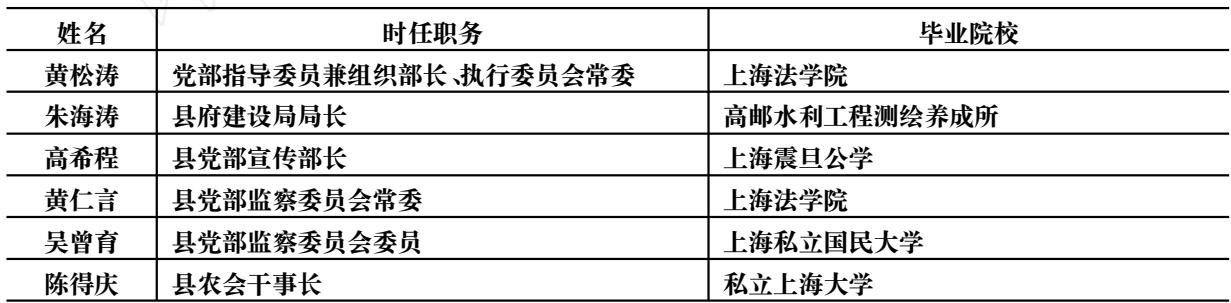
With the formal establishment of the first Executive and Supervisory Committee, a large number of intellectual youths who had just left school quickly entered the Gaoyou Party Headquarters, and young cadres began to take charge of party affairs throughout the county (see the table below). These individuals displayed the radical style characteristic of young people. Through their efforts, the work of the Gaoyou Party Headquarters quickly improved, receiving an "Excellent" rating in the Provincial Party Headquarters' propaganda assessment for 1929, with its ranking in the assessment jumping significantly to fifth place in the province. Encouraged by this, the political attitude of the County Party Headquarters became increasingly radical. Party cadres were no longer satisfied with daily party affairs but hoped to "accomplish some great things" locally. Undoubtedly, this inevitably laid the groundwork for the subsequent launch of the "Beating the City God" movement.
Educational Background of Key Cadres in the County Party Headquarters during the "Beating the City God" Uproar
Name | Position at the Time | Alma Mater
Huang Songtao | Member of the Party Headquarters Guidance Committee and Head of the Organization Department, Standing Member of the Executive Committee | Shanghai Law School
Zhu Haitao | Director of the Construction Bureau of the County Government | Gaoyou Water Conservancy Engineering Surveying and Mapping Training Institute
Gao Xicheng | Head of the Propaganda Department of the County Party Headquarters | Shanghai Aurora Public School
Huang Renyan | Standing Member of the Supervisory Committee of the County Party Headquarters | Shanghai Law School
Wu Zengyu | Member of the Supervisory Committee of the County Party Headquarters | Shanghai Private National University
Chen Deqing | Secretary-General of the County Farmers' Association | Private Shanghai University
Source: Huang Songtao, "Beating the City God," Gaoyou Cultural and Historical Materials, Vol. 2, compiled and printed by the Gaoyou Cultural and Historical Materials Committee, 1985; see also Investigation Table on the Evolution of Party Affairs in Gaoyou County (1930), Jiangsu Provincial Archives, 1/3/677/1.
[1] In early 1926, a secret Kuomintang organization had already been established in Gaoyou, with members mostly being left-wing elements within the party or those with backgrounds in the Chinese Communist Party. However, after the "Purging of Communists," the Provincial Party Headquarters no longer recognized its legitimacy and instead dispatched special personnel to reorganize the Party Headquarters Preparation Committee. See Gaoyou County Gazetteer (compiled by the Gaoyou County Leading Group for Compiling History and Local Chronicles, Jiangsu People's Publishing House, 1990 edition), pp.
[2] 437–438, and Cui Xilin, "The First Kuomintang Party Headquarters in Gaoyou County" (Gaoyou Cultural and Historical Materials, Vol. 1, compiled and printed by the Gaoyou Cultural and Historical Materials Committee, 1984), pp. 18–23. After the arrival of the Northern Expedition Army, the establishment of the Party Headquarters Preparation Committee was announced, presided over by Wu Yuan, a special envoy from the Provincial Party Headquarters. However, the committee quickly fell into serious division and was at odds with the County Government. Many former members of the Party Headquarters Preparation Committee left to join the County Government; there also emerged the awkward situation where former members of the County Party Headquarters' Special Committee refused to hand over work to the Provincial Party Headquarters' special envoy, making it difficult to launch party affairs for a long time. See Cui Xilin, "The First Kuomintang Party Headquarters in Gaoyou County" (Gaoyou Cultural and Historical Materials, Vol. 1), pp. 18–23.
[3] By early 1931, Gaoyou County had a total of 122 Kuomintang members, among whom 28 held university degrees, 51 had graduated from normal schools or specialized schools, 23 had graduated from middle schools, and 20 had other educational backgrounds. (Gaoyou County Gazetteer, p. 438) After the Party Purge, the personnel structure of the Kuomintang exhibited a tendency toward elitism, with most members belonging to the upper-middle social strata who possessed family assets and had received a good education. For related research, see Wang Qisheng, “The Organizational Transformation of the Kuomintang After the Party Purge” (Modern Chinese History Studies, Issue 5, 2003, pp. 38–39).
[4] “Comprehensive Assessment Table of Work Achievements of the Propaganda Departments of County Party Headquarters in Jiangsu Province from December of the 18th Year to March of the 19th Year,” Jiangsu Party Affairs Weekly, Issue 20, June 1, 1930, pp. 31–32.
The reason the Party Headquarters sought to “smash the City God” was primarily because the “City God” was the most important traditional belief in the locality, and various social resources had accumulated extensively in the City God Temple. For a long time, the people of Gaoyou, like most people in the Jiangsu and Zhejiang regions, maintained the traditional custom of “Parading the City God” during the Lantern Festival. During the procession, not only did all residents within the county town turn out, but farmers from surrounding villages also entered the town to “watch the City God parade.”1 After the Kuomintang came to power, voices criticizing such traditional religious activities increased day by day. Some Kuomintang members even attributed the long-standing “closed atmosphere and cultural backwardness” of the northern Jiangsu region to the local populace being “mostly dominated by divine authority,” with superstitious psychology remaining unbreakable in the area.2 Encouraged by such rhetoric, many Party Headquarters in the Jiangsu and Zhejiang regions became eager to try their hand, and “breaking superstition” gradually appeared on the agendas of various grassroots Party Headquarters. They no longer adhered strictly to the established policies of their superiors but proactively planned more radical actions. Huang Songtao, who was then an executive committee member of the Gaoyou Party Headquarters, recalled, “At that time, generally knowledgeable youths all thought like this: If the City God is not overthrown, when will it be? If the property of the City God Temple is not utilized, when will it be?”3 Consequently, the Party Headquarters began to urgently plan the temple closure action, and the prelude to “smashing the City God” was about to begin.
On February 17, 1931, the Party Headquarters of various counties in northern Jiangsu gathered in Yangzhou to hold a meeting on “Strengthening Propaganda and Breaking Bad Customs,” conveying instructions from the Central Propaganda Department of the Kuomintang, requiring county Party Headquarters to strengthen anti-superstition propaganda.4 Upon receiving this instruction, the Gaoyou County Party Headquarters immediately held an internal discussion meeting, intending to seize the opportunity to promote the anti-superstition movement in Gaoyou. Huang Songtao, the person in charge of the Party Headquarters and an executive committee member, called upon party members when conveying the spirit of the meeting: Everyone should change “propaganda” into “action” and strive to carry forward and promote the spirit of the anti-superstition movement.5 Huang Renyan, a supervisory committee member of the Party Headquarters, further declared: “Setting policies depends on the Central Government, while execution relies on the grassroots.”6 By the end of the meeting, the executive and supervisory committee members quickly reached a consensus, planning to “take advantage of this major propaganda campaign to adopt a lightning-style action, close the City God Temple in one go, and ensure its smooth completion.” Of course, the Party Headquarters’ actions would not be satisfied merely with the assertion of ideology; they also hoped to use the “temple closure action” to “reclaim temple property for public ownership and designate it as Party property,” and then actively promote “abolishing temples to promote industry,” establishing a development committee, and preparing to set up a new enterprise development company on the original site of the City God Temple to develop industry.7 To this end, the Party Headquarters formulated a specific handling plan: 1. The original farmland and all buildings and utensils of the City God Temple would be taken over by the development committee for use in launching enterprises; 2. Establish a new enterprise development company, accumulate capital, and seek commercial shares and private investment; 3. Based on the production conditions of local agricultural products and local specialties, grasp the raw material sources for the planned factories, open factories, and carry out production.8
On February 23, the seventh day of the first lunar month, while the people inside and outside Gaoyou county town were actively preparing for the Lantern Festival temple fair, the City God Temple was suddenly attacked by “a group of mysterious men.” Five or six people wearing Western-style suits and overcoats, holding ropes, knives, and axes, disregarded the attempts of the Taoist priests inside the temple to stop them, forcibly broke in, and “smashed all the statues of gods and Buddies to pieces.”9 After the incident, the entire city was greatly shocked, and people speculated about the origins of these attackers. It was not until the next day that the people learned from the newspapers that these “mysterious men” were actually the executive and supervisory committee members of the Gaoyou County Party Headquarters.
After the sudden attack on the City God Temple on February 23, the County Party Headquarters urgently convened a summary meeting of the anti-superstition movement attended by representatives of all county agencies and organizations. Zhu Haitao, the Director of the County Construction Bureau, and Wu Zengyu, a supervisory committee member of the County Party Headquarters, successively introduced the course of the “smashing the City God” action that morning.
[1] The scene during the procession was historically unprecedented in scale locally: The City God deity was first moved from the rear palace to the front hall, after which 24 salutes were fired, and bells and drums rang out together in the main hall. At noon, after the offerings were completed, amidst the sounds of bells, drums, and shouting, eight porters dressed as yamen runners formally carried the statue of the City God out on patrol. Along the patrol route, gongs and drums thundered, silk and bamboo instruments played in unison, and the entire city was decorated with lanterns and colorful streamers. In the evening, a fleet of decorated lantern boats would also be organized to escort the “Immortal Boat” to continue patrolling the surrounding waterways. The entire “Parading the City God” activity generally did not gradually end until the second watch of the night. Similar folk customs were relatively common throughout the Jiangnan region, often presided over by local officials during the Ming and Qing dynasties. After the establishment of the Republic of China, the government no longer organized it, and it was taken over by the private sector.
[2, 3, 4] Edited by the Rural Revival Committee of the Executive Yuan: Report on Rural Surveys in Jiangsu, Commercial Press, 1934 edition, p. 76. Huang Songtao: “Smashing the City God,” Gaoyou Cultural and Historical Materials, Issue 2, p. 40. “Local Correspondence—Yangzhou,” Shen Bao, February 2, 1931, p. 7.
[5] Such rhetoric was very common among the Party Headquarters in northern Jiangsu, and many grassroots organizations had shouted similar slogans. In the Zhenjiang region, adjacent to Gaoyou, the local county Party Headquarters had also submitted a memorial, accusing “superstition and supernatural beliefs” of affecting the revolutionary spirit and hindering the country’s modernization, and advocating for “more effective actions.” See “Superstitious Supernatural Films,” Xin Jiangsu Bao, 22 March 1931,
p. 6.
[6, 7] Huang Songtao: “Smashing the City God,” Gaoyou Cultural and Historical Materials, Issue 2, pp. 41–42. Zhu Lin: “Smashing the City God in County G,” Xin Jiangsu Bao, March 24, 1931, p. 7. It is worth noting that this article adopted a method of concealing real names, but based on the events described in the text, which match the Gaoyou “Smashing the City God” incident in every detail, we can conclude that the so-called “County G” is Gaoyou.
[8, 9] Huang Songtao: “Smashing the City God,” Gaoyou Cultural and Historical Materials, Issue 2, p. 41. “Local Correspondence—Gaoyou: Idols Smashed at the City God Temple,” Shen Bao, February 26, 1931, p. 9.
as well as past experiences of anti-superstition movements in neighboring counties.1 Subsequently, other committee members spoke in succession to mobilize, requiring the representatives to actively support the Party Headquarters and implement the revolutionary creed of anti-superstition. For a time, the crowd inside and outside the venue was excited, and the party members present were eager to act, expressing one after another: “We are willing to immediately depart for the City God Temple, smash all the statues, close the temple gates, abolish the temple to build a factory, and use temple property to promote education.”2 Consequently, the meeting immediately decided to print notices and seals, and the County Party Headquarters planned to post the “Letter to the People of Gaoyou” to elucidate the great significance of breaking superstition.
The following morning, cadres of the county Party headquarters led the representatives once again to the City God Temple to 'beat the City God,' intending to completely destroy it. Along the way, they shouted slogans. When passing various schools in the county seat, some teachers led students to join the Party members, and they proceeded together to the City God Temple.3 However, on the other hand, the Party headquarters failed to mobilize many people; the actual number of people who went to the City God Temple was small. Most residents stayed behind closed doors and offered no positive response. In the end, fewer than one hundred people arrived at the City God Temple, forcing the Party headquarters to spend money hiring laborers to help complete the destruction.4 After finding a group of helpers, everyone together pulled down all twenty-four statues of gods and Buddhas and threw them into the river behind the temple. Before leaving, the Party cadres ordered the Daoist priest Hua Kaidi and others at the City God Temple to continue guarding the temple property but to cease all superstitious activities and await further arrangements.5 Finally, the Party members posted the county government's proclamation, seals, and the 'Open Letter to the People of Gaoyou,' the full text of which is as follows:
The City God Temple is the stronghold of superstition in Gaoyou! It concentratedly expresses the reactionary ideological consciousness of the feudal dynasty! Under its influence, everyone has been branded with the mark of feudalism!
It uses clay and wooden puppets to propagate tales of gods and ghosts, claiming that everyone is guilty and deserves punishment by saws, axes, and halberds! This makes everyone tremble in fear before feudal rule, unable to rest easy for a single day, and shackled by feudal chains.
Now that the Republic has been established for over a decade, how can the City God Temple, representing the feudal dynasty, still be active, spreading superstitious legends, playing tricks with gods and ghosts, and continuing to use this spiritual shackle to threaten, exploit, and deceive the people!
Now, obeying orders from the Central Government to thoroughly eradicate superstition, propaganda has been conducted for some time. Following a representative meeting of Party and government organs, organizations, and schools, everyone set out for the City God Temple today to destroy all idols, seal the temple gates, ensure that wooden puppets no longer claim to be gods and clay statues no longer act as ghosts, so that the people are no longer deceived, extorted, or frightened by them, forever freed from spiritual shackles, and sharing in the happiness of freedom and democracy!
After abolishing the temple, and through joint decision, in accordance with the principle of 'building factories on the site of the abolished temple and promoting education with temple property,' we will soon organize the County Temple Development Committee and the Gaoyou Emerging Enterprises Development Company to build a new Gaoyou. We aim to build Gaoyou into a brilliant, splendid, wealthy, and prosperous city in the near future! All people of Gaoyou should understand this intention well, make contributions, and jointly help fulfill this wish!6
Through this 'Open Letter to the People of Gaoyou,' a complete system of revolutionary discourse was constructed according to the laws of revolutionary ideology, thoroughly negating the symbolic function of popular beliefs in expressing religious emotions. Obviously, the legitimacy of the anti-superstition movement derived directly from the demands for modernization since the May Fourth Movement, but it was also mixed with the practical needs of grassroots power construction. For the Gaoyou Party headquarters, another significant meaning of 'eradicating superstition' lay in overthrowing traditional local authorities and replacing them with a brand-new revolutionary ideology. On the other hand, the Party headquarters also hoped to gain more social resources through the movement and strengthen its own power. But unexpectedly, 'beating the City God' not only attracted
[1] For example, in mid-February, Zhenjiang County also experienced an intense 'beating the City God' movement. The county Party headquarters demanded the abolition of the City God Temple and its conversion into a cultural and entertainment venue, but this proposal was quickly rejected by the Zhenjiang County Government and the higher-level Party headquarters. See 'Converting the City God Temple into a People's Entertainment Ground,' Xin Jiangsu Bao, February 12, 1931, page 5.
[2, 3] Huang Songtao: 'Beating the City God,' Gaoyou Cultural and Historical Materials, Vol. 2, p. 42. On the eve of 'beating the City God,' teachers from various schools in the county had held a strike and demonstration to demand unpaid wages, but the county government only promised to first pay back forty percent of the arrears. Seeing that the teachers were deeply resentful, the Party headquarters expressed support for the wage demands, using this opportunity to win over more teachers. For related details, see 'Local Correspondence—Gaoyou: County Town Teachers and Staff Demand Wages' (Shen Bao, February 14, 1931, page 9), 'Local Correspondence—Gaoyou: Education Sector's Wage Demands Reach a Stage' (Shen Bao, February 15, 1931, page 8), and 'Local Correspondence—Gaoyou: Massive Wage Demands by Urban and Rural Teachers and Staff' (Shen Bao, February 17, 1931, page 7).
[4] 'Local Correspondence—Gaoyou: Further News on the Destruction of City God Idols,' Shen Bao, February 27, 1931, page 9.
[5, 6] Huang Songtao: 'Beating the City God,' Gaoyou Cultural and Historical Materials, Vol. 2, pp. 39–40. Gaoyou County Gazetteer, p. 826.
the opposition of conservative forces among the populace, but also triggered a new round of conflict with the county government.
III. Respecting Old Customs: The County Government's Resistance
The Gaoyou County Government had opposed 'beating the City God' from the beginning. Although the county Party headquarters posted the county government's proclamation during the 'beating the City God' action, various indications show that this proclamation was issued by the county Party headquarters falsely in the name of the county government. First, at the time of the incident, County Magistrate Wang Long had returned to Wuhu to visit relatives and was not in Gaoyou; Secretary-General Qiang Tianjian was acting in his place. Qiang Tianjian had consistently opposed sealing the temple and was unlikely to issue such a notice in the name of the county government. Second, after the Party member representative meeting on the 24th, the Party members went directly to the City God Temple without previously holding a Party-government consultation meeting to inform the county government of the matter. Previously, the 'beating the City God' affair had always been secretly planned by a few core members of the Party headquarters, who had never informed any third party, so there was no possibility of prior notification to the county government.1
After this notice was posted, the county Party headquarters immediately submitted a detailed 'Temple Property Renovation Plan' to the county government. The plan roughly consisted of four items:
(1) Establish a Development Committee and a company to renovate the City God Temple and its affiliated Fire God Temple area, converting the front section into a commercial market, the middle section into a factory, and the rear section into a school; the commercial market will be contracted out to merchants. (2) The funds for the Development Committee will be included in the county government's fiscal budget and disbursed on time. Renovation costs will be financed by borrowing from banks with temple property as collateral. (3) Order the Daoist priests and spirit mediums originally in the City God Temple to return to secular life and be reorganized as workers for the Development Committee. (4) The ultimate goal is to achieve mechanization and electrification in industry, and mechanization, substitute farming, and water conservancy in agriculture.2 At the same time, the Party headquarters also demanded that the county government grant the 'Development Committee' maximum authority, enabling its jurisdiction to encompass production, commerce, agriculture, and cultural and educational undertakings.3
Faced with the Party headquarters' ambitious plan, the county government not only failed to express support but instead poured cold water on it. Acting County Magistrate Qiang Tianjian made excuses, stating: 'We must wait for County Magistrate Wang to return to Gaoyou and handle it himself,' refusing to approve the establishment of the Development Committee, and even admonishing Party members at all levels in the county to 'respect old customs.'4 Due to the lack of cooperation from the county government, the Gaoyou County Party headquarters could neither obtain the renovation budget nor directly mobilize various administrative resources within the county. Although the county Party headquarters repeatedly urged the county government to hold a Party-government consultation meeting and repeatedly wired Wang Long to return to Gaoyou as soon as possible to handle the temple property renovation affairs, rumors circulated that County Magistrate Wang deliberately stayed away because he disagreed with abolishing the temple, hoping to wait for the movement to collapse
5.
In addition to the county government's resistance to the renovation, prominent local figures also lined up on the side of the county government, expressing dissatisfaction with the temple closure. The gentry representative Yang Jinzhi actively contacted Buddhist and Taoist figures, such as Hua Kaidi, the Taoist abbot of the City God Temple, and Tieqiao, the chairman of the Gaoyou Buddhist Association, to explicitly oppose the closure. The gentry and religious representatives argued that the City God Temple was a cultural heritage site rather than merely a religious venue, and therefore the Party headquarters should not completely demolish it.6 They hoped to reopen the City God Temple as soon as possible under the guise of "protecting historical sites," and thus collectively petitioned the county government. Qiang Tianjian suggested that part of the City God Temple could be converted into a "Sun Yat-sen Memorial Hall," with the remaining parts conditionally reopened. However, the county Party headquarters quickly
[1] Gaoyou County Gazetteer, p. 827.
[2, 3] Huang Songtao, "Beating the City God," Gaoyou Cultural and Historical Materials, Vol. 2, p. 42. Such demands were relatively common among grassroots Party headquarters; for related discussions, see Wang Qisheng, "Party-Government Relations: The Operation of Kuomintang Party Rule at the Local Level (1927–1937)," Social Sciences in China, No. 3, 2001, pp. 187–203.
[4, 5] Huang Songtao, "Beating the City God," Gaoyou Cultural and Historical Materials, Vol. 2, p. 43. It is worth noting that at the time, the Civil Affairs Department of the Jiangsu Provincial Government was conducting performance reviews for the reappointment of county magistrates. Gaoyou, however, was embroiled in the "Beating the City God" controversy at this time. Wang Long, the county magistrate, naturally did not want to "get himself into trouble" and thereby affect his personal career prospects. After weighing the pros and cons, his choice to stay away and refuse to return home was reasonable. For specific details, see Zhu Lin, "Beating the City God in County G," New Jiangsu Daily, March 24, 1931, p. 7.
[6] Around 1930, Suzhou also experienced a series of disputes over the definitions of "historical sites" and "superstitious facilities." For related research, see Peter J. Carroll, Between Heaven and Modernity: Reconstructing Suzhou, 1895–1937 (Stanford University Press, 2006).
rejected this proposal, insisting on taking over all temple properties, and the first attempt at Party-government coordination broke down.1
This "Beating the City God" incident was not the first conflict between the Gaoyou County Government and the Party headquarters. Since its establishment, the Gaoyou Party headquarters had been in constant friction with the government. In modern northern Jiangsu, the land was poor and the people impoverished; the Gaoyou County finances had always been tight. The county government always minimized allocations for Party affairs whenever possible, so several terms of Party headquarters had already fallen out with the county government over Party budget issues. The most severe incident occurred in July and August 1929, when the county Party headquarters had a financial dispute with the then county magistrate Yang Yan. As a result, the county government angrily suspended funding, forcing the Party headquarters to temporarily relocate to Zhenjiang, the provincial capital, to operate, relying on subsidies from the provincial Party headquarters to barely survive. Only after Yang Yan left office was the county Party headquarters able to move back to Gaoyou.2
From a more macro perspective, it is not difficult to see that the chaotic conflicts between grassroots Party and government organs were quite widespread throughout northern Jiangsu and even the entire province of Jiangsu.3 In Jiangdu County, adjacent to Gaoyou, conflicts between the county Party headquarters and the county government also erupted repeatedly over Party budgets.4 Therefore, the active involvement of grassroots Kuomintang members in the temple closure campaign was driven not only by ideological factors but also by practical interests, namely the desire to seize more grassroots social resources. The widespread grassroots Party-government conflicts across Jiangsu also exposed two major weaknesses of the Kuomintang: the lack of an effective mechanism for managing grassroots Party members and the chaos in the ideological sphere.
In terms of management mechanisms, between 1926 and 1929, the total number of Kuomintang members rapidly expanded from 150,000 to 630,000. Among them, young Party members gradually became the "main force" of Party headquarters across the country, with large numbers of youths flooding into Party organs at all levels. Taking Jiangsu Province as an example, by 1931, there were 12,285 Kuomintang members, of whom young Party members under the age of 30 accounted for approximately sixty percent of the total.5 The existing Party management mechanisms were completely unable to cope with the rapidly expanding scale of Party membership, let alone manage it effectively. The Central Party Headquarters lacked the ability to control the behavior and ideology of grassroots Party headquarters. At the time, senior figures within the Kuomintang, such as Shao Yuanchong, lamented when discussing grassroots Party headquarters: "Friction between higher and lower-level Party headquarters is extremely severe, to the extent that other various forces take advantage of the situation to cause chaos."6
On the ideological level, after the "Purging of the Party," the young people who had joined the Kuomintang with "revolutionary passion" could neither continue to "make revolution" like the Communists nor were satisfied with the Kuomintang Central Committee's "turning back the clock." They often adopted a hypocritical attitude toward central directives, hoping to seize the opportunity to fulfill their "revolutionary ambitions" as much as possible. In grassroots Party headquarters where young Party members constituted the majority, this dissatisfaction with the status quo and independent, radical style was extremely common. They had just joined the Kuomintang with the revolutionary ideals of the Great Revolution period, only to immediately encounter the ideological shock of the "Purge of the Communists." The minds of grassroots Party members were filled with revolutionary passion, and this impulse continued in the ideological sphere with inertia. In addition, the huge ideological divisions within the Kuomintang also made it difficult for the Nanjing authorities to re-establish a highly appealing spiritual banner among grassroots Party members. American scholar Bradley K. Geisert pointed out that the ideological differences between local Party headquarters and the Nanjing side were the primary cause of their disagreements on specific policies.7
Faced with the fragmentation of Party organs, the Nanjing authorities, from the perspective of actual administrative efficiency, were more inclined to employ old administrative personnel from the Beiyang era and relatively steady and conservative grassroots government officials at all levels to implement and execute specific policies.8 Of course, this also involved considerations of real political interests. Wang Qisheng argues that it was precisely because Chiang Kai-shek feared the expansion of dissident forces within the Party at the grassroots level that he turned to rely on
[1, 2] Zhu Lin, "Beating the City God in County G," New Jiangsu Daily, March 24, 1931, p. 7. Gaoyou County Gazetteer, p. 442.
[3] For related discussions, see Li Julan, Anomie and Reconstruction: A Study on the Orderization of Local Regimes in Northern Jiangsu, 1927–1937 (PhD dissertation, Department of History, East China Normal University,
[4, 5, 6] 2005), pp. 101–123. Yang Gu, "What I Knew About the Factions of the Provincial and County Kuomintang," Jiangdu Cultural and Historical Materials, Vol. 2, Jiangdu Cultural and Historical Materials Committee, 1984 edition, pp. 16–17. Zhao Ruheng (ed.), Jiangsu Province Yearbook, New China Construction Society, 1934 edition, p. 55. Shao Yuanchong, Diary of Shao Yuanchong, Shanghai People's Publishing House, 1990 edition, pp. 472–473.
[7] Bradley Kent Geisert, “From Conflict to Quiescence: The Kuomintang, Party Factionalism and Local Elites in Jiangsu, 1927—31,” The China Quarterly, No. 108 (December, 1986), pp. 680—703. Lloyd Eastman offered a different perspective on this, arguing that the Kuomintang was not a disciplined revolutionary organization but rather a loose political alliance; the Kuomintang was more akin to a collection of different interest groups, lacking any top-down ideological indoctrination system in a subjective sense, and equally lacking a root of contradictions originating from ideology. See [US] Lloyd Eastman, The Abortive Revolution: China under Nationalist Rule, 1927—1937, translated by Chen Qianping et al., China Youth Publishing House, 1992 edition, pp. 12—13.
[8] See Wang Qisheng, “Party-Government Relations: The Operation of Kuomintang Party Rule at the Local Level (1927—1937),” Social Sciences in China, No. 3, 2001, p. 195.
The existing grassroots bureaucratic system attempted to achieve the goal of “controlling the party through politics.”¹ The “Temporary Measures on the Relationship between Party Headquarters at All Levels and Governments at the Same Level,” passed at the Fifth Session of the Second Central Committee of the Kuomintang, formally stipulated that party headquarters had no authority to interfere with governments at the same level; if they believed the government had made errors, they could only report to the higher-level party headquarters, which would then urge the government to handle the matter.² After this policy was introduced, local governments increasingly looked down upon the young party workers in the localities, regarding them as “naïve newcomers to society,” believing they had too little social experience, were ignorant of worldly affairs, lacked political knowledge, and were prone to unrealistic fantasies.³ Various demands and suggestions from grassroots party headquarters to the government were mostly rejected, or at best, perfunctorily addressed. At the Fourth Session of the Third Central Committee, the most heatedly discussed topic even became “reorganizing party affairs and abolishing institutions,” and the congress ultimately decided to shrink local party organizations and reduce the maintenance funds for grassroots party headquarters.⁴
It is not difficult to imagine that the contemptuous attitude of grassroots governments further intensified the hostility and resentment of grassroots party headquarters toward them. Under such a vicious cycle, grassroots party-government relations naturally deteriorated. Some party headquarters, which encountered obstacles everywhere at the grassroots level, even angrily denounced local governments as “remnants of warlords,” or accused them of “betraying the revolution,”⁵ and demanded the punishment of local officials who “opposed the revolution and suppressed the party headquarters”; they even accused the central government of cultivating “feudal forces” and admitting “remnants of the Beiyang clique” into governments at all levels.⁶ At the time, many grassroots party headquarters in Jiangsu believed that “the division between local party and government encouraged reactionary forces, caused the people to lose faith in the party, prevented the party from continuing to bear its revolutionary mission, and simultaneously shook the party’s foundation and undermined the revolutionary cause.”⁷
The Nanjing government’s vacillation and lack of clear direction on this series of issues accelerated the differentiation among different interest groups within the Kuomintang. This differentiation further stimulated grassroots party headquarters to frequently launch increasingly radical political movements in an attempt to achieve their goal of “the party leading the government,” causing various political issues to often devolve into political pretexts for grassroots power struggles. Thus, it was not surprising that party headquarters raised the banner of “breaking superstitions” to realize their “revolutionary ideals.” According to Huang Songtao, who was then an executive committee member of the Gaoyou party headquarters: members of the county party headquarters were all dissatisfied with the conservatism and reaction of the Kuomintang Central Committee, and all hoped to revitalize the true essence of the National Revolution through their own actions.⁸
However, the Gaoyou County Party Headquarters failed to realize that the county government possessed an inherent advantage in social mobilization and often received strong support from the populace. Consequently, movements such as “Smashing the City God” not only failed to steer grassroots movements in a direction favorable to the party headquarters, but instead revealed a certain “counter-movement” tendency across various social strata. Just ten days after the Gaoyou “Smashing the City God” incident occurred, it unexpectedly reached a reversal of fortune.
IV. Party-Government Relations during the Riot and the Failure of “Smashing the City God”
On February 27, the Gaoyou “Smashing the City God” uproar reached its most tense moment. Various anti-temple-abolition forces in Gaoyou, with the tacit consent of the county government, finally began their counterattack. That day, dozens of Daoist nuns gathered at the City God Temple and began parading through the streets of the city, shouting along the way: “The Bodhisattvas are in distress, why don’t you come out to save them!” At this time, farmers from surrounding villages were entering the city for market and incense offerings. Upon discovering that the county party headquarters had closed the City God Temple, and incited by the Daoist nuns, their dissatisfaction immediately surged. In moments, believers with agitated emotions gathered on all the streets of the county seat.
[1] For institutional studies on the local organizations of the Kuomintang during the Nanjing Government period, see respectively Wang Qisheng, Party Members, Party Power, and Party Struggles (Shanghai Bookstore Publishing House, 2003 edition); Wang Qisheng, “Party-Government Relations: The Operation of Kuomintang Party Rule at the Local Level (1927—1937)” (Social Sciences in China, No. 3, 2001); and Jiang Yongjing, “The Background and Setbacks of Implementing Political Tutelage in the Early Nanjing National Government—The Contest between Military Power, Party Power, and Civil Rights” (Modern Chinese History Studies, No. 5, 1993), among other studies.
[2, 3, 4, 5, 6] Edited by Rong Mengyuan, Materials on the National Congresses and Central Committee Plenums of the Chinese Kuomintang, Vol. 1, Guangming Daily Publishing House, 1985 edition, p. 757. Xiao Ming, “How to Eliminate Party-Government Disputes in Various Counties,” Jiangsu Party Affairs Weekly, No. 4, February 2, 1930, p. 23. Diary of Shao Yuanchong, pp. 675—676. “We Should Pay Attention to the Activities of Warlord Remnants,” Jiangsu Party Voice, No. 25, January 3, 1929, p. 9. “Provincial Party Headquarters Letter Requesting Provincial Government to Severely Punish Corrupt Officials,” Revolutionary Jiangsu, No. 3, November 1929, p. 13.
[7, 8] Jianbai, “The Division between Party and Government and Governing the Country by the Party,” Jiangsu Party Voice, No. 16, November 1, 1928, p. 5. Huang Songtao, “Smashing the City God,” Gaoyou Cultural and Historical Materials, Vol. 2, p. 41.
in large numbers. Led by Daoist priests and spirit mediums, nearly a thousand angry people marched to the county party headquarters with gongs and drums, threatening to smash it.¹ The people at the party headquarters had originally assumed that the people of Gaoyou were always law-abiding and would certainly not cause trouble, never expecting to incite a popular uprising. Upon learning of this, Propaganda Director Gao Xicheng and Administrative Officer Guan Zhizhi hurried back to the party headquarters, urgently organized personnel to set up defenses, and repeatedly warned the guards not to fire their guns easily, to prevent a popular uprising from erupting. Huang Songtao immediately went to the county government to consult with Qiang Tianjian on countermeasures, requesting the deployment of the county police force to suppress the unrest and maintain public order. The riot of Gaoyou believers had already taken on the appearance of an impending storm.
In fact, in many grassroots "Anti-Superstition Movements" in the Jiangsu and Zhejiang regions, violent incidents in which the populace resisted the Party Headquarters were not uncommon, and large-scale popular riots even occurred. For example, at the end of 1928, the Yancheng County Party Headquarters in Jiangsu sealed the "City God Temple" in one stroke, resulting in a large-scale popular riot. Angry farmers attacked the County Party Headquarters, the Education Bureau, the Public Security Bureau, and other agencies, even briefly threatening nearby areas.2 The following year, a similar incident erupted in Yongjia County, where the populace and monks, dissatisfied with the Party Headquarters' actions, stormed the Party Headquarters' assembly hall. "The unruly populace tore up the flags of the Party and the Nation, while the wicked monks slandered them as bandits."3 A similar popular riot also occurred in Suqian County, where the Party Headquarters and schools were besieged for several consecutive days. In Wuxian County, monks from the Xuanmiao Temple even sued the County Party Headquarters in court, protesting the County Party Headquarters' plan to demolish the Xuanmiao Temple.4 In Huaiyuan and Fuyang in Anhui, the "Abolition of Temples" nearly triggered riots among believers.5 In 1929, the "Dao Hui" (Sword Societies) in northern Jiangsu launched successive riots to resist the grassroots Party Headquarters' Anti-Superstition Movement, affecting several counties and forcing the government to mobilize large numbers of troops to suppress them one by one. In all the large-scale popular uprisings listed above, the Party Headquarters and schools invariably became targets of popular attacks. This was closely causally related to the role of the grassroots Party Headquarters as the "vanguard" in the Anti-Superstition Movement, and the situation in Gaoyou was no exception.
Despite the desperate pleas of the Gaoyou County Party Headquarters, Acting County Magistrate Qiang Tianjian rejected Huang Songtao's request. He believed that military force should not be lightly used to suppress popular unrest,6 arguing that the police force in Gaoyou County was too thin, with fewer than 120 officers under its command, and the number of members of the Defense Corps stationed outside the county seat was only 135, utterly insufficient to handle the large number of people. He further pointed out that if the police were deployed to suppress the unrest, it would trigger larger-scale conflicts, making the situation uncontrollable.7 When large crowds approached the County Party Headquarters, the County Police Team maintained a wait-and-see attitude, only reluctantly agreeing to set up guard posts because the County Party Headquarters and the County Government were adjacent. The populace gathered in front of the Party Headquarters, intimidated by the military and police, dared not directly storm it, and instead went to the private residences of the various Executive and Supervisory Committee members to continue causing trouble. As a result, the homes of several Party Headquarters cadres, including Huang Songtao, suffered varying degrees of vandalism and destruction, yet the County Government did not arrest any perpetrators, sitting by and watching the situation deteriorate.
On the afternoon of the 28th, large crowds of believers gathered at the City God Temple and re-erected the spirit tablets. Subsequently, many people re-entered the temple to burn incense, causing the surrounding streets to become extremely crowded. Thereafter, the devout men and women, led by the Dao Po (female Daoist practitioners), once again stormed the Party Headquarters and the residences of its members. In the ensuing chaos, large crowds "beat the Party Headquarters until it was in shambles, and beat the private residences of Party Committee members until the roof tiles flew high."8 Although the situation had evolved into violent conflict, the police remained on the sidelines regarding the popular riot, deploying cordon lines only around the County Government area. With nowhere to stay, the members of the Party Headquarters had no choice but to flee in disarray into the County Government for refuge. Helpless, Huang Songtao, without consulting Qiang Tianjian, directly sent an urgent telegram in the name of the County Party Headquarters to Zhang Zhijiang, the Jiangsu Pacification Superintendent, and Cheng Zhuang, the Commander of the Sixth District of the Provincial Security Force stationed in Guazhou, requesting troops to reinforce Gaoyou County seat and protect the Party Headquarters and Party members'
safety.9
The Party Headquarters' hasty request for external aid was partly because the rioting populace only attacked the various organs of the County Party Headquarters and Party members, and partly
[1, 2, 3] "Local Communications—Gaoyou: Detailed Account of the Great Riot of the Dao Po," Shen Bao, March 2, 1931, p. 8. "The Tragedy of the Yancheng Riot," Shen Bao, October 13, 1928, p. 10. "Report from the Executive Committee of the Yongjia County Branch to the Central Party Headquarters (July 30, 1927)," held in the Second Historical Archives of China, Archives on Jiangsu Provincial KMT Party and Government Personnel Reporting Opponents of the Party, 1/2/151.
[4, 5] "The Lawsuit Regarding the Demolition of Xuanmiao Temple in Wuxian (September 1930)," held in the Second Historical Archives of China, Archives on Temple Property Disputes in Jiangsu Province, 2/2/1058. "Local Communications—Huaiyuan," Shen Bao, January 8, 1929, p. 9.
[6, 7] Zhu Lin: "The Beating of the City God in County G," Xin Jiangsu Bao, March 24, 1931, p. 7. Yearbook of Internal Affairs (II), Commercial Press, 1936 edition, "Police Affairs Section" (C), pp. 100–103, 311.
[8, 9] Zhu Lin: "The Beating of the City God in County G," Xin Jiangsu Bao, March 24, 1931, p. 7. Huang Songtao: "Beating the City God," Gaoyou Cultural and Historical Materials, Vol. 2, p. 44.
more importantly, because the County Government refused to provide the Party Headquarters with necessary police protection. Since the Acting County Magistrate was unwilling to deploy the police for direct intervention, the Party Headquarters had no choice but to seek external aid for self-preservation. Upon receiving the telegram, Cheng Zhuang immediately dispatched a battalion of troops from Jieshou, rushing through the night to Gaoyou County seat, arriving in the early hours of the 29th. Battalion Commander Zhang Guifang told Huang Songtao: The Provincial Security Force is the loyal armed force of the Party! It will definitely protect Party property and Party members, and resolutely execute the orders of the Party Headquarters. Only after receiving this support did the Party Committee members dare to gradually leave the County Government and return to the Party Headquarters to resume work.1
Subsequently, the Provincial Security Force began patrolling within the county seat accompanied by Party Headquarters cadres, but the County Government insisted on not sending police to join them. Along the way, they frequently found devout men and women publicly cursing the Party Headquarters members who had led the temple-sealing action. Many spirit mediums, Daoist nuns, and commoners cursed the County Party Headquarters in front of the Confucian Temple west of the City God Temple. People placed tofu on the ground, chopping it with knives while saying: "Huang Songtao, may you be stabbed a thousand times, a thousand times over and still not enough!" "Huang Songtao scrapes gold off the Buddha's face!"2 Witnessing this scene, the Security Force immediately took action, forcibly dispersing the gathered crowd, re-guarding the City God Temple, and preventing any more believers from coming to burn incense and worship. Although the gathered populace was temporarily dispersed, a large number of people lingering in the county seat refused to leave, and the situation was far from settled.
Before one wave subsided, another arose. As the Lantern Festival approached, merchants in the county seat jointly launched a market strike to protest the temple sealing.3 It is noteworthy that behind the market strike, the shadow of the County Government could still be easily discerned. For example, Liu Jiansan, the leader of the Gaoyou Chamber of Commerce, personally went to the County Government to consult with Qiang Tianjian before organizing the strike, and it is not difficult to imagine that a private tacit understanding may have been reached between the two.4
On March 2, hundreds of people held placards and small flags, marching along the streets in protest and calling on shopkeepers to maintain the market strike. Patrol officers from the County Public Security Bureau maintained order along the streets, demanding that the march end quickly and shops resume business. This provoked popular dissatisfaction, and one patrol officer was beaten and injured by the unruly crowd. Strangely, however, the County Government maintained extreme restraint throughout, neither forcibly dispersing the marchers as the Security Force did, nor arresting anyone.5 Facing a situation bordering on riot, the County Government and the police maintained an unusually tolerant attitude, tacitly allowing the development of this popular "counter-movement" from beginning to end. Compared to the "magnanimity" of the County Government, the Party Headquarters and the Security Force treated the situation as if facing a great enemy, not only patrolling around the Party Headquarters with loaded guns but also frequently falling into severe standoffs with the dissatisfied populace.
In view of the tense situation in Gaoyou, Zhang Zhijiang, the Jiangsu Pacification Superintendent, had ordered Liang Guanying, the commander of the Huaiyang Sub-district, to intervene in the matter. Upon receiving this order, a unit of the 32nd Division under Liang Guanying’s command, led by Battalion Commander Zhao Changtai, was moved to Gaoyou. The intervention of local military forces in grassroots party-government and party-population disputes was extremely common at the time, and the military often played the role of “arbiter” in such local conflicts. For example, in 1929, the Party Headquarters in Huaiyuan County, Anhui, also launched a “Smash the City God” movement, which triggered a popular riot that “destroyed the Party Headquarters.” Gu Zhutong had dispatched troops to stop the unrest and conduct what was called “armed mediation.”6
It is worth noting that the troops dispatched by the Pacification Office and the provincial Security Corps belonged to different military command systems. The Security Corps was under the Provincial Government’s Security Department, while the troops under Liang Guanying’s command were regular army units under the jurisdiction of the Pacification Office. As early as mid-February, Zhang Zhijiang had issued a general order stating that all armed forces in Jiangsu counties should be unified under the Pacification District, and all armed forces should accept the command of the Pacification Office or the heads of the Pacification Districts. Generally speaking, as long as matters concerned “bandit suppression,” public security, and similar issues, the Pacification Office could take overall charge of military, administrative, and party affairs within the Pacification District. Local governments and Party Headquarters were expected to cooperate actively, and its actual status was higher than that of local governments at all levels. Therefore, Zhao Changtai, who was stationed in Gaoyou representing the Pacification District, naturally held the power to influence the local situation in Gaoyou.
power.
[1] “Local News—Gaoyou: The Popular Riot Case Continues,” Central Daily News, March 5, 1931, p. 9.
[2, 3] Huang Songtao, “Smash the City God,” Gaoyou Cultural and Historical Materials, Vol. 2, pp. 48–49. Merchants’ dissatisfaction with the “sealing of temples” also grew increasingly intense, as the Party Headquarters’ actions directly touched upon their commercial interests. On the eve of the temple fair, the Party Headquarters sealed the City God Temple, preventing the fair from being held normally, which naturally cut off the merchants’ source of income. In addition, the County Party Headquarters not only wanted to “Smash the City God” but also to “abolish temples and promote industry.” According to the Party Headquarters’ plan, relying on the confiscated temple properties, they would vigorously develop party-run industry and commerce. If the transformation succeeded, these emerging party-run industries and businesses would inevitably deal a huge blow to private industry and commerce. This was, of course, contrary to the merchants’ wishes, and a general strike became their way of protesting. See “Local Dispatch—Gaoyou: Detailed Account of the Daopo Riot,” Shen Bao, March 2, 1931, p. 8.
[4, 5, 6] Zhu Lin, “Smashing the City God in County G,” Xin Jiangsu Bao, March 24, 1931, p. 7. “Local News—Gaoyou: Daopo Orders Shops to Strike,” Shen Bao, March 5, 1931, p. 10. “Huaiyuan—Ignorant People Protect the City God, Opposing the Appointed Committee’s Overthrow of the City God Idol,” World Daily, January 24, 1929, p. 4.
The Security Corps and the regular army successively rushed to Gaoyou, resulting in the bizarre situation of “two armies in one place,” which inevitably led to the problem of how to coordinate between the two. When Zhao Changtai’s troops arrived in Gaoyou, Liu Jiansan, a representative of the Chamber of Commerce, and Yang Jinzhi, a leader of the local gentry, visited Zhao’s headquarters at the introduction of the county government, hoping to persuade Zhao Changtai to oppose the sealing of the temple or at least maintain strict neutrality. Zhao immediately stated that he also did not wish to see the situation escalate and agreed to mediate the matter.1 In fact, Zhao’s stance was not merely the personal opinion of a grassroots officer; to a large extent, it also followed the instructions of his superiors. On the eve of the “Smash the City God” frenzy, Liang Guanying had traveled to Nanjing to meet Chiang Kai-shek and was ordered to intensify bandit suppression and maintain social stability north of the Yangtze River. In late February, the Huaiyang Pacification District began concentrating forces to encircle and suppress roaming bandits wandering along the Jiangsu-Anhui border. At this time, bandit suppression and sweeps were the priority of the Pacification District’s work. If they had to divert attention to suppress popular uprisings, the military would certainly be unable to cope, and naturally, they hoped to avoid those un-
necessary troubles.
On the morning of the Lantern Festival, March 3, Zhao Changtai personally visited the County Party Headquarters to call on the cadres. He told Huang Songtao that all parties should quickly settle the matter and avoid escalating the conflict; the military’s task was only to stabilize the local tense situation, so it would not interfere in local self-governance affairs, nor would it express support for the Party Headquarters’ actions. He even warned Zhang Guifang that the Pacification Office held a higher status than the provincial Security Corps, and therefore hoped that the provincial Security Corps would take consistent action with him.3 The County Party Headquarters was greatly disappointed by Zhao’s stance and had no choice but to continue lobbying, hoping to gain the support and protection of the pacification troops. At noon that day, Huang Songtao and others, in the name of the Executive and Supervisory Council of the County Party Headquarters, hosted a banquet for the officers of Zhao Changtai’s and Zhang Guifang’s troops, attempting to persuade Zhao Changtai to change his attitude over drinks.
Just as the County Party Headquarters was trying its best to win over Zhao Changtai, the course of events took a dramatic turn—County Magistrate Wang Long quietly returned to Gaoyou on the night of March 3. He claimed to have brought back clear instructions from the Provincial Government and the Provincial Party Headquarters: (1) To stabilize local public security, the “Smash the City God” actions in all counties should be temporarily suspended; (2) In counties and townships where large-scale riots broke out, if the response was inadequate, the responsibility of party and government cadres should be investigated as appropriate; (3) The Provincial Party-Government Consultative Meeting had passed a resolution approving the proposal submitted by Provincial Civil Affairs Director Hu Puan to “stop large-scale temple sealings everywhere.”4 The background to Jiangsu Province’s issuance of this instruction was that Kuomintang veteran Dai Jitao had written a letter to Jiangsu Provincial Chairman Niu Yongjian (Dai’s brother-in-law), criticizing the provincial government for allowing the “Smash the City God” movement in northern Jiangsu to run rampant, asserting that the matter was definitely related to the Chinese Communist Party, and demanding that the propaganda and implementation of eliminating superstitions be suspended as soon as possible.5 On March 11, the Jiangsu Provincial Government held a meeting, criticizing the local authorities for poor handling that led to popular unrest, and demanding that the incident be quelled as quickly as possible for follow-up arrangements.6 The Provincial Party Headquarters also immediately issued a similar directive, with an especially cautious attitude, demanding that the “Anti-Superstition Movement” currently underway in various parts of northern Jiangsu be immediately halted.
After Wang Long returned to Gaoyou, he followed the provincial government’s directive and immediately began negotiations with all parties to quell the turmoil. He promised the Daopo nuns and the public at the City God Temple: “The issue of rebuilding the City God Temple is already being communicated and handled with superiors, and shops in the city should also reopen as soon as possible.”7 Subsequently, under the county government’s mediation, the Party Headquarters also began consultations with the City God Temple side. The Party Headquarters demanded that the front hall of the City God Temple be converted into the “Zhongshan Shrine,” while the rear hall would be retained as the City God Temple.8 However, this proposal was firmly opposed by the City God Temple side, and the County Party Headquarters ultimately had to completely abandon all previous claims. Thus, the City God Temple was ultimately fully preserved and returned to the management of the Taoist priests within the temple.9 The Security Battalion under Zhang Guifang’s command was [ordered to withdraw/removed] by the Provincial Security Department
[1, 2] Huang Songtao, “Smash the City God,” Gaoyou Cultural and Historical Materials, Vol. 2, p. 45. “Liang Guanying Arrived in Nanjing Yesterday,” Central Daily News, February 19, 1931, p. 4.
[3, 4] Huang Songtao, “Smash the City God,” Gaoyou Cultural and Historical Materials, Vol. 2, p. 45. “Minutes of the 381st Meeting (March 18, 1931),” Jiangsu Provincial Archives, Minutes of the Jiangsu Provincial Government Committee Meetings, 100/Yi/716; Huang Songtao, “Smash the City God,” Gaoyou Cultural and Historical Materials, Vol. 2, p. 44.
[5] Huang Songtao, “Smashing the City God,” Gaoyou Cultural and Historical Materials, Vol. 2, pp. 44–45. Generally speaking, when party-government disputes occurred at the local grassroots level, the Kuomintang’s central authorities or provincial party headquarters would mostly advise grassroots party branches to restrain their radical actions and warn them to avoid interfering in local administration. In other words, they neither provided support for party affairs nor established a legal-institutional framework of “governing administration through the party” at the grassroots level. See Wang Qisheng, “Party-Government Relations: The Operation of Kuomintang Party Rule at the Local Level (1927–1937),” Social Sciences in China, No. 3 (2001),
p. 196.
[6, 7, 8, 9] “Minutes of the 380th Meeting (March 11, 1931),” Jiangsu Provincial Archives, Minutes of the Jiangsu Provincial Government Committee Meetings, 100/Yi/716. “Local Correspondence—Gaoyou: Daoist Nuns Petition the County Government,” Shen Bao, March 6, 1931, p. 9. “Local Correspondence—Gaoyou: The Uproar over Smashing the Idols in the City God Temple Has Been Resolved,” Shen Bao, March 8, 1931, p. 11. “Local Correspondence—Gaoyou: New Twists in the Uproar over Smashing the City God Temple,” Shen Bao, March 9, 1931, p. 10.
were recalled, leaving only Zhao Changtai’s troops. The county party headquarters lost its “loyal armed forces” to rely on, was powerless to “continue the revolution,” and had to let events take their course.1 With the support of numerous local gentry and commoners, the Daoist nuns of the City God Temple collected funds door-to-door within the city walls and immediately began restoration work.2 Within just one year, the number of people participating in the temple’s repair reached ten thousand. By the Lantern Festival of the following year, the City God Temple had reopened, and the scene was as lively as ever.3
V. Concluding Remarks
The “Smashing the City God” incident in Gaoyou appears to be a simple event of folk belief, but behind it, researchers can discern a structural conflict of grassroots party-government power during the early period of the Nanjing National Government. Throughout the entire uproar, the City God Temple became the intersection of various ideologies and real-world interests. During the “Smashing the City God” uproar, both the county party headquarters and the county government attempted to use this event to strike at and weaken each other. Although this covert grassroots party-government confrontation was hidden behind other social events such as the preservation or abolition of traditional beliefs, compared to those overt party-government confrontations, this type of engagement conducted through social events also had a decisive impact on the actual state of grassroots politics.
For the county government, its interest lay in maintaining the status quo and striving to exclude the party headquarters from the existing circle of grassroots power. Therefore, it inevitably opposed any actions that challenged the traditional social structure and religious customs; resisting the “Smashing the City God” campaign was a natural consequence. Throughout the entire uproar, it was the tacit approval of the county government that played the decisive role. Figures such as Qiang Tianjian and Wang Long exerted their influence from the shadows, watching the development of events, and sought to curb the development of the party headquarters by tolerating riots by forces opposed to closing the temple.
What benefits could the party headquarters gain from abolishing the temple? We can perhaps understand this through the following two aspects. First, the party headquarters’ “Smashing the City God” campaign was intended to fulfill ideological demands. As soon as the grassroots party headquarters, as a “revolutionary organ,” appeared, it viewed the traditional governance model as a compromise by local governments with “folk superstition” and was thus eager to eradicate it.4 Second, behind the Gaoyou party headquarters’ active promotion of “abolishing temples to promote industry” and “abolishing temples to promote education,” there were extremely pragmatic considerations of interest. In fact, in the Gaoyou turmoil, this interest-based consideration may have even played a decisive role. As an external organ, the party headquarters had very scarce social and economic resources to utilize locally. The county party budget relied entirely on provision by the county government, lacking economic autonomy. Therefore, the party headquarters naturally hoped to secure more practical benefits for itself through “Smashing the City God.”
Through the case analysis of Gaoyou, it is not difficult to find that the basis for the actions of grassroots Kuomintang members did not come entirely from policy directives from above, but rather from interpreting the so-called “Campaign to Eliminate Superstition” according to their own political needs, even openly defying central directives. For them, the immediate, concrete, and realistic grassroots situation was more worthy of attention and more worthy of risky attempts than macro-level, long-term political trends. At the ideological level, they regarded slogans such as “eliminating superstition,” “abolishing temples to promote industry,” and “abolishing temples to promote education” as self-evident revolutionary truths; in specific movements, they expected social mobilization where one call would be answered by a hundred. However, this radical action, detached from reality, lacked a necessary foundation of public opinion and often fell into a severe disconnect between ideology and actual implementation. As Philip C. C. Huang pointed out when discussing the construction of the Kuomintang’s grassroots regime: in the process of modernization, state concepts gradually became separated from folk customs, yet the former was often nominally built upon the latter.5
Despite the party headquarters’ utmost efforts, it failed to overthrow old customs and superstitions; instead, it lost its legitimacy at the grassroots level, even becoming the target of attacks by believers and various social forces, leading to its complete failure in its contest with the county government. The “Smashing the City God” movement ultimately evolved into a “Smashing the
[1, 2, 3] Zhu Lin, “Smashing the City God in G County,” Xin Jiangsu Bao, March 24, 1931, p. 7. “Local News—Gaoyou: The Case of Popular Riot Continues,” Central Daily News, March 5, 1931, p. 9. Gaoyou County Gazetteer, p. 710; Yangzhou Cultural and Historical Materials Committee (ed.), Yangzhou Cultural and Historical Materials, Vol. 19, Jiangsu Ancient Books Publishing House, 1999 edition, p. 233.
[4] Bradley Kent Geisert, “From Conflict to Quiescence: The Kuomintang, Party Factionalism and Local Elites in Jiangsu, 1927—31,” The China Quarterly, No. 108 (December 1986), pp. 680–703.
[5] Philip C. C. Huang, Code, Custom, and Legal Practice in China: The Qing and the Republic Compared, Shanghai Bookstore Publishing House, 2003 Chinese edition, p. 188.
Party Members” movement. After this incident, facing mounting external pressure, internal contradictions arose within the county party headquarters, which was even on the verge of disintegration; party affairs development stagnated, and morale collapsed. When the county executive and supervisory committees were re-elected in 1932, the party headquarters members split into the “Shanghai faction” (those who joined the Kuomintang in Shanghai) and the “Local faction” (those who joined the Kuomintang in Gaoyou later), with the two sides locked in dispute. Upon learning of this, the provincial party headquarters had no choice but to temporarily establish a Gaoyou County Party Affairs Reorganization Committee. When the Fourth Gaoyou County Congress of the Kuomintang was convened in 1933, the number of party members had dropped from 122 in 1931 to 106.1
The outbreak of the “Smashing the City God” movement in Gaoyou was the result of grassroots political maneuvering, and the “Campaign to Eliminate Superstition” became a political tool for contending for power. In order to compete for resources and demonstrate their political stance, grassroots party headquarters were willing to wage war against the traditional social order. This was not an active plan to impose “revolutionary consciousness” from top to bottom, but rather an external manifestation of changes in the grassroots political landscape. The struggle between the interests of the party and government in Gaoyou was projected onto the picture of the faith dispute in Gaoyou’s “Smashing the City God.” However, as had already happened in many other places, once the radical political movements of grassroots Kuomintang members expanded to the social level, they were difficult to escape from ending with a bang but a whimper.
[Author: Sha Qingqing, Assistant Researcher at the Information Consulting and Research Center, Shanghai Library; Supervisor: Feng Xiaocai, Professor in the Department of History, Fudan University. Shanghai, 200031. qqsha@libnet.sh.cn]
(Responsible Editor: Xie Wei)
[1] Gaoyou County Gazetteer, p. 442.