
Preface to the Traditional Chinese Edition of Friend or Foe?
《敌友难辨》繁体版自序
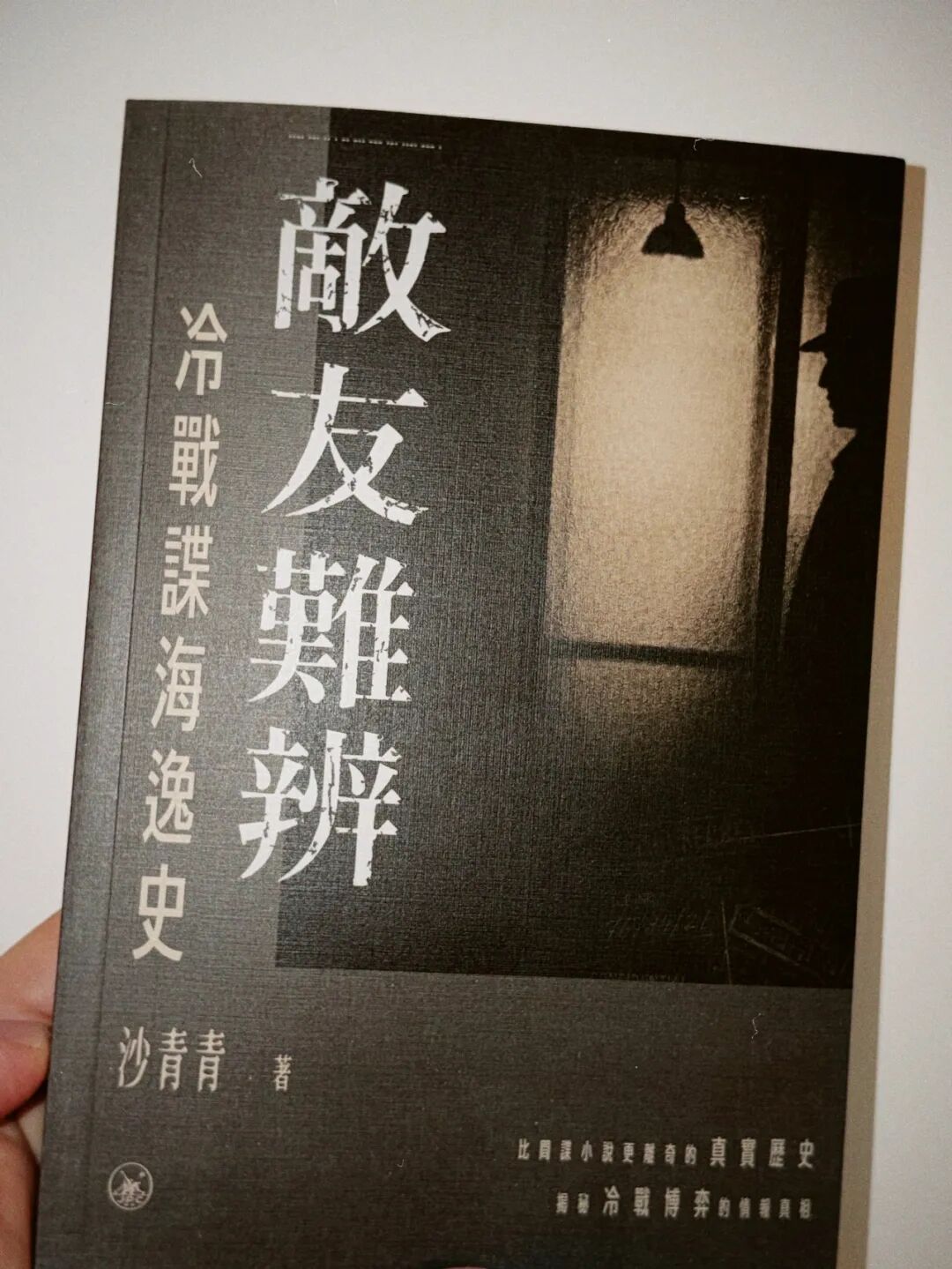
The Traditional Chinese edition of Friend or Foe?: Untold Stories of Cold War Espionage has recently been published by Joint Publishing (Hong Kong) Co., Ltd.
The following is the preface to the Traditional Chinese edition, provided for reference.
When facing any spy story, people always look forward to the process of revelation. They want to know who the real traitor or undercover agent is; which file holds the final answer; whether a seemingly mediocre bureaucrat has actually been working for another country for years. The allure of these spy stories lies precisely in the belief that behind the known "surface world," there exists a "hidden world" supported by codes, aliases, secret meetings, and internal reports. As long as one finds the key, everything might be rearranged.
However, these spy stories often begin with revelation, and are most prone to distortion during the process of revelation.
In the history of the Cold War, intelligence history has never been a simple game of revelation. What it leaves behind is not a straight line leading to the truth, but a series of tortuous and interconnected questions: How is loyalty defined? How is betrayal defended? How do intelligence agencies protect the state, and how do they protect their own reputations? Is a person’s account of their own past testimony, memory, confession, or yet another carefully arranged performance? These questions sometimes appear in archives, sometimes on the front pages of newspapers, and are sometimes repackaged by novels, memoirs, plays, and interviews.
I am very pleased that the Traditional Chinese edition of Friend or Foe? has been successfully published. For the author, this is naturally a rare affirmation.
The entry point of this book is the controversy sparked by Peter Wright’s publication of Spycatcher in 1987. Wright had worked for MI5 for many years, but after retirement, he claimed in his memoirs that former MI5 Director-General Roger Hollis might have been a Soviet "mole" lurking within the core of British intelligence. Such an accusation was certainly enough to cause a sensation. If the highest official of a counter-intelligence agency was himself a foreign spy, then what was damaged was not just one person’s reputation, but the legitimacy of the entire system. The exploration, review, and speculation surrounding this event will serve as a thread running through this book. What this spy mystery truly reveals may not be the guilt or innocence of a specific individual, but a certain structural dilemma of the Cold War intelligence world itself: the more secrets there are, the less certainty there is; the greater the suspicion, the more eager the institution is to maintain its own dignity.
I hope readers will view this book as an organization of pathways through Cold War intelligence history, rather than merely a collection of bizarre spy tales. Here there are defections, betrayals, wiretaps, nuclear crises, and long-unrevealed secrets, but what they truly point to is a fundamental predicament in international politics of the latter half of the twentieth century: enemies and friends cannot always be distinguished by camps, passports, or public identities; institutions believe they control secrets, yet are often dominated by those secrets in return; individuals believe they serve their beliefs, but in the end may simply be swept along by larger state machines, bureaucratic logic, and historical currents.
Of course, this is not an advocacy of historical relativism, nor does it imply that all positions can cancel each other out. On the contrary, the more one faces research on intelligence history, which is inherently dramatic, the more necessary it is to place judgments of position back into their historical context.
Furthermore, intelligence history is always filled with all kinds of fascinating stories, but fascinating stories are often the most dangerous traps. As John le Carré said: "If you want to keep a secret, make it a story."
In comparison, I am more inclined to believe in a limited "truth": it may not be complete, may not be satisfying, and may even raise more new questions, but it at least requires us to first see where the materials come from, and what doubts and limitations they have, before making judgments.
If readers still feel confused after finishing this book, this is not necessarily a regret.
In fact, if this allows one to see the hidden lines left by spies of the Cold War era, to see how intelligence agencies of various countries wavered between defending the nation and defending their own reputations, and to see how novels, memoirs, archives, and news reports jointly shaped our imagination of that era, then the modest purpose of this book has been achieved.
Sha Qingqing
May 2026
In Xuhui, Shanghai