
The Sorge Affair, Eighty Years Later
《佐尔格事件:八十年后的真相》
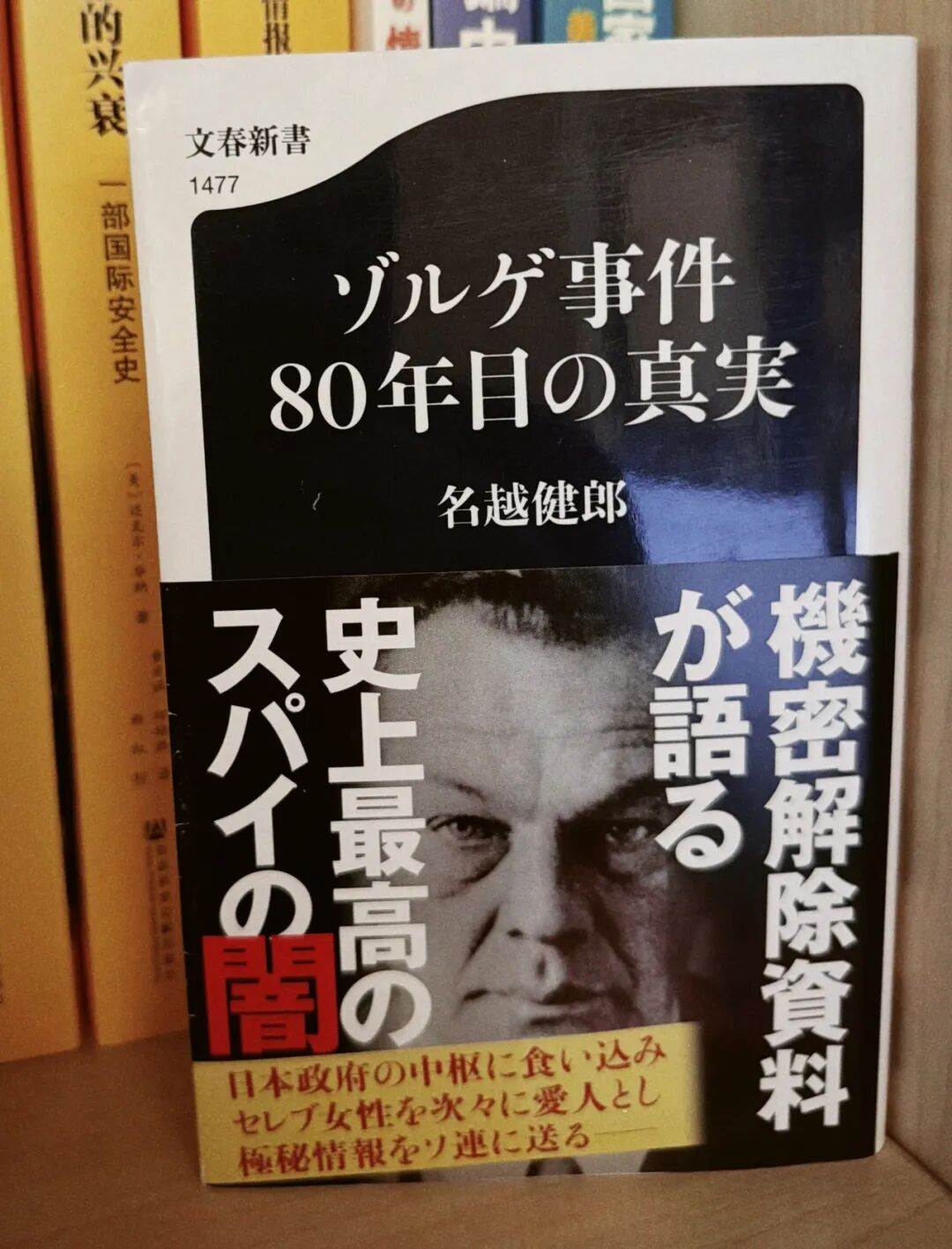
Koshiro Nago, The Truth of the Sorge Affair: 80 Years Later, Bungei Shunju Shinsho, November 2024
As the title suggests, this is a research work marking the eightieth anniversary of Sorge's execution. The story of Richard Sorge has never lacked drama. However, this book does not intend to retell how Sorge became a legend, but rather attempts to pull him out of the legend and place him back among telegrams, letters, headquarters directives, and interrogation records. In other words, the book is concerned not with how a genius spy single-handedly changed the war, but with how an intelligence officer was dispatched by his organization, how he built a network, how he sent back intelligence, and how he was suspected and shelved by Moscow.
Postwar understanding of the Sorge Affair has long been shaped by several narratives originating from Japan. Ozaki Hotsumi's letters from prison imbued the case with a strong sense of idealism and martyrdom; the memoirs, interrogations, and trial materials collected in Sources of Modern History provided the basic framework for empirical research; and the GHQ's reinvestigation of the case placed it back within the framework of "Red Spy" cases in the early Cold War. Thus, Sorge could be viewed on one hand as an anti-fascist hero, and on the other as a symbol of Soviet conspiracy. These two images do not conflict; they are merely differences in stance, yet both rely on materials and memories from the Japanese side.
This book utilizes materials recently declassified and compiled by the Russian side, especially research by Alekseev and others concerning GRU archives, telegrams, letters, and Moscow's decision-making. Starting from these materials, Sorge is no longer just a suspect in Japanese police files, nor merely a martyr in postwar memory, but is placed back within the Soviet military intelligence system. This internal perspective is not romantic in itself, but it is closer to intelligence history.
When Sorge arrived in Shanghai in 1930, he was not a foreign adventurer wandering around on personal charm. He was dispatched to China by the Fourth Department of the Red Army, the predecessor of the GRU system, with the mission of establishing a network to transmit intelligence to Moscow. His identity as a journalist, the German consulate, the German military advisory group, Agnes Smedley's introductions, the translation and recruitment work of Chinese assistants, Ozaki Hotsumi's Japan line, and Clausen's radio communications—these factors combined to form the basic structure of Sorge's Shanghai period.
Popular narratives often like to emphasize Sorge's judgment, courage, and personal charm, as if secret intelligence activities were primarily accomplished by the genius of one individual. However, judging from the materials presented in this book, Sorge was more like an organizational node. Being a node does not mean he was unimportant, but rather that his value can only be clearly seen when placed within the organizational network. He needed a public identity as cover, translators and local assistants to enter the Chinese-speaking environment, figures like Agnes Smedley to open up networks of left-wing expatriates and Chinese contacts, Ozaki to explain Japanese politics and military trends, and radio technology to send intelligence out of Shanghai and Tokyo. Without these, the so-called legend would be impossible.
This book also does not portray Moscow as an omniscient intelligence hub. On the contrary, Russian materials show that there was always tension between headquarters and Sorge. Moscow needed his intelligence but did not always trust him; it acknowledged his usefulness yet suspected he might lose control; it required him to build a network but constantly pressured him regarding funds, personnel, and information quality. This relationship is far more complex and truthful than the narrative of "a hero sending warnings back to the motherland." Intelligence does not automatically become decision-making once sent. It must undergo reception, translation, analysis, and may even be shelved or regarded as suspicious material.
Sorge did indeed warn multiple times that Germany would attack the Soviet Union, and he continuously tracked the possibility of Japan's southward expansion and the breakdown of US-Japan negotiations. His intelligence was important, and some of his judgments were quite accurate. But as this book states, warnings about the outbreak of war between Germany and the Soviet Union did not come solely from Sorge; Moscow also received information from other channels; Sorge's judgments on the date of the war's outbreak changed multiple times; some of his telegrams never reached the highest levels of leadership, and military intelligence headquarters were half-skeptical about certain contents. Considering the fate of Sorge's former superior, Berzin, all of the above is not difficult to understand.
For a considerable period after the war, Sorge's identity and deeds were long neglected in the Soviet Union. Relevant circumstances only gradually became known after Stalin's death. It was not until 1964 that Moscow posthumously awarded Sorge the title of "Hero of the Soviet Union." Of course, in addition to being "unbanned" within the Soviet Union itself, the anti-communist narrative of Cold War America also amplified the international visibility of this case. At the time, many American anti-communists viewed the "Sorge Affair" as material proving the threat of communist infiltration and incorporated it into McCarthyist political narratives.
The author of this book, Koshiro Nago, is an expert on Russian affairs in Japan and formerly served as the head of the Jiji Press bureau in Moscow. He keenly noticed that in recent years, Russia seems to have experienced a resurgence of interest in researching Sorge: Sorge is both an intelligence hero and an anti-fascist hero; he can connect to memories of the Soviet victory and also provide a template for a glorious historical narrative for the current Russian government.
In this sense, Sorge's greatest impact on history may have occurred precisely after his death. Postwar Japanese leftists placed him and Ozaki Hotsumi within memories of anti-war and democratization; Western countries such as the United States during the Cold War borrowed him to exaggerate the threat of "Red spies"; the Soviet Union shaped him into an intelligence hero of loyal dedication; and today's Russia has reconnected him to anti-Western state propaganda.