What Did Special Branch Actually Do?
Special Branch 究竟是干嘛的
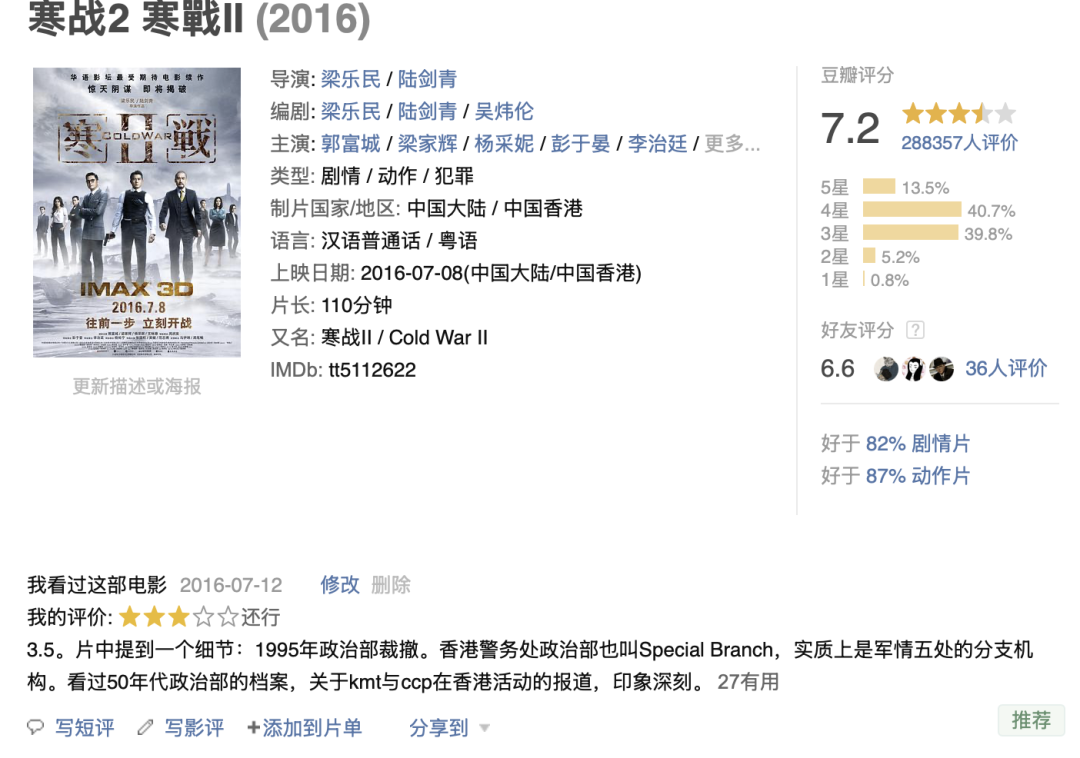
Ten years ago, after watching Cold War II, I left a brief review on Douban:
"3.5. The film mentions a detail: the disbandment of the Political Branch in 1995. The Political Branch of the Hong Kong Police Force was also known as the Special Branch, which was essentially a branch of MI5. Having read archives from the Political Branch dating back to the 1950s, I was deeply impressed by the reports on the activities of the KMT and the CCP in Hong Kong."
Ten years later, Cold War 1994 indeed still revolves around the 'Political Branch' (Special Branch). As for the film itself, I would probably still give it a rating of 'acceptable'.
However, this prequel somewhat overstates the British, or perhaps MI5 or MI6.
Furthermore, the historical 'Political Branch' (Special Branch) differs significantly from its portrayal in the film.
Years ago, I had the opportunity to read a batch of historical archives from the 'Political Branch' (Special Branch) of the Hong Kong Police Force under British rule, held at the UK National Archives, primarily covering the 1950s.
Therefore, I would like to take this opportunity to briefly discuss the history of the 'Special Branch'.
The so-called 'Special Branch', translated as 'Political Branch' in the Hong Kong context, was not a unique feature of the 'British Hong Kong era', but rather a 'traditional practice' of the British Empire for domestic political security.
In the British mainland, in colonies such as Singapore, India, and Hong Kong, and even in the police departments of the Shanghai International Settlement, 'Special Branches' were established, which can also be translated as 'Special Departments'.
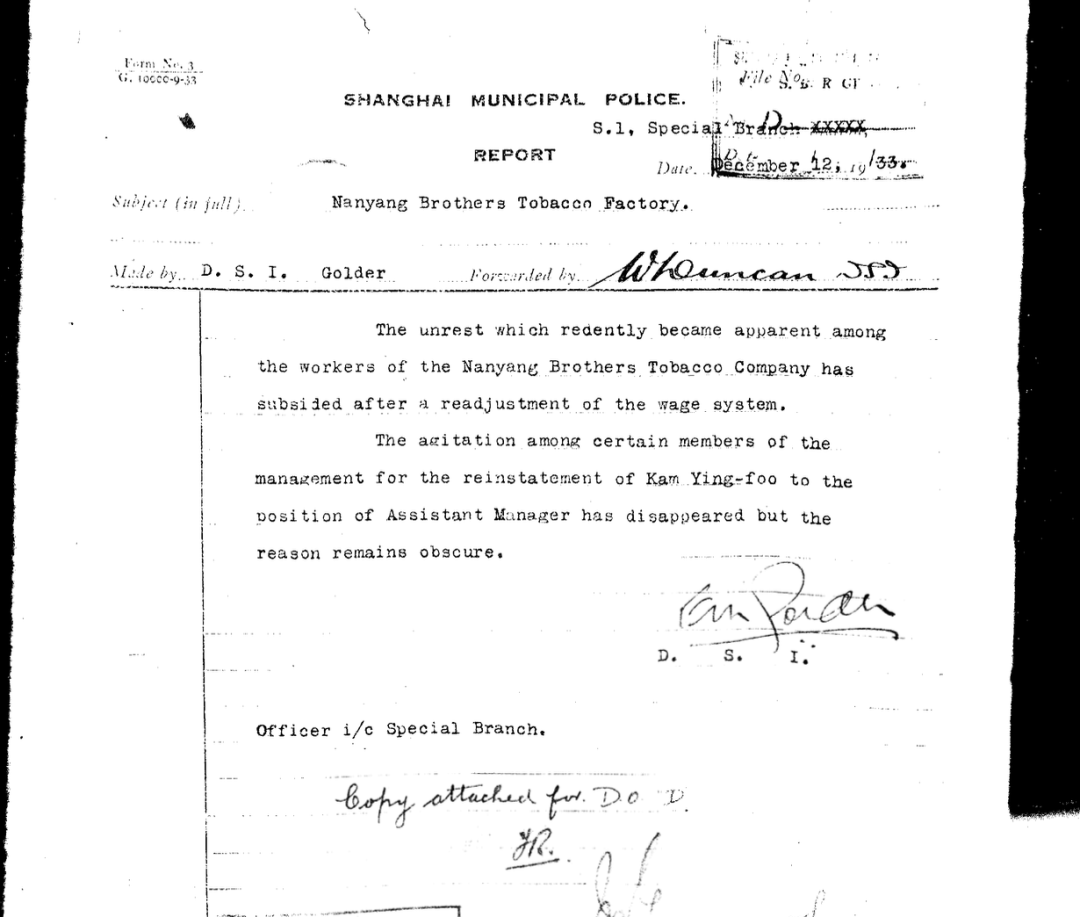
For example, the archives of the Special Branch of the Shanghai Municipal Council Police (the Municipal Police) span from 1894 to the outbreak of the Pacific War in 1941. These archives of the 'Shanghai Special Branch' eventually ended up at the US National Archives. They are vast and complex, containing numerous surveillance records and intelligence files by the 'Special Branch' on the CCP, the Comintern, and left-wing figures, which are of great research value.
Below is a surveillance report from 1933 by the Special Branch of the Shanghai Municipal Council Police on Yuan Dong, a worker at the Nanyang Brothers Tobacco Company.
As for the history of the 'Special Branch', it can be traced back to the late 19th century.
In 1883, the Metropolitan Police Service (the famous 'Scotland Yard') established the 'Special Irish Branch' to combat and suppress the intensifying Irish independence movement and the so-called 'terrorist attacks' derived from it. Shortly thereafter, the scope of this department's responsibilities gradually expanded, no longer limited to Irish affairs, but evolving into a domestic counter-subversion and counter-espionage political security department, and its name was changed to the 'Special Branch'.
At the same time, the British government began to require the establishment of functionally similar 'Special Branches' within the police departments of its major colonies, responsible for monitoring political activities in the colonies, various left-wing political organizations, and resisting infiltration by foreign intelligence personnel, with the Special Branch of the Metropolitan Police Service providing overall management and operational guidance.
As for the relationship between MI5 and the Special Branch, it was initially not one of superior and subordinate, but rather a delicate state of coexisting cooperation and competition.
After MI5 was officially established in 1909, its initial positioning was as a military counter-espionage agency to deal with the 'German spy panic' that was sweeping through Britain at the time. However, it soon began to engage in domestic counter-subversion and political security issues, naturally forming a competitive relationship with the 'Special Branch'. However, at that time, MI5 had very few personnel, and its domestic law enforcement lacked legal basis, so it was not yet sufficient to command or replace the Special Branch. The reversal of their relationship occurred around 1930. At that time, the Special Branch of the Metropolitan Police Service was embroiled in an 'insider scandal', with two Special Branch officials accused of leaking intelligence to the Comintern.
Subsequently, MI5 took advantage of the situation to seize the initiative on domestic security issues in Britain, and the Special Branch began to devolve into an enforcement department. In other words, MI5 was responsible for top-level intelligence management, strategy, and issuing orders, while the Special Branch was primarily responsible for implementing MI5's orders and bearing law enforcement responsibilities (especially within Britain and its colonies). Consequently, the 'Special Branches' within the police departments of the colonies naturally became de facto 'branches' of MI5, a situation that persisted during the Cold War.
In 1992, most of the functions of the Special Branch of the Metropolitan Police Service had been taken over by MI5, and almost all archives were transferred to MI5. After the disbandment of the Political Branch of the Hong Kong Police Force under British rule in 1995, its archives were naturally shipped back to the British mainland and transferred to the responsibility of MI5.
In 2006, the Special Branch and the Anti-Terrorism Branch were merged to form the Counter Terrorism Command of the 'New Scotland Yard'. As an institution, the Special Branch exited the historical stage.
For the Political Branch in Hong Kong, its main functions also lay in intelligence gathering and surveillance. During the Cold War, Hong Kong was a place where all sorts of people mingled, with figures from various factions frequently appearing, which naturally provided the Political Branch with a large stage for activity and significant value. This is why John le Carré, as early as the 1960s, used Hong Kong as an important stage in the world of spies in his novels. After all, the story of Tinker Tailor Soldier Spy begins in Hong Kong, and A Perfect Spy is a spy story about Hong Kong.
Returning to Cold War 1994, the appearance of MI6 at the end of the film is very abrupt and unreasonable; MI5 would have been more appropriate. As for the British laying groundwork and planting mines for the post-1997 era, although expected, the scene would certainly not resemble a foreign company job interview. Anyone with some knowledge would feel out of place upon seeing this.
Furthermore, as I described in my humble work Friend or Foe?, the British intelligence agencies, whether MI5, MI6, or the Special Branch, have historically done many things that were off-key or absurd, both in Ireland and in Hong Kong.
But in the 'Cold War Universe', perhaps for dramatic necessity, the British are perhaps given too much credit.
By the way, I recommend two books:
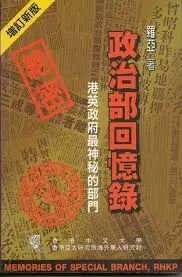
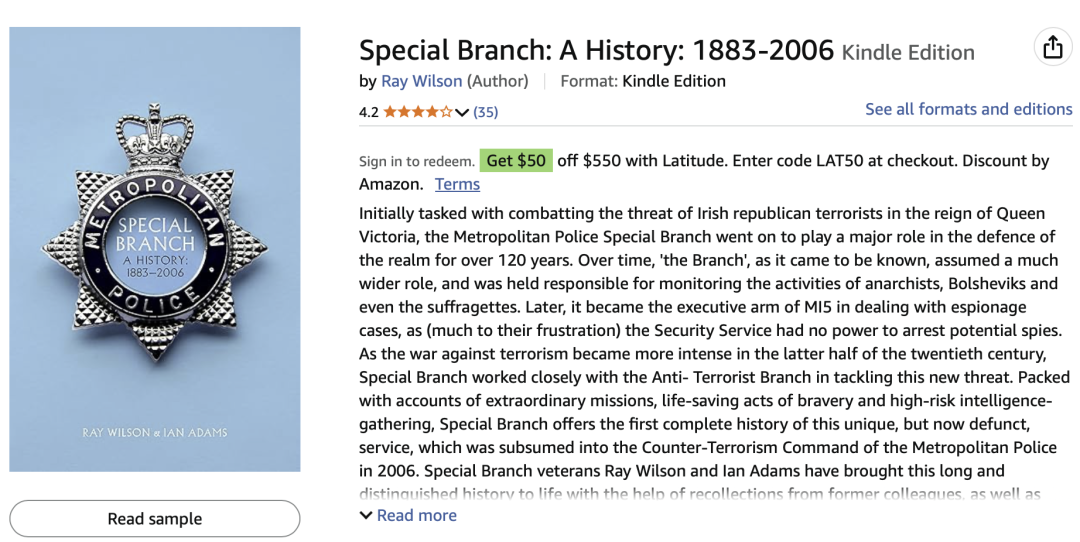
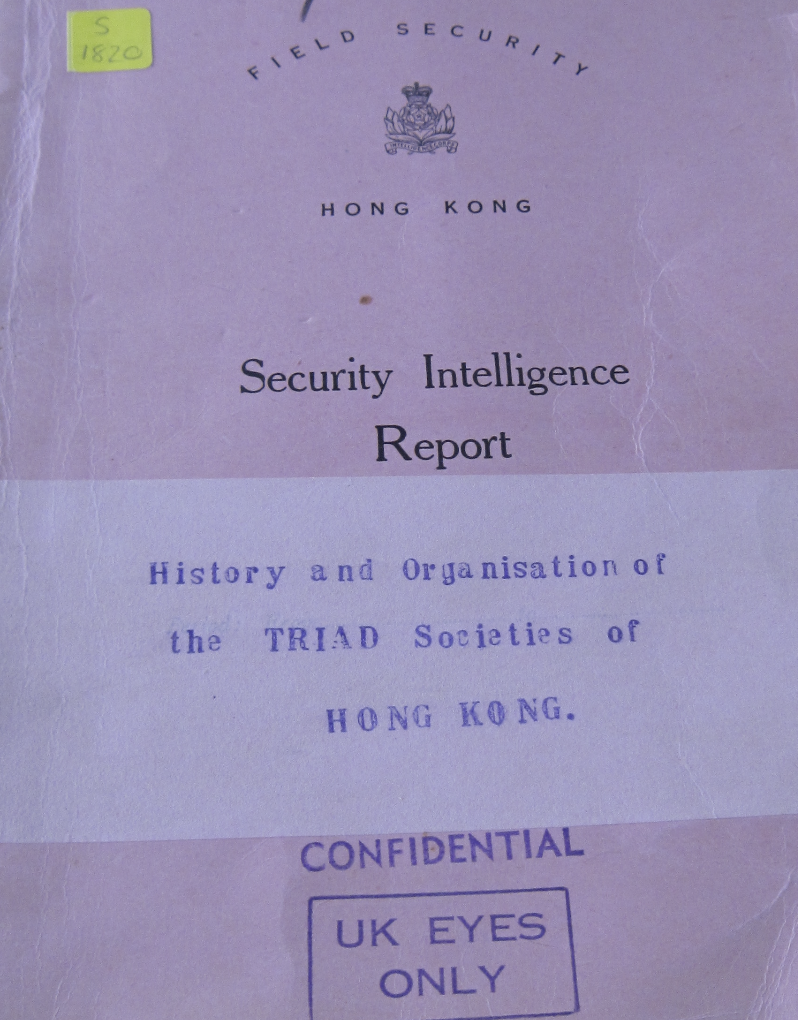
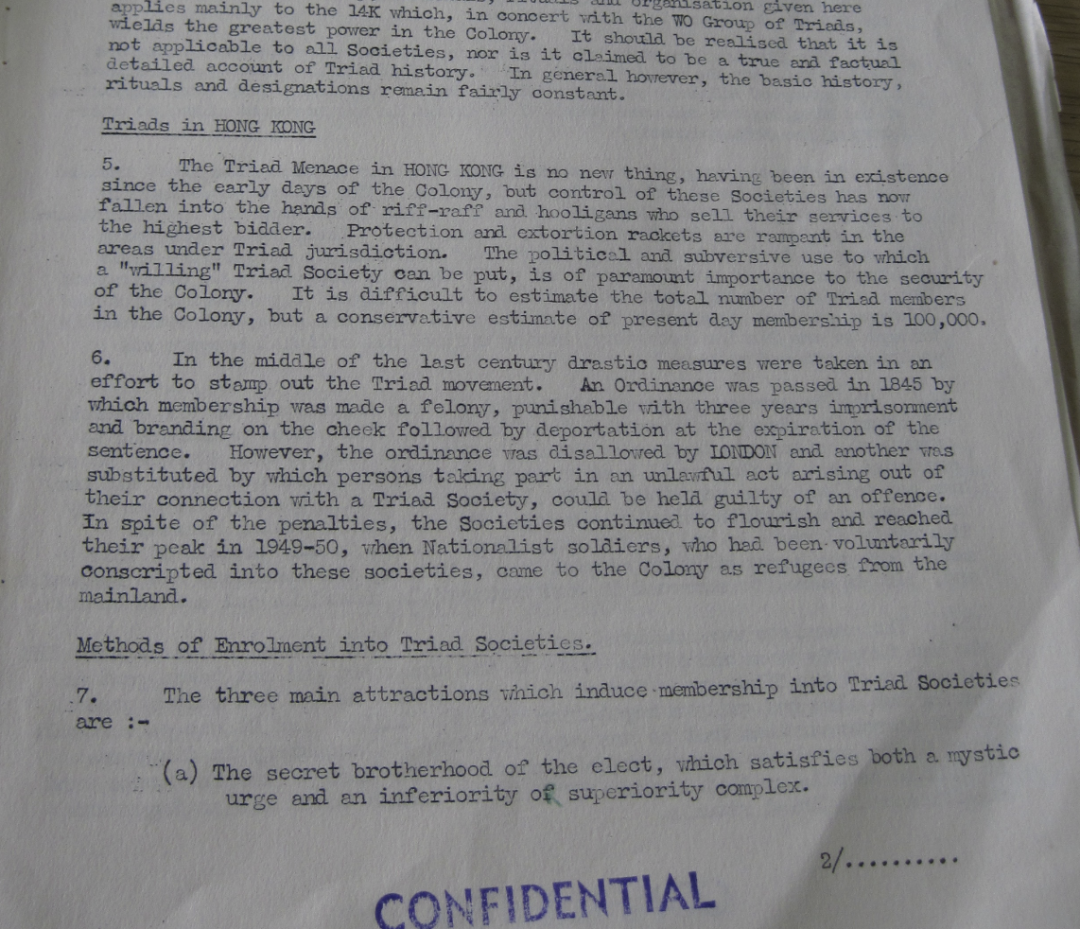
Finally, I will attach two fragments of historical archives from the Political Branch during the British Hong Kong era, which may offer a glimpse into its daily work.
Incidentally, at that time, reports from the Political Branch were almost exclusively for British eyes only (UK EYES ONLY).
The first is a 1952 investigation report by the Political Branch on the Triads.
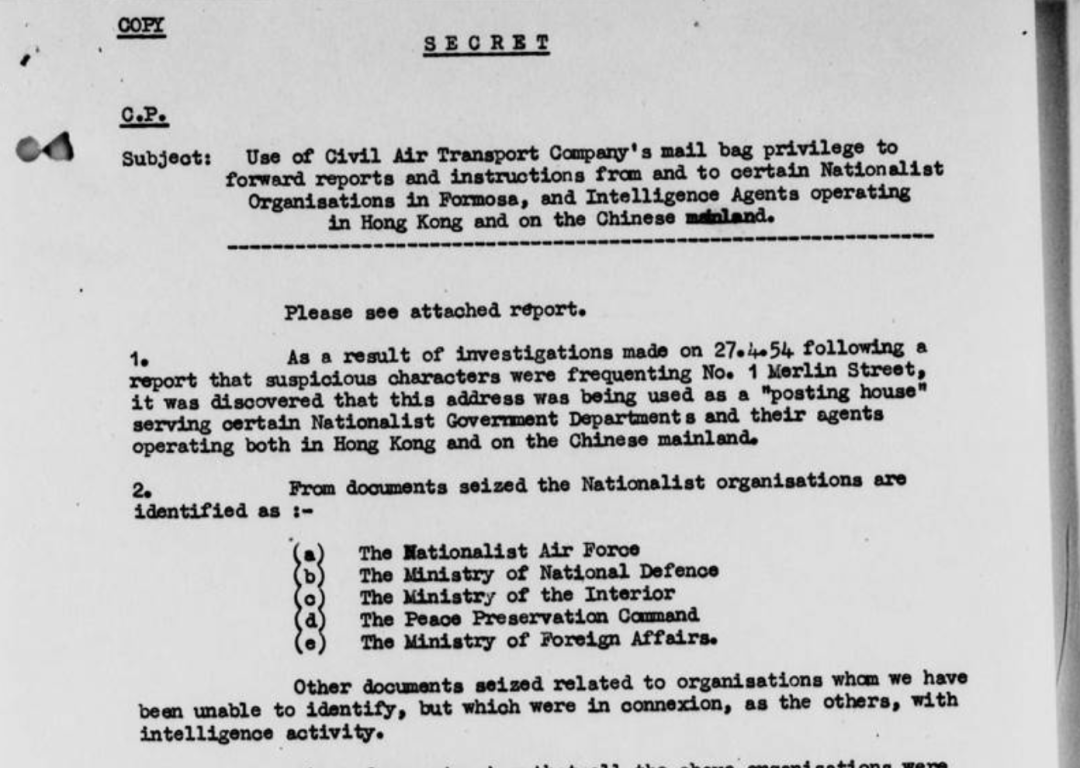
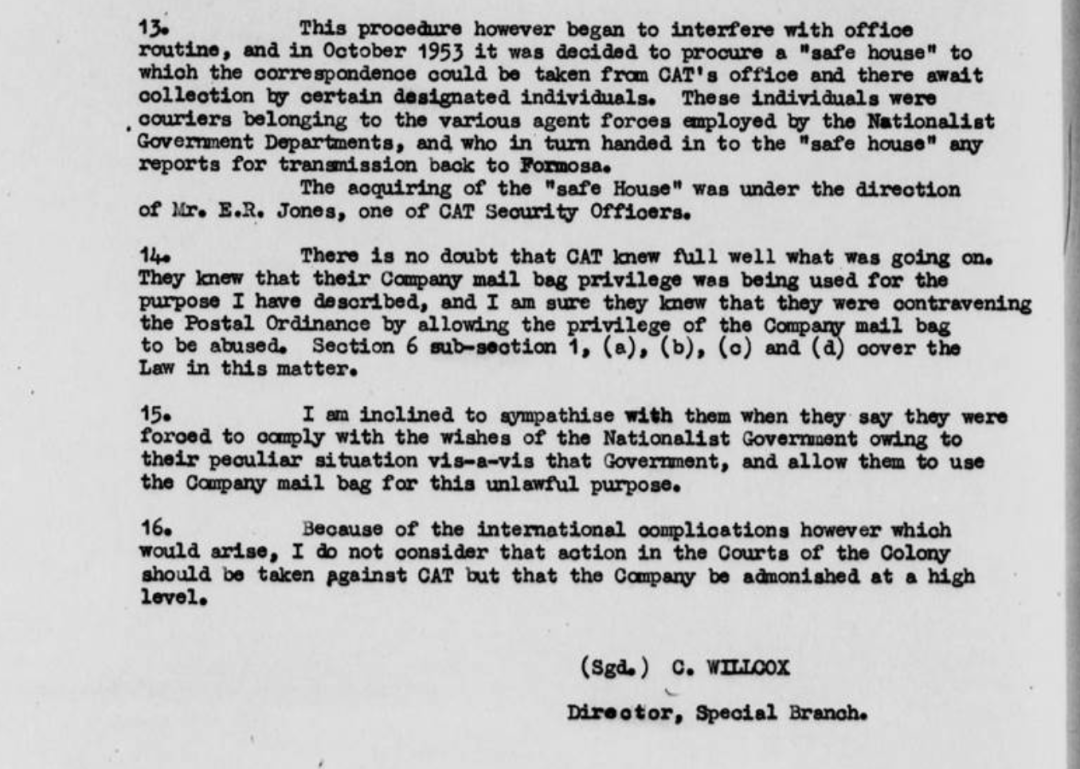
The second is a report from August 1954 by Willoox, the head of the Political Branch of the Hong Kong Police Force under British rule, to the then Commissioner of Police. The gist was that the Political Branch discovered that the Kuomintang authorities, who had retreated to Taiwan, China, were using the company mail of the 'Civil Air Transport' (CAT) to transmit intelligence. The Political Branch had followed the trail and preliminarily grasped the underground contact network of the Kuomintang authorities in Hong Kong, discovering their 'safe houses' in the territory.