
Nippon Steel’s Misreading of America
日铁遭“背刺”,高估了自己也高估了美国
Sha Qingqing, “Nippon Steel’s Misreading of America,” Guancha, 8 January 2025.
[By Sha Qingqing, columnist for Guancha.cn]
On January 3, 2025, the outgoing Biden administration presented its "close ally"—Japan—with an overly heavy New Year's gift.
Before leaving office, US President Biden formally vetoed Nippon Steel Corporation's (hereinafter "Nippon Steel") acquisition of United States Steel Corporation (hereinafter "US Steel"). Prior to this, the Committee on Foreign Investment in the United States (CFIUS), responsible for reviewing the acquisition, failed to reach internal consensus on the deal and instead referred the final decision to the White House.
This move not only deeply disappointed Nippon Steel and the Japanese government behind it, but also cast a shadow over the Tokyo stock market at the start of 2025. On January 6, the first trading day of the Tokyo stock market in the new year, the Nikkei index fell by nearly 600 points, a drop of nearly 1.5%.
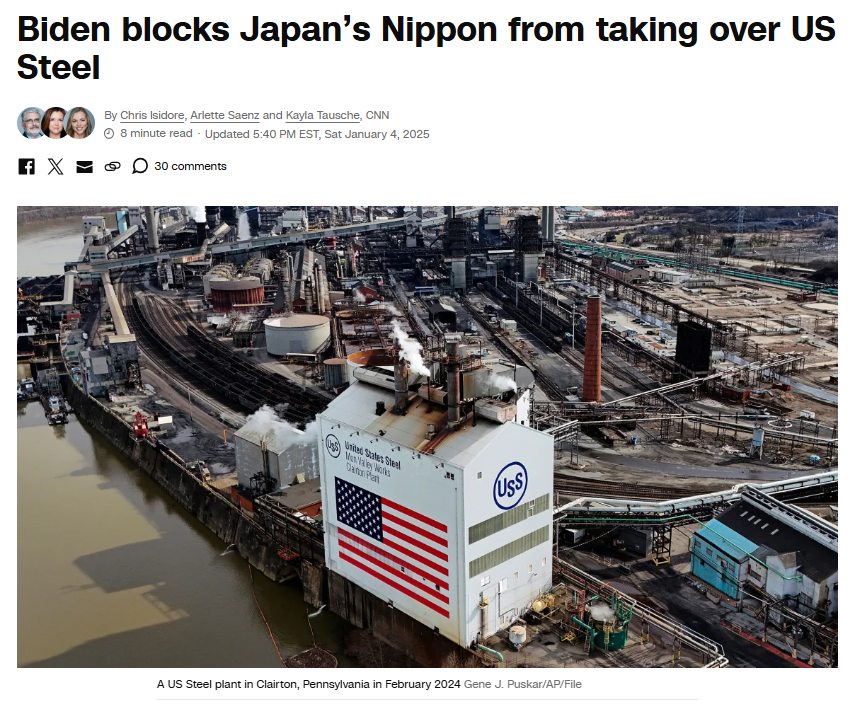
Screenshot of CNN report
In December 2023, Nippon Steel announced plans to acquire US Steel for $14.9 billion. Historically, Nippon Steel and its predecessors have been so-called "national policy companies" in Japan since before the war. Their management and operations, beyond market and economic considerations, largely represented the will of the Japanese government. Therefore, both the previous Kishida administration and the current Ishiba administration paid close attention to and supported this cross-border acquisition.
However, since the peak of the bubble economy in the 1980s, there have been few successful cases of large-scale Japanese acquisitions of US companies. Focusing specifically on the "Rust Belt Five States" (Michigan, Pennsylvania, Indiana, Ohio, and Illinois) where US Steel's headquarters in Pittsburgh is located, the only successful cases of Japanese companies acquiring US companies in the past 40 years were Bridgestone's acquisition of the veteran US tire manufacturer Firestone and Suntory Group's acquisition of Jim Beam whiskey.
Despite the lack of successful precedents, Nippon Steel appeared determined to secure this acquisition. Nippon Steel President Takaya Imai once confidently stated that the acquisition of US Steel was a gamble on the company's fate to transform Nippon Steel into the world's number one steel enterprise in terms of comprehensive strength.
US Steel's management expressed high interest in the acquisition almost immediately. The reason was simple: although US Steel is a company with over 120 years of history that was once the world's largest steel producer, it has been mired in long-term decline in recent years, lagging behind competitors in Japan, South Korea, Europe, and especially China in terms of output, quality, and production processes. Nippon Steel's acquisition was expected to inject new technology and capital into the company.
However, in contrast to the management's enthusiastic welcome, labor unions led by the United Steelworkers (USW) expressed concern, and even opposition, to the acquisition. 2024 was also a presidential election year, and to court union votes and the support of grassroots workers in the "Rust Belt," both Biden and Trump opposed the merger.
In March 2024, before withdrawing from the race, Biden stated that "United States Steel must remain American-owned." Trump, who still vividly remembered the US-Japan trade wars of the 1980s, said: "If United States Steel is bought by the Japanese, that would be a very bad thing." His chosen running mate, Vance, also fiercely opposed Nippon Steel's acquisition.
To this end, Nippon Steel made promises to appease the unions, including "honoring all existing agreements between 'United States Steel' and the unions, not changing the company name, not moving the headquarters out of Pittsburgh, not laying off workers, and making additional investments." It even hired former Secretary of State Mike Pompeo from Trump's first term as a lobbyist in Washington at a high salary.
On the other hand, the Japanese government attempted to lend "legitimacy" to this cross-border acquisition from the macro-strategic perspective of "strengthening the US-Japan alliance," and even hoped to reduce political resistance from the US government to the acquisition by catering to domestic US strategic anxieties regarding China.
In fact, while proposing the acquisition of US Steel, Nippon Steel Corporation simultaneously terminated its twenty-year joint venture with Baoshan Iron & Steel, a subsidiary of China's Baowu Group, and redirected its operational resources to the US, India, and Southeast Asia. The acquisition of US Steel was intended to better capture demand in the US market, and was even viewed as part of a strategy for "decoupling from China." Furthermore, the Japanese side repeatedly emphasized that Nippon Steel's acquisition of US Steel would jointly enhance the competitiveness of the US and Japanese steel industries, aiming to gain a dominant position in future competition against the Chinese steel industry.
On December 3, 2024, when answering questions in the Diet, Japanese Prime Minister Shigeru Ishiba pointed out that Nippon Steel's acquisition of US Steel was "a representative case of mutual investment expansion between Japan and the US, which is indispensable for both sides to further strengthen economic relations and economic security cooperation." In fact, at the end of November, Ishiba had personally written a letter to Biden requesting approval of the acquisition. The letter appealed: "Japan's growing investment in the US will bring benefits to both countries and demonstrate the solidity of the Japan-US alliance to the world."
Ironically, Biden still vetoed the acquisition on the grounds of "national security." The Japanese government's calculation of pushing the acquisition by waving the banner of the "Japan-US alliance" completely fell through. Neither the "solidity of the Japan-US alliance" nor the vision of jointly addressing competition from China seemed to outweigh the practical demands of populist politics within the US.
The headline of a report on this matter by Japan's Sankei Shimbun aptly illustrates the complex and mixed feelings on the Japanese side. The headline read: "Nippon Steel's acquisition plan thwarted, US Steel becomes the biggest loser, China's dominance in steel production continues." A feeling of regret and resentment, of "hating the iron for not becoming steel" (disappointment in unfulfilled potential), leaped off the page.
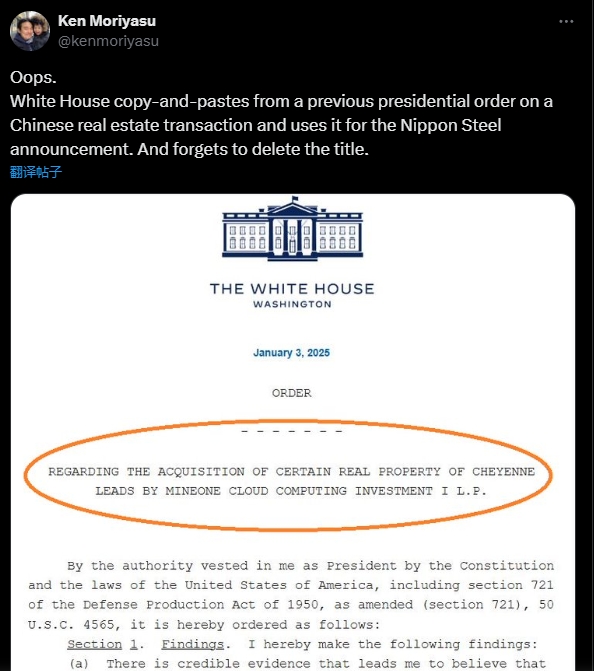
Furthermore, in an awkward and "hellish joke" incident, the first official press release issued by the US White House on January 3 mistakenly titled the release "Chinese companies banned from buying real estate in the US."
At a press conference on January 7, Nippon Steel Chairman Eiji Hashimoto stated that they would file lawsuits against US President Biden and others, demanding that the ban on the acquisition of United States Steel be invalidated. As for whether they were considering abandoning the acquisition, Hashimoto insisted: "We have not considered any alternatives at all. We will never give up doing business in the US," adopting a stance of persisting in the fight to the end. Japanese Minister of Economy, Trade and Industry Yoji Muto also publicly expressed dissatisfaction: "I find it difficult to understand and deeply regret that such a judgment was made on the grounds of concerns regarding national security."
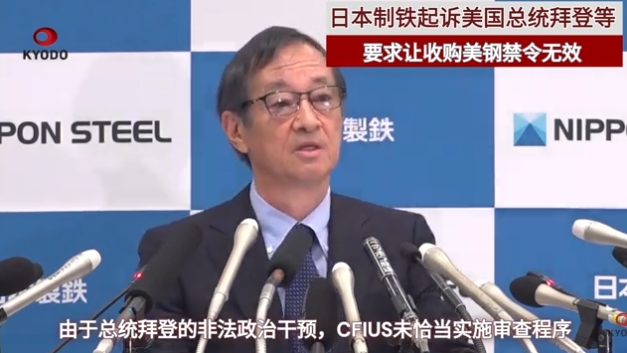
On the morning of January 7, Nippon Steel Chairman Eiji Hashimoto held a press conference in Tokyo. Video screenshot
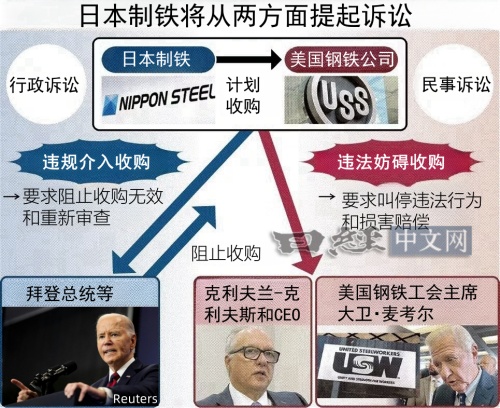
Nippon Steel's litigation strategy Nikkei Chinese Edition
As for Prime Minister Ishiba, he stated at his New Year's press conference: "We must take seriously the concerns arising in Japanese industry regarding investment between Japan and the US, and we will strongly demand that the US government take measures to eliminate (these concerns)."
In fact, as early as the spring and summer of 2024, Shigeru Ishiba, who had not yet been elected president of the Liberal Democratic Party, had expressed dissatisfaction with the US side’s “harassment” of the Nippon Steel acquisition deal. At the time, he frankly criticized: “If (the United States) arbitrarily obstructs this acquisition, is this the attitude one should have toward a close ally?”
On January 6, Trump, who was about to return to the White House, posted on social media: “Through tariff policies, US Steel will become a high-yield, more valuable company. Why sell it now?” Now that Shigeru Ishiba has ascended to the prime minister’s seat, can he still maintain his previous critical stance when facing Trump? It is probably not that easy.
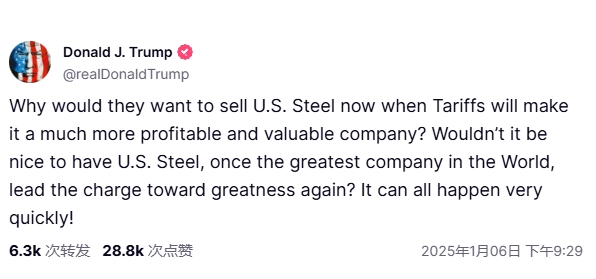
On January 6, Trump posted on social media, commenting on why US Steel should be sold now.
Richard Katz, a contributing correspondent for Japan’s Toyo Keizai and a senior fellow at the Carnegie Endowment for International Peace, keenly pointed out in his commentary on this acquisition: As early as the TPP negotiation stage, the US government had been demanding concessions from other countries while making almost none itself. Since then, this situation has become increasingly severe. This is evident not only in the trade war with China, but also in the tariff discrimination imposed on allies by both Trump and Biden. The labeling of Nippon Steel’s acquisition as a “national security threat” is precisely a product of this context. This is not merely an unlucky individual case surrounding the US election, but a true reflection of the times.