
Grassroots Mobilization and International Revolution in Manchuria
国际革命背景下的基层动员:以中东路事件前后的满洲省委为例
Sha Qingqing, “Grassroots Mobilization and International Revolution in Manchuria,” Open Times, 2011, no. 4, pp. 42–57.
■ Sha Qingqing
[Abstract] In July 1929, the Chinese Eastern Railway Incident broke out. As relations between the Zhang Xueliang authorities in Fengtian and the Soviet Union grew increasingly tense, eventually leading to armed conflict, the CPC Manchuria Provincial Committee also planned to seize this opportunity to mobilize grassroots workers, thereby expanding the momentum and organizational scale of the CPC's activities in the region. Compared to areas inside the Shanhai Pass, CPC organizations in Northeast China, backed by the Soviet Union, should have possessed greater mobilization advantages. However, the actual situation was the exact opposite. Not only did the Manchuria Provincial Committee fail to receive timely assistance from the Comintern or the Communist Party of the Soviet Union (CPSU), but it was instead burdened by them, causing the entire movement to stagnate. The reasons for this situation included detailed factors such as the lack of communication channels and slow information transmission between the CPC Manchuria Provincial Committee and the Soviet side, as well as a deeper, irreconcilable structural conflict between the perception of international revolution and local interests.
[Keywords] Manchuria Provincial Committee; Comintern; CPSU; Chinese Eastern Railway Incident; grassroots mobilization
Grassroots Mobilization in the Context of International Revolution: A Case Study of the Manchuria Provincial Committee Before and After the Chinese Eastern Railway Incident
I. Introduction
On July 10, 1929, after failing to reach an agreement with the Soviet Union, the Zhang Xueliang authorities in Fengtian began unilaterally using force to reclaim the Chinese Eastern Railway.1 The Northeast Transportation Committee officially announced the takeover of the Chinese Eastern Railway Telegraph Office, forcibly dissolved the Soviet-side trade unions and the Communist Youth League, and closed the Soviet Far Eastern State Trading Bureau and the Commercial Office. It also dismissed the Soviet director and deputy director of the railway and arrested more than 200 Soviet nationals in succession. On July 17, since the previous ultimatum had not received a satisfactory response, the Soviet Union officially announced the severance of diplomatic relations with the Nanjing National Government, which subsequently triggered a series of serious military conflicts between the Zhang Xueliang authorities and the Soviet Union, known as the "Chinese Eastern Railway Incident."2
This incident not only held symbolic significance in the history of Sino-Soviet relations but also had a major impact on the communist revolutionary movement within China. At the outset of the incident, the CPC Central Committee responded to instructions issued by the Comintern by publicly shouting the slogan "Support Socialist Soviet Union," and pointed out that the Zhang Xueliang authorities' seizure of the Chinese Eastern Railway "was a manifestation of the entire imperialist offensive against the Soviet Union."3 However, such revolutionary calls, which were detached from the reality of Chinese public opinion at the time, failed to achieve effective mobilization. Furthermore, significant disagreements arose in grassroots mobilization strategies between the CPC Central Committee, which acted entirely in accordance with the Comintern's will, and certain local party organizations that faced practical difficulties. This was particularly pronounced in Northeast China. During the Chinese Eastern Railway Incident, Liu Shaoqi, then Secretary of the Manchuria Provincial Committee, faced criticism from multiple quarters for adopting handling methods on issues such as propaganda and strikes that were inconsistent with those of the CPC Central Committee,
and was ultimately forced to leave Manchuria.4 So, what exactly were the actual conditions of grassroots social movements that prompted Liu Shaoqi to abandon the Central Committee's movement strategy in Northeast China?
When discussing the movement and propaganda mobilization strategies adopted by the CPC Central Committee at the time, traditional narratives of Party history often attribute them to errors of the so-called "Left" line.5 At the beginning of the incident, the CPC Manchuria Provincial Committee also largely agreed with the relevant judgments of the CPC Central Committee, believing that "the Central Committee's assessment of the subjective forces in Manchuria and its work instructions were both appropriate and practical."6 Upon learning of the discussions between the CPC Central Committee and Chen Duxiu regarding propaganda strategies for the Chinese Eastern Railway, the Manchuria Provincial Committee initially also expressed "complete agreement with the Central Committee's opinions."7 It was only after encountering severe setbacks in actual work that it turned to adopt different strategies. Furthermore, previous studies have rarely noted that one of the so-called "different strategies" adopted by the Manchuria Provincial Committee at the time was the continuous attempt to establish direct contact with the Soviet side. This contact also directly influenced the rise and fall of the CPC's development in Northeast China. Therefore, if researchers can temporarily suspend so-called ideological judgments and carefully observe the various practical problems encountered by the Manchuria Provincial Committee before and after this incident, they may be able to analyze the gap between grassroots mass mobilization and the discourse system of international revolution from a new perspective.8
Taking Northeast China as an example, what was the actual operational state of local party organizations represented by the Manchuria Provincial Committee at the time? How did the Manchuria Provincial Committee carry out its work in accordance with the instructions of the CPC Central Committee and the Comintern during the Chinese Eastern Railway Incident? What dilemmas did the grassroots struggle surrounding the Chinese Eastern Railway fall into? How did local party organizations make contact with the Soviet side? What contradictions would erupt when the international communist revolutionary movement directly encountered local organizations at various levels?
In response to the above questions, the author will use the Manchuria Provincial Committee before and after the Chinese Eastern Railway Incident as a case study, attempting to provide answers on the basis of historical reconstruction.
II. The Actual State of the CPC Manchuria Provincial Committee in the Early Stages of the Chinese Eastern Railway Incident
Since the establishment of the CPC Manchuria Provincial Committee in October 1927, the Zhang Xueliang authorities in Fengtian had consistently adopted a high-pressure policy against communist forces in Northeast China. For a long time, various CPC organizations in the Northeast could only remain in "the abyss of avoiding struggle," becoming "unable to withstand blows and unfit for struggle."9 On December 23, 1928, when the CPC Manchuria Provincial Committee held an expanded provincial committee meeting at the home of a party member in Fengtian, it was surrounded and arrested by military police. "All comrades were arrested," including Provincial Committee Secretary Chen Weiren, totaling 13 people.10 The entire provincial committee was almost completely wiped out, "Party cadres were lost almost entirely," and those who luckily remained were "limited to just one or two," causing the operation of party organizations throughout Northeast China to fall into paralysis. [11]
On January 2, 1929, the CPC Central Committee urgently ordered Liu Shaoyou, who had arrived in Manchuria from Shanghai less than two weeks earlier, to serve as acting secretary and deal with the aftermath. Liu, however, was a southerner who had never done organizational work in Northeast China. As he himself put it, he was “relatively unfamiliar with conditions in Manchuria; at a crisis like this, how can one man on his own cope?”[12] The provisional Manchuria Provincial Committee then asked the Central Committee to “send northerners, not southerners, as cadres for Manchuria.”[13] On February 16, the Central Committee formally appointed Wang Ligong, a local party member from Dalian, as the new provincial secretary. Serious illness prevented Wang from ever taking up the post, so Liu Shaoyou continued as acting secretary.
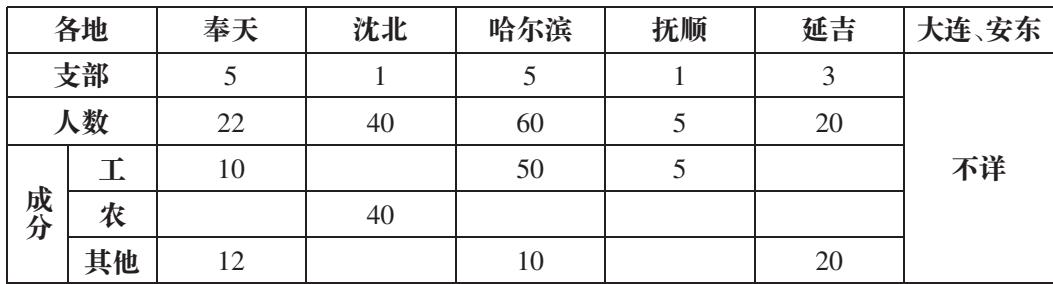
At this time, the Manchuria Provincial Committee had not yet recovered from the previous severe blow. As of February 1929, there were only 147 party members in the entire Northeast region. [14] The temporary provincial committee was unable to effectively carry out various tasks. "The general comrades themselves lacked clarity, and their influence among the masses was naturally very low." In various workers' movements, situations even arose where "party members actually avoided mass organizations, and dared not raise the demands of struggle,"
[15] Whether in Fengtian or in large and medium-sized cities such as Harbin, the respective "party organizations were so weak that in the main industrial masses, eight or nine out of ten had no party organization, and even where there were party organizations, they were mostly timid and unable to engage in active activities" [16], and the barely rebuilt party organizations were in a "primitive small-group era." [17]
In view of the severe situation in the Northeast, the Central Committee of the Communist Party of China (CPC) decided in June 1929 to dispatch Liu Shaoqi, who had rich experience in labor and social movements, to Manchuria to take charge of the reconstruction of the Party organization. On June 7, the CPC Central Committee held a special conference on Manchurian affairs in Shanghai, where it also approved the list of members for the new provincial committee. [18] However, due to factors such as transportation difficulties, Liu Shaoqi had still not arrived in the Northeast by early July, and the Manchurian Provincial Committee noted that 'Comrade Liu Shaoqi's delay in arriving has had a significant impact on the work.' [19] Yet, even when the Chinese Eastern Railway (CER) Incident erupted, Liu Shaoqi had not yet assumed his post. It was not until July 14 that Liu Shaoqi and his wife, He Baozhen, finally arrived in Fengtian after a circuitous journey. The day before, the CPC Manchurian Provincial Committee, following instructions from the CPC Central Committee, had already issued a notice calling on Party branches across the Northeast to actively organize the 'August 1st Demonstration' to coordinate with the struggle over the CER, resolutely raising slogans such as 'Oppose armed aggression against the Soviet Union! Protect the Soviet Union!' and 'Chinese and Russian workers, unite to oppose imperialism and its running dogs!' [20]
Due to unfamiliarity with the environment and other reasons, Liu Shaoqi only made contact with the provincial committee three days after arriving in Fengtian. At this time, the CER Incident was escalating further, and the most urgent task for the new provincial committee was how to mobilize the masses to participate in the upcoming so-called 'August 1st Demonstration.' However, the shadow of the devastating blow suffered by the previous provincial committee still loomed over the responsible comrades in the new committee. In the actual discussions of the provincial committee, although 'comrades spoke very little,' 'many incorrect viewpoints' were revealed in their few words. [21] Some members believed that 'the organizational foundation was too fragile to stage a demonstration at all,' while others pointed out that if the masses were to be mobilized, the call should be 'purely anti-Japanese, without mentioning the slogans regarding the Soviet Union and the CER, or waiting for an opportunity to raise them later.' [22] In a report submitted to the CPC Central Committee, the provincial committee frankly admitted: 'We are experiencing extreme difficulties in political, organizational, and technical aspects,' and pessimistically noted, 'If most comrades cannot be mobilized, it is possible that the provincial committee may be forced to cancel the demonstration.' [23] Meanwhile, cadres sent to Harbin 'submitted no reports for ten days after their departure,' and only sent some brief reports after repeated urging, which 'mentioned nothing about the organizational situation of the Party, the response to the CER Incident, or the preparations for the August 1st Demonstration, apart from some news.' [24]
Under such circumstances, the first social movement following the CER Incident was nearly a failure. On the day of the 'August 1st Demonstration,' apart from Party members sporadically distributing propaganda leaflets in Fengtian and Fushun, little was accomplished. In Fengtian, 'preparatory work was extremely inadequate, and many plans that could subjectively have been put into action were not executed,' and Liu Shaoqi, due to illness, was unable to specifically guide
Table 1: Statistical Table of Communist Party Organizations in Various Parts of Manchuria, February 1929
| Category | Fengtian | Shenbei | Harbin | Fushun | Yanji | Dalian and Andong |
|---|---|---|---|---|---|---|
| Branches | 5 | 1 | 5 | 1 | 3 | Unknown |
| Members | 22 | 40 | 60 | 5 | 20 | Unknown |
| Composition: workers | 10 | 50 | 5 | Unknown | ||
| Composition: peasants | 40 | Unknown | ||||
| Composition: other | 12 | 10 | 20 | Unknown |
Source: 'First Report of the CPC Manchurian Provincial Committee—The Political Situation in Manchuria and the Party's Work Line,' in Central Archives et al. (eds.), Collection of Revolutionary Historical Documents in the Northeast Region (April 1928–February 1929), Vol. A2, 1988, p. 371.
the work of guiding organizations at all levels, resulting in 'public propaganda and agitation work being completely neglected.' [25] Due to the difficult operational conditions of Party organizations at all levels in the Northeast region, Liao Ruyuan, who was then in charge of organizational work for the provincial committee, reported to the Central Committee that an embarrassing situation arose before and after the demonstration where 'not a single mass member could be mobilized,' and those participating in propaganda activities amounted to no more than twenty-odd Party members. [26] Furthermore, Harbin, which should have been the focus of the movement, organized no effective actions at all. The Manchurian Provincial Committee had not received any information regarding the demonstration by August 8, to the extent that it exclaimed 'Terrible!' in its report to the Central Committee. [27]
Just as the provincial committee was planning to reorganize the situation of Party committees in various places, Provincial Committee Secretary Liu Shaoqi and Standing Committee member Meng Jian were unexpectedly arrested on August 22 while attending a Party branch meeting at the Fengtian Spinning and Weaving Mill. The CPC Manchurian Provincial Committee had to form a temporary provincial committee composed of Li Yishan, Ren Guozhen, and Rao Shushi to take charge of rescuing the two. [28] Subsequently, due to insufficient evidence and other reasons, the Fengtian High Court issued a verdict in early September stating 'insufficient evidence, no prosecution, released on bail.' Although Liu and Meng were ultimately released, this unexpected incident severely disrupted the process of organizational reconstruction by the CPC in the Northeast region and delayed the launch of various struggle movements related to the CER. [29] According to the provincial committee's own account, 'the influence among the masses did not expand; not a single mass member or comrade was gained from this incident, and comrades instead accepted bourgeois propaganda.' [30]
On September 21, the CPC Central Committee once again issued clear work instructions: the current work line for the Party in Manchuria was to seize the CER issue as the center and carry out various basic tasks on this basis; the CER issue should be regarded as the most serious political task facing China, and particularly the Party in Manchuria, at present, and other tasks must be subordinate to this political task, with all work linked to this political task. [31] Facing the explicit requirements of the Central Committee and the actual predicament in the Northeast region, the Manchurian Provincial Committee inevitably needed to explore new methods of movement to possibly make progress.
III. The Awkwardness of Two Parties in One Place: Attempts to Establish Organizational Links Between the CPC and the CPSU in the Northeast
When the CER Incident erupted, the total number of workers on the entire railway was approximately over 10,000, including about 3,000 Soviet workers, about 4,000 Chinese workers, and about 3,600 White Russian workers. [32] They mainly lived concentrated in the Sanshupeng, Dibao, and Shanghao areas of Harbin. Among them, Sanshupeng had about 3,000 people, the Dibao area had about 2,000, and another 300 lived in the Shanghao area. The number of Chinese and Russian workers in these three places was roughly equal. Although Chinese and Russian workers often resided in the same areas, Soviet employees generally occupied better positions. In terms of wages, the two sides were in a state of inequality, with Soviet employees' wages generally being three to four times those of Chinese employees in similar positions. For a long time, Chinese workers had no goodwill towards the Soviet managers of the CER, because 'in any conflict between Chinese and Russian workers, the Russians were always right.' [33]
After the eruption of the CER Incident, many Soviet employees even said to Chinese workers: 'If we leave, we would rather hand the railway over to the Japanese than to the Chinese.' [34] Although the vast majority of Chinese employees worried that their treatment might decrease after the Fengtian clique took over the railway, they were even more dissatisfied with the past unequal treatment and the remarks made by Soviet employees after the incident. [35] One of the most popular slogans among ordinary workers at the time was 'Equal treatment for Chinese and Russian workers.' [36] According to a survey by the CPC Harbin Municipal Committee, the opinion of most Chinese workers at the time was that if the CER were 'in Chinese hands, even if the pay is low, there is still work to do; if the Russians come, they must get out.'
If the CPC Manchurian Provincial Committee truly wanted to mobilize Chinese workers to participate in the struggle against the Fengtian clique's recovery of the CER, it inevitably needed the Soviet side to cooperate in terms of public opinion propaganda and movement organization, or at least not to increase resistance or exacerbate existing ethnic contradictions. As early as July 20, the Manchurian Provincial Committee had appealed to the CPC Central Committee, stating, 'We must issue a call to the brother party...'
regarding relationships, no matter how strict the secret techniques, we can all comply"; and believed that "it is incorrect to avoid establishing relationships for fear of affecting diplomacy, and we request the Central Committee to introduce us to them."[37] This was also the first time the Manchuria Provincial Committee explicitly requested that the CPC Central Committee and the Comintern dispel concerns in this regard and establish a direct communication channel with the Soviet Party organizations in Northeast China.[38] Most members of the Manchuria Provincial Committee, represented by Liu Shaoqi, generally believed that "currently, the Party's leadership over the masses is very weak. Now, we must send several strong comrades from the Russian Communist Party to the Chinese Eastern Railway to do production work."[39] Therefore, the CPC Manchuria Provincial Committee planned to seek cooperation from the Soviet side in mobilizing and organizing railway workers, while also attempting to leverage their resources to launch new activities, "hoping that the All-Union Communist Party would take measures to unite Russian workers and Chinese workers in joint action under these slogans."[40]
In addition to the practical needs of movement work, another reason the CPC Manchuria Provincial Committee hoped to establish direct contact with the Soviet Union may have been based on considerations of scarce mobilization resources. Due to inconvenient transportation and other reasons, the connection between the CPC Manchuria Provincial Committee and the CPC Central Committee had long been in a relatively difficult state. The CPC Central Committee was often unable to promptly dispatch personnel or provide activity funds to the Manchuria Provincial Committee located outside the Shanhai Pass. For example, in a report to the Central Committee on September 27, it complained that relevant work had been delayed because funds and personnel had not arrived in time, stating, "We had already prepared a highly systematic practical plan considering all aspects, but you have never replied. Especially regarding finances... the one or two hundred yuan the Central Committee owes us has already caused us great difficulty, and in fact, it cannot but hinder work. Now, our livelihood has become a major problem. All loans are due and cannot be repaid; if the money does not arrive within three more days, we will be at a loss... We request the Central Committee to consider the difficulties of the local area."[41] Under these circumstances, the Manchuria Provincial Committee naturally turned to hoping to obtain help with movement resources directly from the existing Soviet forces in the Far East and Northeast China, rather than having the Comintern supply the CPC Central Committee, which would then transfer them to the CPC Manchuria Provincial Committee far away in the Northeast.
Shortly after the outbreak of the incident, the Soviet side gradually realized the importance of the CPC's activities in Manchuria. In fact, the instructions issued by the CPC Central Committee to the Manchuria Provincial Committee on September 21 were the result of adhering to previous resolutions of the Comintern. On September 13, the Executive Committee of the Comintern passed a resolution on "the issue of strengthening the CPC's work in Manchuria," instructing that "the CPC Central Committee take measures in Northern Manchuria to strengthen work among workers, peasants, railway employees, and especially in the army," while simultaneously "suggesting that the CPC Central Committee strengthen work among workers in Southern Manchuria, especially among those Chinese working on the railways in Southern Manchuria."[42] Furthermore, the Moscow side was also considering "dispatching a responsible Chinese comrade to China to guide the CPC Central Committee on the CPC's tasks in Manchuria," while requiring the CPC Central Committee to "send a Chinese comrade to Khabarovsk as the representative of the CPC Central Committee" for timely communication. Representatives from both sides should conduct urgent consultations in Khabarovsk and take measures to publish and distribute Chinese-language newspapers and leaflets in Northeast China as soon as possible to support the Soviet struggle regarding the Chinese Eastern Railway.[43] The reason for arranging the consultation location for representatives from both sides in Khabarovsk was naturally based on the desire to be as close as possible to Northeast China. In addition, the Comintern planned to "mobilize 50 Chinese comrades from various schools in Moscow and send them to the East to strengthen work in Northern Manchuria," while also "absorbing Chinese comrades and Korean comrades residing in the Soviet Far East to participate in this work."[44]
Faced with the Comintern's instructions and the appeals of the Manchuria Provincial Committee, the CPC Central Committee quickly agreed to the previous request of the Manchuria Provincial Committee. Subsequently, relevant Soviet personnel stationed in the Northeast quickly attempted to make contact with personnel from the CPC Manchuria Provincial Committee. Since October 1929, the CPC Harbin Municipal Committee had begun directly writing to the Soviet Party organizations in Khabarovsk for instructions.[45] However, because the Manchuria Provincial Committee lacked those proficient in Russian, they could not make direct contact, and there were certain difficulties in communication between the two sides. Consequently, the Manchuria side had to request personnel assistance from the Transportation Department of the CPC Central Committee.[46] Chen Tanqiu, who was then the inspector for the Northeast region, was specifically ordered to be responsible for conveying the situation of contacts between CPC organizations in the Northeast region and the Soviet side to the Central Committee.[47] At the end of October, the Manchuria Provincial Committee once again to
the CPC Central Committee reported that due to language issues, they were unable to establish effective contact with the All-Union Communist Party forces existing in the Northeast region, "only obtaining some materials," and therefore "requested the Central Committee's help in establishing formal relationships."[48] However, in addition to language barriers, the All-Union Communist Party organizations in the Chinese Eastern Railway and Harbin areas were also subjected to crackdowns by the Fengtian-Zhang authorities. The CPC Manchuria Provincial Committee had explained to the CPC Central Committee: In the struggle over the Chinese Eastern Railway, it was "absolutely necessary" for CPC organizations and the Soviet side to "establish relationships with each other," however, "recently they suffered another major blow, and the future outcome is unknown."[49]
At this time, due to the failure of negotiations between the Soviet Union and the Fengtian-Zhang authorities, intense large-scale armed conflicts erupted between the two sides. On October 1, the Soviet army began attacking Manzhouli. On the 12th, the Battle of Sanjiangkou broke out, and the Soviet army subsequently occupied Tongjiang, with the Northeast Army retreating. On the 31st, the Soviet army also captured Fujin. On November 17, the Soviet army launched a large-scale offensive. Two days later, Manzhouli and Zhalainuoer fell one after another, and the 15th and 17th Brigades of Heilongjiang Province were completely annihilated. During this period, Stalin, who had just emerged victorious in the intra-party power struggle, pointed out in a letter to Molotov that the focus of the Chinese revolution should "shift to organizing the revolutionary movement for an uprising in Manchuria."[50] In his view, although the Soviet army had launched a full-scale offensive in Northeast China, military actions initiated solely by the Soviet army were still not
sufficient.[51]
Stalin believed it was necessary to organize a local anti-Zhang military armed force in the Northeast region, which could avoid international criticism of the Soviet Union, "if an uprising occurred within Manchuria, it would be perfectly understandable under the system established by Zhang Xueliang," and thus "would not violate any international law."[52] The main content of his conception was "to organize two brigade-sized units, mainly composed of Chinese, provide them with all necessary weapons, let Chinese serve as brigade commanders, and send them to Manchuria," and their task was "to incite an uprising of the Manchurian army... expand into divisions, and occupy Harbin. After accumulating strength, declare the deposition of Zhang Xueliang and establish a revolutionary regime."[53] On November 20, Zhang Xueliang, having suffered severe losses, finally sought peace with the Soviet Union. On December 2, Fengtian-Zhang negotiation representative Cai Yunsheng rushed to Khabarovsk to formally conduct peace talks with Soviet representatives. Since Zhang Xueliang had fully acknowledged all conditions proposed by the Soviet side, Stalin decided to temporarily shelve the plan to launch the so-called "Manchurian military uprising."
However, Moscow continued to closely monitor the role the CCP could play within the Manchuria Provincial Committee, believing that at this time, beyond the "regular work on the Chinese Eastern Railway issue," the focus of the CCP Manchuria Provincial Committee needed to be concentrated on coordinating movements for the "twelfth anniversary of the Russian Revolution, the second anniversary of the Guangzhou Uprising, and the approaching Chinese New Year."[54] The All-Union Communist Party also, through the Comintern, further required the CCP Manchuria Provincial Committee to secretly develop its own organizations among the Fengtian army soldiers captured by the Soviet Union. In a circular issued in December, the CCP Central Committee also emphasized the importance of soldier work to local party organizations, pointing out that it was "a very important task under the general line of armed protection of the Soviet Union... especially in places where warlord wars had already erupted and on the front lines attacking the Soviet Red Army."[55]
Upon receiving these instructions, the CCP Manchuria Provincial Committee "systematically began soldier work in Northern Manchuria, the Fengtian provincial capital, and other places"[56], mobilizing grassroots party members to "expand our political influence among the soldier masses, actively undermine this army, and link this to the aspect of supporting the Soviet Union."[57] Subsequently, in a letter to Huang Ping[58], Liu Shaoqi also proposed that "repatriated prisoners of war should establish close and firm ties with the Manchuria party organization... therefore, when prisoners of war returned home, several strong comrades should be sent to return with them," and that this "connection with the Manchuria party organization should be conducted through liaisons of the military organization (Intelligence Department)."[59] While writing to members of the CCP stationed in the Soviet Union, Liu Shaoqi also, on behalf of the Manchuria Provincial Committee, wrote to the Far Eastern Krai Committee of the All-Union Communist Party, requesting that they establish a formal cooperative relationship with Huang Ping.[60]
By the end of 1929, as the Soviet Union and the Zhang Zuolin faction reached a consensus on peace, the situation on the Chinese Eastern Railway also gradually eased. However, the intense fighting in Northeast China prior to this had, conversely, provided the CCP organization with some room for development in the Northeast region. At the same time, the CCP Manchuria
Provincial Committee's contacts with the Soviet side also gradually opened up, seemingly capable of bringing a new face to the struggle in the Northeast region. However, the actual trajectory of the struggle turned out to be the exact opposite.
IV. The Comintern's Slow Response and Internal Divergences within the CCP Manchuria Provincial Committee
On December 21, 1929, Cai Yunsheng, representing the Zhang Zuolin faction, and Semenov, representing the Soviet side, signed a preliminary agreement. Its key points were that the Zhang Zuolin authorities would immediately restore the actual status of the Chinese Eastern Railway, consulates, and all commercial institutions to the state prior to July 10.[61] Taking the Chinese Eastern Railway as an example, all Soviet employees dismissed after July 10 were immediately reinstated, while all personnel unilaterally hired by the Chinese side during the conflict were dismissed.[62] It was precisely this demand by the Soviet side that caused the entire struggle over the Chinese Eastern Railway to take a sudden and dramatic
turn.
When news of the peaceful resolution of the Chinese Eastern Railway issue first emerged, most Chinese workers felt happy but worried that "the Red Russians would return to take retaliatory measures against Chinese workers, because in the past, Chinese workers often did not follow the Red Russians on dispute issues."[63] Another group of newly hired workers and those promoted during the incident felt panic, fearing layoffs or demotion to their original positions. At that time, the biggest task of the CCP Harbin Municipal Committee was to mobilize the masses to welcome the return of the Red Russians, planning to "hold a mass meeting when the Red Russians entered the factory."[64] To soothe the workers' anxieties, the Manchuria Provincial Committee originally required the Harbin Municipal Committee to propose the slogan: "Restore all treatment from the Red Russian era, oppose the dismissal of Chinese workers, and dismiss all White
Russians."[65]
On January 9, 1930, Soviet management personnel returned to the factory areas in Harbin, and almost all key positions were once again occupied by them.[66] Shortly thereafter, "a rumor suddenly spread that the factory was preparing for massive layoffs; the machines were divided into four sections, one section had only over 80 people, and 73 were laid off, with similar situations in other factories and sections." Upon hearing this, the already anxious Chinese workers immediately filled the air with voices of resistance and opposition to the Soviet Union, "the atmosphere throughout the factory changed instantly, becoming a situation of anti-Red Russian sentiment. Workers threw machines, cursed, and the whole factory buzzed with discussion."[67] That afternoon, near the end of the shift, the Railway Bureau convened a staff meeting, where a fierce physical altercation erupted between Chinese representatives, staff, and Soviet representatives. Fan Qiguang, who had acted as the director of the Railway Bureau after the incident, got into a fistfight with the Soviet representative, causing extreme chaos in the venue for a time.[68] For the following days, Chinese workers remained in a state of panic and work slowdowns.
The next day, the Railway Bureau officially published the layoff list for the Harbin area. Among them, over three hundred Chinese workers were laid off, and approximately two hundred White Russians were also laid off; all those hired after July 10 were dismissed. To the considerable embarrassment and awkwardness of the CCP Manchuria Provincial Committee, Li Meiwu, the main person in charge of the Chinese Eastern Railway workers' movement in Harbin, and other activists were also included in the layoff list. There were no party members or Youth League members left in the factory, and organizational connections were severed.[69] A widely held view among the workers was that "as soon as the Red Party arrives, they lay people off; the atmosphere of opposing the Red Party is very strong." Many workers, railway police, and White Russians united to hold strikes against the layoffs. Protests from workers throughout the railway line rose one after another, eventually酿成 (brewing into) the largest wave of labor unrest on the Chinese Eastern Railway in years. However, this was not a wave of labor unrest supporting the Soviet Union, but precisely a wave of Chinese workers opposing the Soviet Union.
Initially, the Harbin side had hoped for help from the All-Union Communist Party forces within the Railway Bureau, constantly trying to report the situation to the Harbin Committee of the All-Union Communist Party (Bolsheviks) and the Far Eastern Krai Committee, hoping the Soviet side would take measures to ensure "at least political and strategic consistency."[70] Given the unfavorable mass atmosphere at the time, "the relationship with the All-Union Communist Party is currently a serious and urgent problem," because
the CCP side "needed to explain the truth of the current struggle to Soviet workers and unite with them for joint action."[71] At that time, the Soviet party members in the factory not only failed to effectively cooperate with the CCP but instead created many additional troubles. For example, "some Soviet youths claiming to be members of the Communist Youth League, unaware of the serious situation, conducted agitation work among the masses against Chinese workers," resulting in "a very tense situation in the main railway repair shops."[72] Although the Manchuria Provincial Committee and the Harbin Municipal Committee had repeatedly written letters requesting face-to-face contact, they had not received any reply. At this point, the Municipal Committee stated that "apart from urging via letters, we earnestly request the Provincial Committee to quickly introduce us to this relationship through the Central Committee."[73]
At the same time, the Harbin Municipal Committee not only failed to cooperate with the Comintern's organization in Harbin but even erupted into conflict. In early 1930, the Municipal Committee's military wing severely criticized its person in charge of military work for disregarding "the organizational approval of the Chinese party," recruiting individual party and Youth League members for Comintern work "based on personal comradely relationships," i.e., "looking for comrades everywhere, randomly pulling people in." The Municipal Committee believed that "the Central Committee should forward this to the Comintern for severe disciplinary action."[74] Subsequently, this issue was also discussed within the Comintern, but it was considered that "the representatives of the Comintern should be treated with great respect and propriety."[75] By this point, the efforts of the CCP's Northeast party organizations to open up the Soviet route ultimately failed to yield results, and instead, due to the passive attitude of the Soviet side, they fell into a predicament.
Regarding the issue of cooperation with the CCP's Manchurian Party organization, the shift in the Soviet side's attitude from previously active and even radical to slow and passive can perhaps be understood from two aspects. First, the channels of information communication between Moscow and the CCP Central Committee and the Manchurian Provincial Committee were not smooth at the time. Although the letter from the Manchurian Provincial Committee to the Far Eastern Krai Committee of the Communist Party of the Soviet Union had been sent as early as January 11, it was not forwarded to Pyatnitsky, the then-head of the Comintern Liaison Department, until February 24. This period was precisely the critical time when the situation of the Chinese Eastern Railway struggle underwent major changes. Subsequently, Pyatnitsky also inquired with the CCP representative in Moscow about Liu Shaoqi. As a result, Qu Qiubai did not reply to Pyatnitsky until March 25, stating, "I know Comrade Liu Shaoqi well. It is best to establish contact with him through the CPSU Harbin organization."[76] By this time, however, Liu Shaoqi had already left his post as Secretary of the Manchurian Provincial Committee and returned to Shanghai. Second, for the Soviet Union, the most important issue was how to strengthen the Soviet Union's substantive control along the railway line through limited military strikes. Moscow also hoped to quickly resolve the long-standing tension between China and the Soviet Union through a short and powerful military demonstration. This was a manifestation of Stalin's realist diplomatic strategy.[77] Since Zhang Xueliang had already agreed to meet its demands, there was no need to take greater risks to further expand the situation.[78] Such risks also included supporting the CCP's mass movement in Manchuria. On the contrary, what the Soviet side hoped for at this time was to quickly stabilize and restore the transportation and production status of the Chinese Eastern Railway, so they gradually lost motivation and enthusiasm in inter-party contacts.
For the Manchurian Provincial Committee, the problem in Northeast China had by this time evolved into how to appease the widespread anti-Soviet sentiment among workers. However, Liu Shaoqi, who was working on the front line, and the CCP Harbin Municipal Committee believed that it was necessary to combine the actual needs of workers, expand the CCP's influence among the masses by mobilizing unemployed workers, and win the sympathy and support of all sectors of society.[79] Therefore, Li Meiwu, a key member of the CCP within the Railway Administration, led unemployed workers to petition the Soviet director multiple times, proposing specific demands such as equal treatment for Chinese and Soviet workers. At the same time, with Liu Shaoqi's direct participation, the CCP also began to organize the so-called "Unemployment Group." The various actions of CCP members on the Chinese Eastern Railway were often carried out under the name of the "Industrial Maintenance Association," a workers' organization recognized by the authorities, so "the struggle could be conducted entirely in an open manner, and articles in the newspapers could also be published."[80] Since the struggle of the unemployed workers was open, "workers from various places sent representatives to the Chinese Eastern Railway to express support for the unemployed workers of the Chinese Eastern Railway." The Harbin Action Committee, headed by Liu Shaoqi, believed that "the mass struggle has now begun to reach a climax in Harbin. The struggle of the Chinese Eastern Railway workers has influenced workers in various departments—trams, electricity, the Huhai Railway, the Jichang Railway, the entire Chinese Eastern Railway line,"
the Chinese Eastern Railway police, and handicraft workers and shop assistants, etc."[81]
However, the Manchurian Provincial Committee, which remained in Fengtian, completely rejected the approach after receiving the report from Harbin. First, they considered the Industrial Maintenance Association to be a "yellow union" and absolutely refused to associate with it. Second, they criticized the Harbin Municipal Committee and the Harbin Work Committee for "only knowing that as long as the masses rose up in struggle, it was a great protection for the Soviet Union," while ignoring the danger that the mass struggle would evolve into an anti-Soviet struggle. They further demanded that the Harbin side "shift the center of future work to the employed workers of the Chinese Eastern Railway," rather than continuing to mobilize unemployed workers for petitions and demonstrations. Even if unemployed workers were able to return to work, it could not be regarded as an effective achievement of the work on the Chinese Eastern Railway. In addition, the Provincial Committee even considered demands such as "half Chinese and half Soviet workers" to be a manifestation of narrow nationalism; and they could not adopt the so-called "anti-Red Devil tone" just to mobilize workers to rise up in movement.[82]
The conflict between these two opinions escalated continuously over the following half-month, with neither side yielding. The fact that Moscow was slow to express its position on this issue further exacerbated the expansion of divisions within the CCP organization. Finally, both sides labeled each other as "Trotskyist liquidators," and the strategy of mobilizing unemployed workers was regarded by some members of the Provincial Committee as "right opportunist." On March 13, Liu Shaoqi submitted the "General Report on the Struggle of Chinese Eastern Railway Workers" to the CCP Central Committee in his personal name, detailing the entire process of the CCP organization's struggle on the Chinese Eastern Railway, while also summarizing the various contradictions and problems existing within the Manchurian Provincial Committee.[83] The next day, Liu Shaoqi wrote another letter to the CCP Central Committee stating, "My illness is very severe. The heart disease I contracted in Harbin causes my blood to rush to my head from time to time... The brain disease has reached the point where I cannot sleep regularly. I am indeed completely unable to work."[84] Under repeated urging from the CCP Central Committee, Liu Shaoqi officially left Manchuria and returned to Shanghai in late March. Although Liu Shaoqi's health was indeed poor, the real reason that prompted the CCP Central Committee to urgently recall him to Shanghai was dissatisfaction with the strategy he adopted in the Chinese Eastern Railway struggle. At the time, someone in the Politburo accused Liu Shaoqi to his face, saying: "You will destroy the Party in Manchuria! The failure of the struggle on the Chinese Eastern Railway is the result of the Party's shameful opportunist leadership. The guiding organs rejected the Central Committee's line, therefore the guiding organs are reorganized, and you are recalled."[85]
Just as the relevant work of the Manchurian Provincial Committee fell into stagnation due to personnel changes, the Moscow side suddenly remembered Liu Shaoqi, who had just been transferred away. At this time, on April 4, Pyatnitsky finally responded to the previous requests from the CCP Manchurian Provincial Committee and Liu Shaoqi personally. The Comintern Liaison Department believed that the CPSU (Bolsheviks) and the CCP organizations should establish close ties, and therefore the party committees at all levels of the CPSU in the Far East and Harbin "should each send one cautious and strongly party-minded comrade to do this... It is best to first establish contact with Liu Shaoqi, who is well known here."[86]
V. Concluding Remarks
Compared to most areas within the pass, the development history of the CCP in Northeast China was relatively special. This is because the CCP organizations in this region had to face a more complex international background. Taking the period before and after the Chinese Eastern Railway Incident as an example, the CCP Manchurian Province had once pinned its hopes for the success of the movement on the strong support of the international revolution, but its multiple efforts ultimately ended in failure. The CCP Harbin Provincial Committee summarized the various troubles encountered during the movement and struggle process as follows: "Having two parties exist in the same industry, failing to establish close relations with each other, and adopting opposite strategies, is a very inappropriate method."[87] The deep-seated cause of this strange situation stemmed from the irreconcilable contradiction between international communist revolution and national interests.[88]
Facing the situation on the Chinese Eastern Railway after 1930, if one stood from the perspective of the CCP's Manchurian Party organization, one would inevitably encounter a situation that was almost a paradox: on the one hand, one could utilize the workers' passionate emotions to establish CCP leadership and thereby promote
the development of the revolution; on the other hand, the foundation that made the mobilization of related movements possible was dissatisfaction with the headquarters of the international revolution—the Soviet Union—and once such movements formed, they inevitably conflicted with the actual interests of the Soviet Union. In fact, this paradoxical contradiction accompanied the development process of the Manchurian Provincial Committee from beginning to end.
With Liu Shaoqi's transfer, the various tasks of the CPC Manchuria Provincial Committee concerning the Chinese Eastern Railway gradually entered a low period and came to a close. Immediately afterwards, the Provincial Committee suffered another exceptionally severe blow—nine members, including the newly appointed Party Secretary Li Zifen, were suddenly arrested on April 9, 1930. In the following days, more than thirty people were arrested in various locations, and "the Party and League Provincial Committee had completely disintegrated," leaving the entire organization in Northeast China in a state of irreversible decline.[89] However, until the CPC Central Committee decided to formally dissolve the Manchuria Provincial Committee in 1936, how to handle the gap between international revolution and local practical movements remained an intractable
dilemma.
Notes:
1 The so-called Chinese Eastern Railway, also known as the Eastern Provinces Railway or the Eastern Qing Railway, was originally built in Northeast China with Russian funding based on a series of treaties including the "Sino-Russian Secret Treaty" and the "Eastern Provinces Railway Company Contract." The main line started westward from Manzhouli, passed through Harbin, and reached Suifenhe in the east; the straight line ran from Harbin through Changchun to Dalian. After the Russo-Japanese War, the railway section from Changchun to Dalian was transferred to Japan and renamed the South Manchuria Railway. After the Russian Revolution, China and the Soviet Union signed an agreement in 1924, subsequently recognizing the Soviet government's jurisdiction over the Chinese Eastern Railway.
2 For recent domestic research on the Chinese Eastern Railway Incident, see Liu Xianzhong, "Several Issues in the Study of the Chinese Eastern Railway Incident," Historical Research, No. 6, 2009, pp. 79–100; Yang Kuison, "Chiang Kai-shek, Zhang Xueliang, and the Negotiations over the Chinese Eastern Railway Incident," Modern Chinese History Studies, No. 1, 2005, pp. 137–187; Zuo Shuangwen, "Re-examining the Conclusion of the 1929 Chinese Eastern Railway Incident," Republican Archives, No. 4, 2005, pp. 66–78; Shen Xiaoyun, "A New Exploration of the Chinese Eastern Railway Incident," Journal of Nanjing University (Philosophy, Humanities and Social Sciences Edition), No. 6, 2002, pp. 40–49.
3 "Declaration of the Communist Party of China Against Imperialist Aggression on the Soviet Union" (July 12, 1929), in Selected Documents on the Comintern, the Communist Party of the Soviet Union (Bolsheviks), and the Chinese Revolution (1927–1931), Vol. 1, translated by the First Research Department of the CPC Central Party History Research Office, Beijing: Central Party Literature Press, 2002, pp. 607–610.
4 For the specific process of Liu Shaoqi's transfer from Manchuria, see Liu Guitian, "How Liu Shaoqi Left the Position of Secretary of the Manchuria Provincial Committee—Reading 'Liu Shaoqi's Letter to the Central Committee: A Defense Against the Central Committee's Criticism of the Work of the Manchuria Provincial Committee' and 'Minutes of the Meetings of the CPC Manchuria Provincial Committee'," Party Literature, No. 5, 2002, pp. 49–52. For Liu Shaoqi's previous work experience in Manchuria, see Liaoning Provincial Academy of Social Sciences (ed.), Comrade Shaoqi in the Manchuria Provincial Committee (1929–1930), Shenyang: Liaoning People's Publishing House, 1981; Wang Chunyang, "Liu Shaoqi and the Chinese Eastern Railway Workers' Movement," Century Bridge, No. 3, 2009, pp. 19–20.
5 For studies discussing the Chinese Eastern Railway Incident from the perspective of the relationship between the Comintern and the CPC, see Mu Xiangbin, "The Impact of the Comintern's Strategy in the Chinese Eastern Railway Incident on the Chinese Revolution," Theory Journal, No. 3, 2003, pp. 104–108; Zhu Yan, "A Review of the Debate Between Chen Duxiu and the 'Left' Central Committee on the 'Chinese Eastern Railway Incident'," Journal of the Central Party School of the CPC, No. 2, 2006, pp. 101–105; Tan Yi and Wang Lianjie, "The Chinese Eastern Railway Incident and the Dispute Over Two Slogans Within the CPC," in Guo Junsheng (ed.), The Chinese Eastern Railway and the Chinese Eastern Railway Incident, Shenyang: Liaoning People's Publishing House, 2010, pp. 282–297; Gao Yang, "A Preliminary Analysis of Internal Disagreements Within the CPC on Responding to the Chinese Eastern Railway Incident," in Guo Junsheng (ed.), The Chinese Eastern Railway and the Chinese Eastern Railway Incident, pp. 298–307.
6 "Summary of the CPC Manchuria Provincial Committee's Discussion on the Chinese Eastern Railway Issue" (July 28, 1929), in Central Archives et al. (eds.), Collection of Revolutionary Historical Documents in Northeast China (April 1928–February 1929), Vol. A2, 1988, p. 199. Collection of Revolutionary Historical Documents in Northeast China (April 1928–February 1929), Vol. A2, 1988, p. 199.
7 "Resolution of the CPC Manchuria Provincial Committee on the Discussion of the 'Two Slogans'" (September 25, 1929), in Central Archives et al. (eds.), Collection of Revolutionary Historical Documents in Northeast China (April 1928–February 1929), Vol. A3, 1988, pp. 313–314.
8 Academic research on the CPC Manchuria Provincial Committee is relatively scarce in domestic scholarship. Currently, notable works include Liu Guitian, Guo Huaguang, and Wang Enbao's Study on the History of the CPC Manchuria Provincial Committee (Shenyang Publishing House, 2001) and Li Yuejun's "Analysis of the Organizational Ecology of the CPC Underground Party in Northeast China (1927–1933)," Party Literature, No. 5, 2007, pp. 59–62.
9 "Notice No. 5 of the CPC Manchuria Provincial Committee" (April 24, 1929), in Central Archives et al. (eds.), Collection of Revolutionary Historical Documents in Northeast China (March 1929–October 1929), Vol. A3, p. 44.
10 "Letter from the CPC Manchuria Provincial Committee to the Central Committee—On the Destruction of the Previous Committee and the Formation of the New Provincial Committee" (January 2, 1929), in Central Archives et al. (eds.), Collection of Revolutionary Historical Documents in Northeast China (April 1928–February 1929), Vol. A2, p. 333. [11] Ibid., pp. 334–335.
[12] Ibid., p. 335.
[13] "Letter from the CPC Manchuria Provincial Committee on Its Own Organizational Status and Requests to the Central Committee" (January 13, 1929), in Central Archives et al. (eds.), Collection of Revolutionary Historical Documents in Northeast China (April 1928–February 1929), Vol. A2, p. 338.
[14] The specific numbers for the Dalian and Andong regions are unknown and are not included in the count; see "First Report of the CPC Manchuria Provincial Committee—The Political Situation in Manchuria and the Party's Work Line" (February 5, 1929), in Central Archives et al. (eds.), Collection of Revolutionary Historical Documents in Northeast China (April 1928–February 1929), Vol. A2, p. 371.
[15] "First Report of the CPC Manchuria Provincial Committee—The Political Situation in Manchuria and the Party's Work Line," in Central Archives et al. (eds.), Collection of Revolutionary Historical Documents in Northeast China (April 1928–February 1929), Vol. A2, p. 372.
[16] "Report of the CPC Manchuria Provincial Committee on Party Affairs" (April 1929), in Central Archives et al. (eds.), Collection of Revolutionary Historical Documents in Northeast China (March 1929–October 1929), Vol. A3, p. 60.
[17] "Draft Work Plan of the CPC Manchuria Provincial Committee," in Central Archives et al. (eds.), Collected Revolutionary Historical Documents of the Northeast Region (March 1929–October 1929), Vol. A3, p. 87.
[18] The members of this provincial committee totaled seven: Liu Shaoqi, Zhao Ziqi, Meng Jianding, Wang Ligong, Li Yishan, Ren Guozhen, and Zhang Zi'an, with three additional alternate members.
[19] "Report No. 26 (Man Character) from the CPC Manchuria Provincial Committee to the Central Committee—On the Party Work Situation in Fengtian, Fushun, Lüshun, Dalian, and Harbin" (July 10, 1929), in Central Archives et al. (eds.), Collected Revolutionary Historical Documents of the Northeast Region (March 1929–October 1929), Vol. A3, p. 158.
[20] "Notice No. 2 from the CPC Manchuria Provincial Committee—On the Incident of the Chinese Eastern Railway and the 'August 1st' Work" (July 14, 1929), in Central Archives et al. (eds.), Collected Revolutionary Historical Documents of the Northeast Region (March 1929–October 1929), Vol. A3, pp. 167–168..
[21] "Report No. 29 (Shen Character) from the CPC Manchuria Provincial Committee to the Central Committee—Work Plan of the Provincial Committee after the Chinese Eastern Railway Incident" (July 20, 1929), in Central Archives et al. (eds.), Collected Revolutionary Historical Documents of the Northeast Region (March 1929–October 1929), Vol. A3, p. 183.
[22] Ibid., pp. 182–183.
[23] Ibid., pp. 183–184.
[24] "Report No. 33 (Man Character) from the CPC Manchuria Provincial Committee to the Central Committee—On the Preparations for the 'August 1st' Work" (July 30, 1929), in Central Archives et al. (eds.), Collected Revolutionary Historical Documents of the Northeast Region (March 1929–October 1929), Vol. A3, p. 208.
[25] "Report from the CPC Manchuria Provincial Committee to the Central Committee on the Situation of the 'August 1st' Work" (August 8, 1929), in Central Archives et al. (eds.), Collected Revolutionary Historical Documents of the Northeast Region (March 1929–October 1929), Vol. A3, pp. 239–240.
[26] Ibid., pp. 239–240.
[27] Ibid., p. 243.
[28] Liaoning Academy of Social Sciences (ed.), Comrade Shaoqi in the Manchurian Provincial Committee (1929–1930), pp. 48–49.
[29] At the time, there were also internal divisions within the Manchurian Provincial Committee. Liao Ruyuan, who served as Secretary-General of the Provincial Committee, had once written a letter to the CPC Central Committee in his personal capacity criticizing Liu Shaoqi’s working style of personally inspecting the front lines for every matter, arguing that his “organizational concepts were extremely vague.” This also laid the groundwork for the subsequent split within the Provincial Committee. For details, see Report by Liao Ruyuan of the CPC Manchurian Provincial Committee to the Central Committee on the Work Situation of the Provincial Committee, in Central Archives et al. (eds. and pub.), Collection of Revolutionary Historical Documents of the Northeast Region (March 1929–October 1929), Vol. A3, pp. 231–233.
[30] Report Transmitted by the CPC Manchurian Provincial Committee from the Harbin Municipal Committee—Errors in the Past Anti-Imperialist Movement and the Line for Future Work (September 26, 1929), in Collection of Revolutionary Historical Documents of the Northeast Region (March 1929–October 1929), Vol. A3, p. 327.
[31] CPC Central Committee Literature Research Office (ed.), Chronicle of Liu Shaoqi (1898–1969), Vol. 1, Beijing: Central Party Literature Press, 1996 edition, p. 59.
[32] Among these White Russian émigrés, a considerable number chose to acquire Chinese nationality in order to avoid Soviet control. Between 1925 and 1926, the Chinese Eastern Railway Bureau, which was under Soviet control, ordered the dismissal of employees who did not hold Soviet or Chinese nationality, thereby forcing White Russian émigrés to reapply for Soviet nationality. Out of economic considerations, most Russian émigrés had to apply for Soviet nationality, but several thousand still refused and instead acquired Chinese nationality to retain their jobs. The Fengtian-Zhang clique authorities, seeking to check Soviet influence, were also willing to accept such individuals nominally naturalized as Chinese nationals. See Viktor Usov, Soviet Intelligence Agencies in China in the 1920s, translated by Lai Mingchuan et al., Beijing: PLA Publishing House, 2007 edition, p. 108. For the White Russian issue before and after the Chinese Eastern Railway Incident, see also Liu Xianzhong, “Several Issues in the Study of the Chinese Eastern Railway Incident,” Historical Research, No. 6, 2009.
[33] Report by the CPC Manchurian Provincial Committee to the Central Committee—Transcription of the Municipal Committee’s Investigation on the Situation of Workers on the Chinese Eastern Railway (July 24, 1929), in Central Archives et al. (eds. and pub.), Collection of Revolutionary Historical Documents of the Northeast Region (March 1929–October 1929), Vol. A3, p. 192.
[34] Report by the CPC Manchurian Provincial Committee to the Central Committee—Transcription of the Municipal Committee’s Investigation on the Situation of Workers on the Chinese Eastern Railway (July 24, 1929), in Central Archives et al. (eds. and pub.), Collection of Revolutionary Historical Documents of the Northeast Region (March 1929–October 1929), Vol. A3, p. 193.
[35] In terms of the situation at the time, the treatment of workers on the Chinese Eastern Railway was likely among the best in the country. The salary in the first year was approximately 10 rubles, 20 rubles in the second year, and 30 rubles in the third year. After working for three years, employees could become regular staff and enjoy various other subsidies. Before the incident, wages in the Chinese Eastern Railway system were primarily paid in “gold rubles,” and most workers felt that if the Fengtian-Zhang clique formally took over, wages would inevitably be switched to “Harbin silver dollars.” Considering factors such as exchange rates and actual purchasing power, wages could potentially decrease by nearly 40% in real terms.
[36] Report by the CPC Manchurian Provincial Committee to the Central Committee—Transcription of the Municipal Committee’s Investigation on the Situation of Workers on the Chinese Eastern Railway (July 24, 1929), in Central Archives et al. (eds. and pub.), Collection of Revolutionary Historical Documents of the Northeast Region (March 1929–October 1929), Vol. A3, p. 193.
[37] Report No. Shen-29 by the CPC Manchurian Provincial Committee to the Central Committee—Work Plan of the Provincial Committee After the Chinese Eastern Railway Incident (July 20, 1929), in Central Archives et al. (eds. and pub.), Collection of Revolutionary Historical Documents of the Northeast Region (March 1929–October 1929), Vol. A3, Page 184.
[38] The Soviet organizations in Northeast China were divided into three categories. The first category consisted of Party and Communist Youth League organizations directly led by the Far Eastern Krai Committee of the All-Union Communist Party (Bolsheviks), involving Soviet citizens, expatriates, and others. The second category comprised personnel affiliated with the Comintern system, such as liaisons and special envoys carrying out various missions, including both Soviet and Chinese nationals. The third category consisted of intelligence operatives with highly secret identities, most of whom came from the State Political Directorate (GPU), the Intelligence Directorate of the Workers' and Peasants' Red Army, and the Comintern. For relevant research, see Viktor Usov, Soviet Intelligence Agencies in China: The 1920s.
[39] Liu Shaoqi's Letter to Huang Ping, in The All-Union Communist Party (Bolsheviks), the Comintern, and the Chinese Soviet Movement (1927–1931), Vol. 9, translated by the First Research Department of the Central Party History Research Office, Beijing: Central Party Literature Press, 2002 edition, p. 25.
[40] Letter from the CPC Manchuria Provincial Committee to the Far Eastern Krai Committee of the All-Union Communist Party (Bolsheviks), in The All-Union Communist Party (Bolsheviks), the Comintern, and the Chinese Soviet Movement (1927–1931), Vol. 9, p. 28.
[41] Report No. 55 (Man-zi No. 55) from the CPC Manchuria Provincial Committee to the Central Committee—On the Propaganda Work Plan and Funding Issues (September 27, 1929), in Central Archives et al. (eds.), Collection of Revolutionary Historical Documents in Northeast China (March 1929–October 1929), Vol. Jia 3, pp. 338–339.
[42] Minutes of Meeting No. 4 of the Political Commission of the Political Secretariat of the Executive Committee of the Comintern (September 13, 1929), in The All-Union Communist Party (Bolsheviks), the Comintern, and the Chinese Soviet Movement (1927–1931), Vol. 8, p. 164.
[43] Ibid.
[44] Ibid.
[45] Report from the CPC Harbin Municipal Committee to the Manchuria Provincial Committee on the Situation of the Struggle over the Chinese Eastern Railway (October 24, 1929), in Central Archives et al. (eds.), Collection of Revolutionary Historical Documents in Northeast China (May 1929–November 1936), Vol. Jia 32, 1990, pp. 9–10.
[46] Report from the CPC Manchuria Provincial Committee to the Central Committee—On the Party's Work in Fengtian, Fushun, Liaoyang, Harbin, and Other Places (September 19, 1929), in Central Archives et al. (eds.), Collection of Revolutionary Historical Documents in Northeast China (March 1929–October 1929), Vol. Jia 3, pp. 309–310.
[47] Report from the CPC Manchuria Provincial Committee Forwarding the Harbin Municipal Committee's Report—Errors in Past Anti-Imperialist Movements and the Line for Future Work (September 26, 1929), in Central Archives et al. (eds.), Collection of Revolutionary Historical Documents in Northeast China (March 1929–October 1929), Vol. Jia 3, pp. 333–334.
[48] Report from the CPC Manchuria Provincial Committee to the Central Committee—On Party Organization and Other Work, and Ren Guozhen's Personal Opinions (September 29, 1929), in Central Archives et al. (eds.), Collection of Revolutionary Historical Documents in Northeast China (March 1929–October 1929), Vol. Jia 3, p. 341 –342.
[49] Report from the CPC Harbin Municipal Committee to the Manchuria Provincial Committee on the Situation of the Struggle over the Chinese Eastern Railway (October 24, 1929), in Central Archives et al. (eds.), Collection of Revolutionary Historical Documents in Northeast China (May 1929–November 1936), Vol. Jia 32, p. 10.
[50] Stalin's Letter to Molotov (October 7, 1929), in The All-Union Communist Party (Bolsheviks), the Comintern, and the Chinese Soviet Movement (1927–1931), Vol. 8, p. 187.
[51] Ibid.
[52] Ibid.
[53] Ibid.
[54] Letter from the Far Eastern Bureau of the Executive Committee of the Comintern to the Executive Committee of the Communist International, in The All-Union Communist Party (Bolsheviks), the Comintern, and the Chinese Soviet Movement (1927–1931), Vol. 8, pp. 214–215.
[55] Central Notice No. 60—On Implementing the Practical Strategy of Armed Protection of the Soviet Union (December 8, 1929), in Central Archives (ed.), Selected Documents of the CPC Central Committee (1929), Vol. 5, Beijing: Central Party School Press, 1991 edition, pp. 569–570.
[56] Notice No. 8 from the CPC Manchuria Provincial Committee—On the De-escalation of the Chinese Eastern Railway Incident and the Protection of the Soviet Union (December 22, 1929), in Central Archives et al. (eds.), Collection of Revolutionary Historical Documents in Northeast China (November 1929–April 1930), Vol. Jia 4, 1988, p.
84.
[57] Report from the CPC Manchuria Provincial Committee to the Central Committee (December 22, 1929), in Central Archives et al. (eds.), Collection of Revolutionary Historical Documents in Northeast China (November 1929–April 1930), Vol. Jia 4, p. 86.
[58] Also known as Youheng, with the Russian name "Vorovsky." In 1920, he worked for the Soviet Far Eastern News Agency. In 1923, he went to Moscow to study at the Communist University of the Toilers of the East, joined the CPC the following year, and later participated in the Guangzhou Uprising. In 1928, he returned to Moscow to attend the Sixth Congress of the Comintern. After the Chinese Eastern Railway Incident, he was commissioned by the Comintern to go to the Far East to conduct propaganda and agitation work among Fengtian Army prisoners of war. For relevant experiences, see his autobiographical memoirs, Huang Ping's Posthumous Manuscripts, in Party History Research Office of the Chinese Revolution Museum (ed.), Party History Research Materials, Vol. 4, Chengdu: Sichuan People's Publishing House, 1983 edition, pp. 68–78.
[59] Liu Shaoqi's Letter to Huang Ping, in The All-Union Communist Party (Bolsheviks), the Comintern, and the Chinese Soviet Movement (1927–1931), Vol. 9, p. 24.
[60] Letter from the CPC Manchuria Provincial Committee to the Far Eastern Krai Committee of the All-Union Communist Party (Bolsheviks), in The All-Union Communist Party (Bolsheviks), the Comintern, and the Chinese Soviet Movement (1927–1931), Vol. 9, pp. 27–28.
[61] Text of the Khabarovsk Protocol, in Ta Kung Pao, January 26, 1930, p. 4.
[62] "All Dismissed Russian Employees of the Chinese Eastern Railway Have the Right to Reinstatement," Shuntian Daily, December 24, 1929, p. 2.
[63] "Report No. 12 of the CPC Harbin Municipal Committee—On Issues Concerning the Chinese Eastern Railway, the Workers' Soviet, the Korean Party, Anti-Imperialism, Rural Areas, and Women's Work" (January 3, 1930), in Central Archives et al. (eds.), Collected Revolutionary Historical Documents of the Northeast Region (May 1929–November 1936), Vol. A32, 1990, pp. 47–48.
[64] Ibid., p. 51.
[65] "Letter from the CPC Harbin Municipal Committee to the Manchuria Provincial Committee on the Struggle over the Chinese Eastern Railway—With the Letter from the Manchuria Provincial Committee to the Central Committee and Clippings on the Struggle over the Chinese Eastern Railway" (January 9, 1930), in Central Archives et al. (eds.), Collected Revolutionary Historical Documents of the Northeast Region (May 1929–November 1936), Vol. A32, p. 69.
[66] "The Chinese Eastern Railway Remains Under Russian Control, with Chinese Staff Having No Say," Shuntian Daily, January 12, 1930, p. 2.
[67] "Letter from the CPC Harbin Municipal Committee to the Manchuria Provincial Committee on the Struggle over the Chinese Eastern Railway—With the Letter from the Manchuria Provincial Committee to the Central Committee and Clippings on the Struggle over the Chinese Eastern Railway" (January 9, 1930), in Central Archives et al. (eds.), Collected Revolutionary Historical Documents of the Northeast Region (May 1929–November 1936), Vol. A32, p. 70.
[68] "Letter from the CPC Harbin Municipal Committee to the Manchuria Provincial Committee on the Struggle over the Chinese Eastern Railway—With the Letter from the Manchuria Provincial Committee to the Central Committee and Clippings on the Struggle over the Chinese Eastern Railway" (January 9, 1930), in Central Archives et al. (eds.), Collected Revolutionary Historical Documents of the Northeast Region (May 1929–November 1936), Vol. A32, pp. 70–71.
[69] CPC Central Committee Literature Research Office (ed.), Chronicle of Liu Shaoqi (1898–1969), Vol. 1, p. 62.
[70] "Letter from the CPC Harbin Municipal Committee to the Manchuria Provincial Committee" (March 20, 1930), in Central Archives et al. (eds.), Collected Revolutionary Historical Documents of the Northeast Region (May 1929–November 1936), Vol. A32, p. 120.
[71] "Letter from the CPC Harbin Municipal Committee to the Manchuria Provincial Committee on the Struggle over the Chinese Eastern Railway—With the Letter from the Manchuria Provincial Committee to the Central Committee and Clippings on the Struggle over the Chinese Eastern Railway" (January 9, 1930), in Central Archives et al. (eds.), Collected Revolutionary Historical Documents of the Northeast Region (May 1929–November 1936), Vol. A32, p. 75.
[72] "Letter from the CPC Manchuria Provincial Committee to the Far Eastern Bureau of the Central Committee of the All-Union Communist Party (Bolsheviks)," in The All-Union Communist Party (Bolsheviks), the Comintern, and the Chinese Soviet Movement (1927–1931), Vol. 9, p. 27.
[73] "Report No. 12 of the CPC Harbin Municipal Committee—On Issues Concerning the Chinese Eastern Railway, the Workers' Soviet, the Korean Party, Anti-Imperialism, Rural Areas, and Women's Work" (January 3, 1930), in Central Archives et al. (eds.), Collected Revolutionary Historical Documents of the Northeast Region (May 1929–November 1936), Vol. A32, p. 52.
[74] "Letter from the CPC Harbin Municipal Committee to the Manchuria Provincial Committee Regarding the Failure of Responsible Comrades in International Military Transport to Observe Organizational Procedures of the Chinese Party" (January 5, 1930), in Central Archives et al. (eds.), Collected Revolutionary Historical Documents of the Northeast Region (May 1929–November 1936), Vol. A32, pp. 65–67.
[75] "Letter from the Far Eastern Bureau of the Executive Committee of the Comintern to the Eastern Secretariat of the Executive Committee of the Comintern" (January 30, 1930), in The All-Union Communist Party (Bolsheviks), the Comintern, and the Chinese Soviet Movement (1927–1931), Vol. 9, p. 37.
[76] "Letter from Liu Shaoqi to Huang Ping," Note 1, in The All-Union Communist Party (Bolsheviks), the Comintern, and the Chinese Soviet Movement (1927–1931), Vol. 9, p. 25.
[77]Alfred F. Rieber,“Stalin as foreign policy-maker:Avoiding War,1927-1953”,Sarah Davies &James Harris (eds.),Stalin:a New History,Cambridge:Cambridge University Press,2005,pp.140-158.
[78] For discussions on the Soviet Union's decision-making model and basis regarding the Chinese Eastern Railway issue and the Northeast issue, see Sha Qingqing, "Reinterpreting Soviet Policy Toward Japan Before and After the Mukden Incident," Historical Research, No. 4, 2010, pp. 19–33.
[79] Due to the severe situation on the Harbin section of the Chinese Eastern Railway, Liu Shaoqi urgently rushed to Harbin in mid-January to guide specific work and specially established the Harbin Work Committee. To concentrate efforts on handling the Chinese Eastern Railway issue, Liu Shaoqi even suggested that the Central Committee establish a separate North Manchuria Provincial Committee, with all work north of Changchun under its responsibility, and a separate South Manchuria Provincial Committee. See "Report from the CPC Harbin Municipal Committee to the Central Committee on the Chinese Eastern Railway Issue and General Mass Struggles" (January 15, 1930), in Central Archives et al. (eds.), Collected Revolutionary Historical Documents of the Northeast Region (May 1929–November 1936), Vol. A32, p. 86.
[80] "Report from the CPC Harbin Municipal Committee to the Central Committee on the Chinese Eastern Railway Issue and General Mass Struggles" (January 15, 1930), in Central Archives et al. (eds.), Collected Revolutionary Historical Documents of the Northeast Region (May 1929–November 1936), Vol. A32, pp. 82–83.
[81] "Letter from the CPC Harbin Action Committee to the Central Committee on the Situation of Workers' Struggles in Various Places" (January 27, 1930), in Central Archives et al. (eds.), Collected Revolutionary Historical Documents of the Northeast Region (May 1929–November 1936), Vol. A32, p. 89.
[82] "Report from the CPC Manchuria Provincial Committee to the Central Committee—Instructions on the Work of the Harbin Municipal Committee" (February 7, 1930), in Central Archives et al. (eds.), Collected Revolutionary Historical Documents of the Northeast Region (November 1929–April 1930), Vol. A4, pp. 154–156.
[83] "General Report by Liu Shaoqi on the Workers' Struggle over the Chinese Eastern Railway" (March 13, 1930), in Central Archives et al. (eds.), Collected Revolutionary Historical Documents of the Northeast Region (November 1929–April 1930), Vol. A4, pp. 207–263.
[84] "Letter from Liu Shaoqi to the Central Committee—On the Situation Within the Manchuria Party and His Personal Health" (March 14, 1930), in Central Archives et al. (eds.), Collected Revolutionary Historical Documents of the Northeast Region (November 1929–April 1930), Vol. A4, p. 269.
[85] Liu Shaoqi’s Letter to the Central Committee—Reply to the Central Committee’s Response Regarding the Work of the Manchuria Provincial Committee (April 9, 1930), in Central Archives et al. (eds.), Collected Historical Documents of the Revolution in Northeast China (November 1929–April 1930), Vol. Jia 4, pp. 335–336.
[86] Piatnitsky’s Letter to Perepechko, in The Communist Party of the Soviet Union (Bolsheviks), the Comintern, and the Soviet Movement in China (1927–1931), Vol. 9, pp. 89–90.
[87] Letter from the CPC Harbin Municipal Committee to the Manchuria Provincial Committee (March 20, 1930), in Central Archives et al. (eds.), Collected Historical Documents of the Revolution in Northeast China (May 1929–November 1936), Vol. Jia 32, p. 119.
[88] This situation was not limited to China; communist party organizations in other countries during the same period also often faced difficult-to-reconcile contradictions with the Comintern. For relevant studies, see Kevin Morgan, Gidon Cohen, and Andrew Flinn (eds.), Agents of the Revolution: New Biographical Approaches to the History of International Communism in the Age of Lenin and Stalin, Bern: Peter Lang AG, 2005.
[89] Report No. 58 (Manchuria Character) from the Provisional Manchuria Provincial Committee of the CPC to the Central Committee—Work Situation and Funding Issues Following the Disruption of the Provincial Committee (April 25, 1930), in Central Archives et al. (eds.), Collected Historical Documents of the Revolution in Northeast China (November 1929–April 1930), Vol. Jia 4, pp. 359–360.
Sha Qingqing: Information Consulting and Research Center, Shanghai Library
Responsible Editor: Liu Qiong