
This Week’s Recommendation: Jietou Xiaoxiaoxiao Bawang
本周推荐:“街头小小小霸王”
This series in the current issue has been on hiatus for a long time, and it seems necessary to "reactivate" it. This time, I recommend a Bilibili content creator I frequently watch: "Street Little Little Little Overlord."
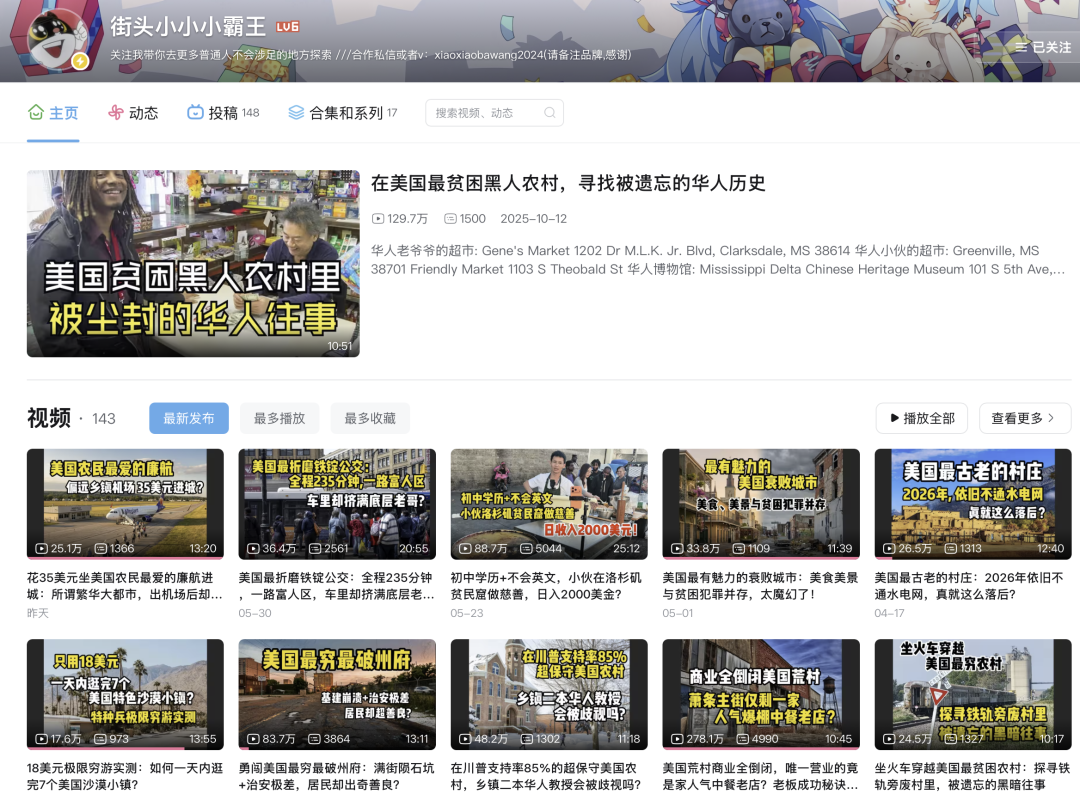
The creator's latest video is titled "Taking the Budget Airline Preferred by American Farmers into the City for $35."
When discussing the United States, it is easy to fall into two types of narratives.
One is the elite version of America: universities, tech companies, Wall Street, and suburban villas. The other is the "America is doomed" version: shootings, drugs, homeless people, racial conflicts, and decaying neighborhoods.
The creator's videos appear to be more related to the latter. However, once you actually click on them, you realize that this is not necessarily the case. His titles are very typical of Bilibili, but the footage itself is often more honest than the titles: walking in, chatting for a few words, having a meal, taking a ride, and looking at house numbers, menus, rents, bus stops, and empty streets, among other things.
For example, when he films "poor white towns" and Black communities across the country, he does not simply slap on labels like "redneck" or "ghetto." What is more valuable is that he shows these places are not just abstract symbols, but social scenes composed of the elderly, shop owners, students, children, immigrant newcomers, those left behind, and passersby. Why can Chinese restaurants in desolate small towns still survive? Why have Chinese restaurants in Black neighborhoods formed a special tradition? Is a conservative rural area with almost no Black or Asian residents closed off and decaying, or is it the natural result of a local order? These questions have no standard answers, but the creator's lens at least reveals a more complex reality, one that cannot be summarized by one or two ideological slogans.
In addition to budget travel, he also films people. For instance, the daily lives of a young man from Shanghai and a Black girl from rural America, the low-cost housing of an Indian PhD student, the Harvard adventure of a "test-taker" from a small American town, a fully funded Chinese PhD student who dropped out to become an electrician, and a psychological counselor in a forensic psychiatric hospital. These people may not be standard representatives of the "American Dream," yet they precisely constitute the realistic footnotes to it. The United States today still offers opportunities, but these opportunities do not always appear in a dignified manner, and everyone faces trade-offs and choices.
In short, the America presented by this creator is concrete and authentic, and he has no intention of proving whether America is truly good or truly bad.