
This Week’s Recommendation: Zhaohuarong
本周推荐:“照花荣”
This week's recommendation series continues to update.
This time, the recommendation is also a Bilibili content creator: Zhao Hua Rong (ID: 629341851).
https://space.bilibili.com/629341851
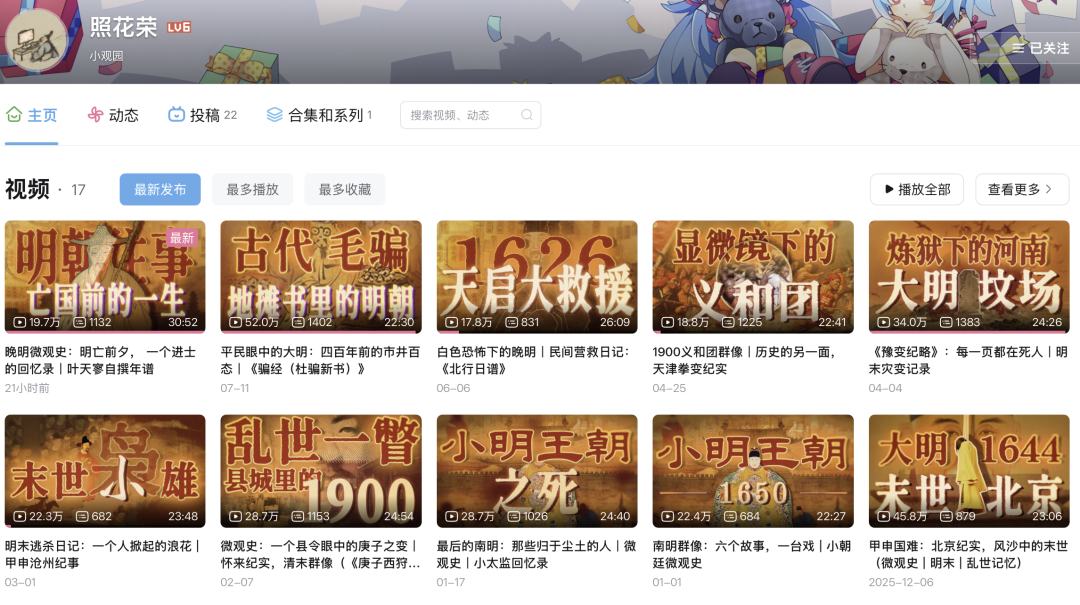
He has not produced many videos.
As of the time of writing, his collection contains a total of 17 videos, mostly focusing on the social customs and public sentiment of the Ming and Qing dynasties. He typically starts with a diary or a notebook, exploring what grand historical narratives actually look like when they land on specific individuals.
When I read history and write, I am also often drawn to diaries, memoirs, letters, and even old receipts. A few lines in traditional historical texts can account for the rise and fall of a dynasty and the life, death, separation, and reunion of thousands, yet it is difficult to see specific individuals. Private records such as diaries and notebooks happen to preserve those trivial matters deemed "irrelevant to the big picture." Centuries later, it is often precisely these small details that most convincingly prove the past truly existed.
For example, using Yao Tinglin's Chronicle of Years (Notes on Experiences in Shangpu) as a thread, he observes the Ming-Qing transition through the eyes of a seventeen-year-old Shanghai youth. News of Emperor Chongzhen's death suddenly arrives via a small newspaper during a Dragon Boat Festival family banquet; there are repeated flights from danger, collective closures of households in towns and villages, locust swarms blotting out the sky, and conflicts between retreating soldiers and civilians. These details restore the "fall of a dynasty" to the fear personally felt by ordinary people.
Similarly, by cross-referencing the Notes of Eunuch Yang by the junior eunuch Yang Deze and Liu Chai's Chronicle of the Hunt in Burma, he traces the process of the Yongli court's exile to Burma until its eventual collapse. The emperor, the crown prince, the eunuchs, and their attendants are no longer just political terms, but people who fled, became separated, and ultimately "returned to dust." Additionally, a notable aspect is that Zhao Hua Rong usually presents the original texts, book titles, and points of doubt. He specifically lists the errors in the Notes of Eunuch Yang, whose chronology is two years ahead of the actual timeline. If interested, viewers can follow the bibliographic references in his explanations to return to the original texts.
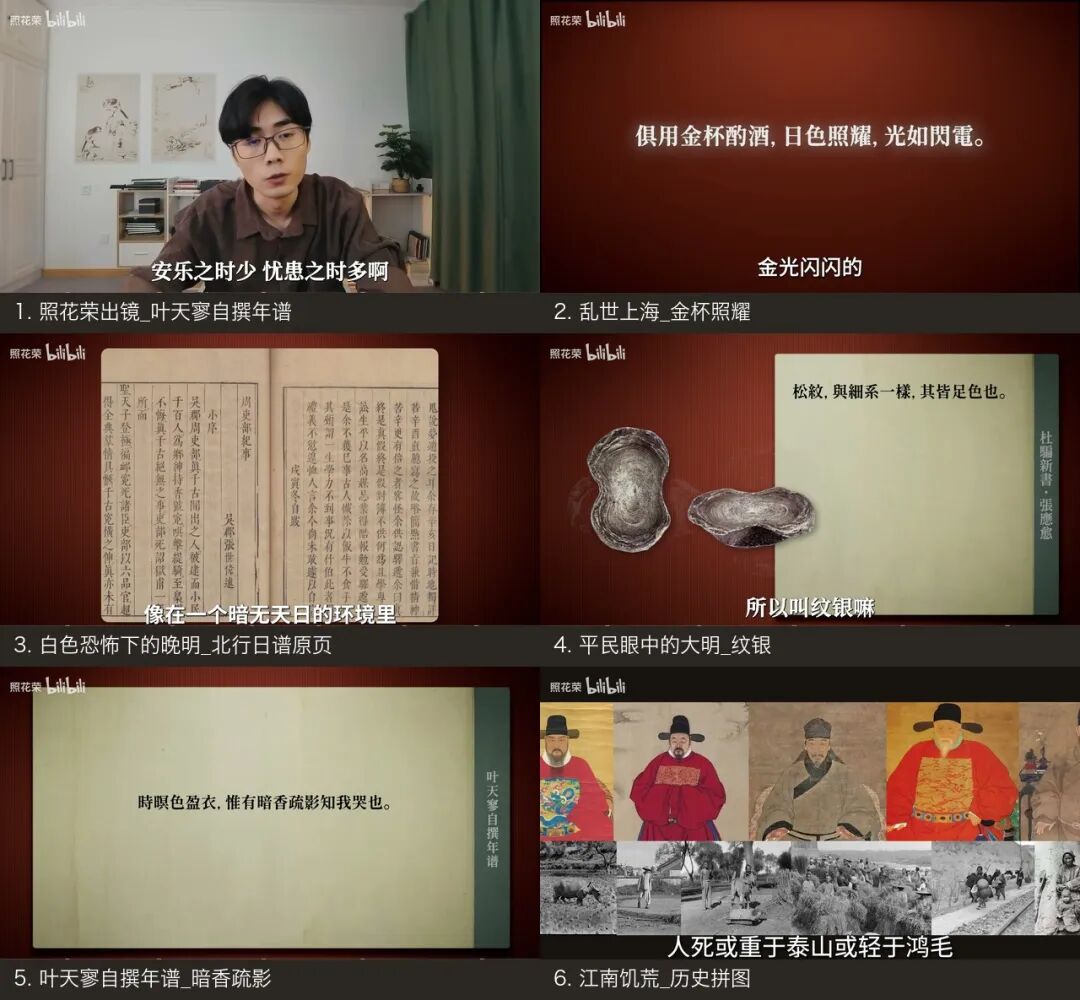
His homepage also features two short columns labeled as "pseudo-essays": one uses the legend of the Jianwen Emperor to write about an old monk in a boat, and the other writes about "people from beyond the heavens" in the style of ancient zhiguai (tales of the strange), both explicitly noted as purely fictional. At the very least, this shows that this content creator enjoys not only the materials found in notebooks but also the notebook genre itself; he might even be a specialist in studying notebooks.
In an environment where everyone loves to comment on national affairs and play grand geopolitical games, this content creator is certainly not "mainstream,"
what I appreciate most is precisely this scale of observation, just as he wrote himself:
"During this period of collective tribulation, I cannot remember many macro-historical events, but I am often deeply impressed by these local observations and historical close-ups, finding them hard to forget."
Incidentally, this content creator also has excellent musical taste. The Western classical music he selects does not feel disconnected when paired with stories of the chaotic late Ming period; rather, they complement each other perfectly.